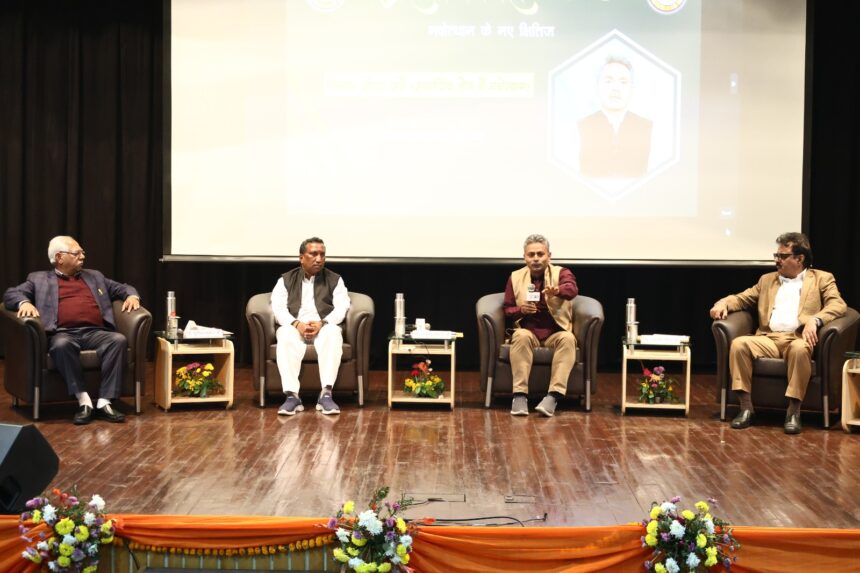
The three-day intellectual conclave Prerna Vimarsh 2025, organised by the Prerna Research Institute Trust, brought together journalists, thinkers, artists and subject experts in Noida to deliberate on India’s evolving journey of national resurgence, with a strong focus on economic self-reliance, social harmony and cultural consciousness rooted in Indian philosophy. Held at the National Institute of Open Schooling in Sector 62, the second day of the programme witnessed intense and meaningful discussions under the central theme “New Horizons of Resurgence”, reflecting the growing discourse around India’s civilisational values in the contemporary global context.

The event served as a platform for ideational exchange, where speakers examined India’s progress, challenges and future direction through the lenses of economy, society and culture. Alongside the discussions, a special edition of the Rashtriya Swayamsevak Sangh’s magazine Keshav Samvad was released, symbolising the synthesis of thought, tradition and modernity that the conclave sought to promote.
Economic Resurgence and the Challenge of Self-Reliant Ecosystems
The first session of the day focused on economic resurgence under the theme “Dharmasya Moolam Arthah”, highlighting the relationship between ethical foundations and economic strength. Senior journalist Harshvardhan Tripathi emphasised that one of India’s most pressing challenges today is the absence of a fully indigenous, self-modified economic and technological ecosystem. He pointed out that the dominance of global technology giants such as Apple, Amazon, Google, Microsoft and Meta has resulted in billions of rupees flowing out of India every year due to the lack of strong domestic digital platforms. According to him, while India has made remarkable progress in economic growth, infrastructure development and digital payments, there remains an urgent need for deeper introspection on technological sovereignty and long-term economic independence.

Tripathi acknowledged the significant strides India has made since 2014, citing rapid expansion in railways, aviation, expressways and physical infrastructure as indicators of accelerated development. He highlighted the success of the Unified Payments Interface, which has emerged as the world’s largest digital transaction system, demonstrating India’s capacity for innovation when policy, intent and execution align. However, he cautioned that economic growth must be accompanied by the creation of indigenous platforms and intellectual property to ensure sustainable national prosperity.

Rupesh Kumar, member of the Akhil Bharatiya Karyakarini of the Rashtriya Swayamsevak Sangh, placed India’s economic resurgence in a historical context, reminding the audience that at one time, nearly 25 percent of global trade originated from India. He described India’s youth as the nation’s greatest strength, noting that more than two lakh startups have already been launched across the country. He underlined the increasing participation of women in entrepreneurship, with women accounting for nearly half of startup directors and a significant share of ownership, reflecting a changing socio-economic landscape.

Kumar also highlighted how government policies have accelerated infrastructure development in regions such as Jammu and Kashmir and Ladakh, unlocking new economic opportunities and strengthening national integration. He noted that India’s growing manufacturing capabilities and emphasis on self-reliance have begun to challenge the long-standing perception of India merely as a consumer market for foreign powers. According to him, economic empowerment is not only a matter of material prosperity but also a foundation for national confidence and global influence.
The session was moderated by Harish Barnwal, Senior Vice President of BlueKraft Digital Foundation, who steered the discussion towards the importance of narratives in shaping economic thought. He observed that the contemporary era is marked by a battle of ideas, where perception often precedes policy. Barnwal stressed that India’s economic resurgence must be accompanied by a coherent narrative that reflects its civilisational ethos, technological aspirations and social responsibility. The session collectively underscored that economic resurgence is inseparable from ethical clarity, innovation and narrative strength.

Social and Cultural Resurgence Rooted in Indian Civilisational Values
The second session addressed social resurgence under the theme “Hindavah Sodara Sarve”, focusing on unity, inclusivity and social transformation. Rajkumar Matale, Akhil Bharatiya Sah Seva Pramukh of the Rashtriya Swayamsevak Sangh, articulated India’s philosophical vision of universal welfare. He emphasised that the concept of Vasudhaiva Kutumbakam is central to Indian thought, promoting harmony beyond boundaries of caste, creed and geography. Matale explained that ancient Indian society was structured around karma rather than birth-based hierarchies and that the term “Arya” historically signified excellence and values, not race or caste.
He addressed the complexities of social change, noting that while external conversion may be easy, genuine transformation of mindset requires sustained societal effort. According to him, colonial forces and certain political ideologies attempted to fragment Indian society, but contemporary developments indicate a gradual shift towards reconciliation and positive change. He argued that social resurgence depends on restoring confidence in indigenous values while fostering dialogue and mutual respect within society.
Filmmaker and social activist Satish Kapoor, Director of the We Care Film Festival and Brotherhood, spoke about the role of values and behaviour in shaping social harmony. He observed that Indian cultural values inherently promote equality and dignity, and that societal transformation begins with everyday interactions. Kapoor pointed to visible changes in public attitudes after 2014, particularly in the perception of persons with disabilities. He highlighted how para-athletes now receive recognition and respect equal to their Olympic counterparts, reflecting a more inclusive societal mindset.
Kapoor also addressed shifts within cinema and popular culture, noting that films increasingly engage with social realities and open dialogue rather than avoidance. He described this openness as a sign of a healthier society willing to confront its challenges honestly. The session was moderated by senior journalist and television anchor Ramveer Shreshtha, who facilitated a dynamic exchange by posing incisive questions that encouraged speakers to explore the deeper dimensions of social resurgence.
The third session shifted focus to cultural resurgence under the theme “Janani Janmabhumishcha”, with actor and theatre personality Manoj Joshi delivering a deeply reflective address. Joshi asserted that spirituality lies at the heart of Indian identity and has sustained the civilisation through centuries of adversity. He spoke candidly about the influence of appeasement in cinema and cultural expression, while reaffirming that India’s philosophical traditions rooted in the Vedas, Puranas and Shastras have remained unbroken.
Joshi recounted historical attempts by invaders to destroy India’s centres of knowledge, including the burning of institutions such as Nalanda. Despite these assaults, he noted, India preserved its wisdom through the oral traditions of shruti and smriti. He argued that epics like the Ramayana played a crucial role in safeguarding India’s spiritual continuity and preventing large-scale cultural erosion. According to him, the evolving education system is now enabling younger generations to reconnect with these foundational values.
At the request of the audience, Joshi recited iconic dialogues from the television series Chanakya, recreating the exchange between Chanakya and Mudrarakshasa, which captivated listeners and reinforced the enduring relevance of classical Indian thought. His performance served as a reminder that cultural resurgence is not merely academic but also experiential and emotional.
Rajiv Tuli, member of the Akhil Bharatiya Prachar Toli of the Rashtriya Swayamsevak Sangh, reinforced the idea that India’s foundational values are indestructible. He emphasised that society ultimately reflects the education and values imparted to it. If positive principles are consistently nurtured, he said, societal progress follows naturally. Senior journalist and India TV anchor Meenakshi Joshi added that strong cultural consciousness enables nations to advance with confidence, stressing the need for ideological and cultural resilience in an increasingly complex world.
Each session concluded with interactive question-and-answer segments, allowing participants to engage directly with speakers and deepen the discourse. The programme witnessed the presence of several distinguished personalities, including Kripashankar, Prant Prachar Pramukh of Uttar Pradesh and Uttarakhand, Preeti Dadu, President of Prerna Research Institute Trust, Prerna Vimarsh 2025 President Anil Tyagi, Coordinator Shyam Kishore Sahay, Co-Convenor Akhilesh Chaudhary, Secretary Monika Chauhan, Noida Vibhag Sanghchalak Sushil Kumar, and National Institute of Open Schooling Chairman Professor Akhilesh Mishra. The sessions were jointly conducted by Dr Ritu Dubey Tiwari, Dr Manmohan Sisodia and Monika Chauhan, reflecting collaborative leadership and organisational cohesion.
Through layered discussions spanning economy, society and culture, Prerna Vimarsh 2025 emerged as a significant forum for reimagining India’s future through the prism of its civilisational wisdom and contemporary aspirations, reinforcing the belief that national resurgence is a holistic process grounded in values, dialogue and collective consciousness.