Prime Minister Narendra Modi arrived in Johannesburg on Friday to attend the twentieth G20 Leaders’ Summit, marking the first such gathering ever held on the African continent. In his departure message, he announced that India would present its perspective based on the guiding ideals of “Vasudhaiva Kutumbakam” and “One Earth, One Family and One Future,” reflecting a holistic vision for shared global progress. Modi’s visit also includes several bilateral meetings, including talks with Japan’s newly elected Prime Minister Sanae Takaichi, and participation in the sixth IBSA Summit, reinforcing India’s commitment to collaboration across the developing world.
India’s agenda at Africa’s first G20 summit and the significance of Modi’s diplomatic outreach
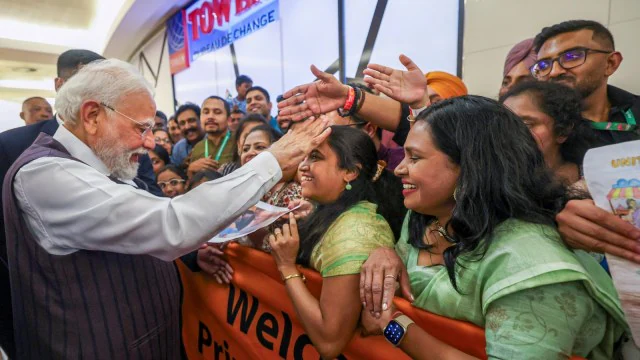
Prime Minister Modi’s arrival was met with a warm reception from the Indian diaspora in Johannesburg, who welcomed him with cultural performances and expressions of solidarity. His visit comes at a moment of global importance, as Africa hosts a G20 summit for the first time, signalling a shift toward greater representation of the Global South in international decision-making.
Modi emphasised that this summit holds special significance because it follows India’s presidency of the G20 in 2023, during which the African Union was admitted as a permanent member of the group. This historic move aligned with India’s longstanding effort to uplift developing nations and ensure that Africa’s voice is meaningfully included in global governance frameworks.
South Africa assumed the G20 presidency in December 2024, continuing the trend of leadership by developing nations after Indonesia, India and Brazil. The theme for this year’s summit, “Solidarity, Equality and Sustainability,” underscores South Africa’s intention to push the development agenda forward while preserving continuity with the outcomes of previous G20 summits held in New Delhi and Rio de Janeiro. Modi stated that India views these thematic priorities as central to achieving a stable and fair global order.
The prime minister is also scheduled to participate in the sixth IBSA Summit, which brings together India, Brazil and South Africa. As a grouping of three major democratic nations from the Global South, IBSA has long served as a platform for cooperation on development, governance and equitable global reform. Modi’s presence at this summit demonstrates India’s focus on strengthening south–south partnerships and shaping a more inclusive international architecture.
During his engagements in Johannesburg, Modi is expected to highlight the importance of disaster resilience, debt stability for low-income nations, accessible climate finance, and fair use of critical minerals—each of which has emerged as a core priority for African economies. South Africa’s presidency has identified these areas as essential for driving equitable development across the continent.
Modi’s emphasis on India’s philosophy of “One Earth, One Family and One Future” signals an attempt to unify diverse nations behind shared global challenges. He has stressed that India is committed to promoting cooperation on climate justice, sustainable development and inclusive growth. These principles, he says, offer pathways to ensure that global transitions—whether in energy, economics or technology—benefit all countries rather than deepening inequality.
The prime minister’s interactions with global leaders, including his planned bilateral meeting with Japanese Prime Minister Sanae Takaichi, are expected to focus on strategic cooperation, technological partnerships and shared interests in regional security. Japan and India, both major players in the Indo–Pacific region, continue to engage on matters related to economic development, resilient supply chains, digital innovation and stability in maritime domains.
India’s presence at the G20 Summit further reinforces its global ambition to serve as a bridge between developed and developing nations. By advocating for the priorities of emerging economies and the Global South, Modi aims to advance policy solutions that enhance global fairness and cooperation. This summit provides a significant platform for India to reinforce its leadership role in international discussions centered on equity and sustainable growth.
G20 priorities under South Africa’s presidency and India’s push for inclusive global development
South Africa’s presidency marks the final year of the first G20 cycle, making the outcomes of this summit especially significant. With the United States set to take over the presidency next year and the second cycle beginning soon after, the Johannesburg summit has become a key moment to consolidate progress achieved by a sequence of Global South presidencies.
South Africa’s priorities reflect the continent’s most pressing challenges—many of which affect developing countries across Asia, Latin America and the Pacific as well. As part of its presidency, South Africa has put forward a development-focused agenda that aims to enhance economic resilience, promote financial stability and secure equitable access to resources.
One of the central themes this year is strengthening disaster response systems. Many developing nations face increasing climate-related disasters, including floods, droughts, cyclones and wildfires. South Africa has emphasised the need for a coordinated global approach to address these increasing threats with enhanced early warning systems, sustainable infrastructure and reliable funding mechanisms. Modi has often reiterated India’s commitment to climate resilience, pointing to India’s expanded disaster relief capacities and its growing role as a first responder in the Indian Ocean region.
Another major priority is achieving long-term debt sustainability for low-income countries. Several African nations, along with other developing economies, are grappling with rising debt levels exacerbated by global financial shocks, inflation and economic disruptions. South Africa has urged the G20 to address structural imbalances in the global financial system, particularly calling for reforms that allow developing nations to access affordable credit.
India has consistently raised similar concerns in global forums, arguing that development should not be hindered by inequitable financial structures. Modi is expected to emphasize the need for transparent and fair lending practices, as well as the importance of multilateral development banks providing greater support to vulnerable regions.
Climate finance remains another critical pillar of this year’s summit. South Africa has repeatedly stressed that the global transition to clean energy must be just, inclusive and supportive of the needs of developing countries. Many African nations depend heavily on fossil fuels for economic stability, making the shift to renewable energy a complex and costly process. Mobilizing sufficient capital for clean energy projects, energy storage systems, hydrogen development and sustainable infrastructure is therefore a central objective.
India, too, has advocated strongly for climate justice, arguing that historical responsibility for emissions lies with developed countries. Modi is expected to reiterate that wealthy nations must fulfill their commitments to climate financing, technology transfer and capacity building.
The inclusive development of critical minerals—such as lithium, cobalt and rare earth elements—is another major focus of South Africa’s presidency. These minerals are essential for the global transition to clean energy, especially for electric vehicles and battery technologies. Africa possesses some of the richest reserves of these resources, but their extraction has often lacked local benefits. The presidency aims to promote transparent, ethical and sustainable mineral supply chains that ensure meaningful returns for local communities.
South Africa has also outlined two additional focus areas: reviewing the G20’s work in the first cycle and creating a roadmap for future cycles, and addressing the challenge of high capital costs in developing countries. Many nations in the Global South face exceptionally high interest rates for borrowing compared to wealthier nations, hindering development projects. India has highlighted this issue repeatedly, calling for more accessible and equitable financial mechanisms.
Modi is expected to use the summit to push for a more balanced global order where development, sustainability and cooperation take precedence over geopolitical rivalry. With Africa hosting the summit for the first time, India aims to support African priorities and demonstrate solidarity with countries seeking a more fair and inclusive global system.