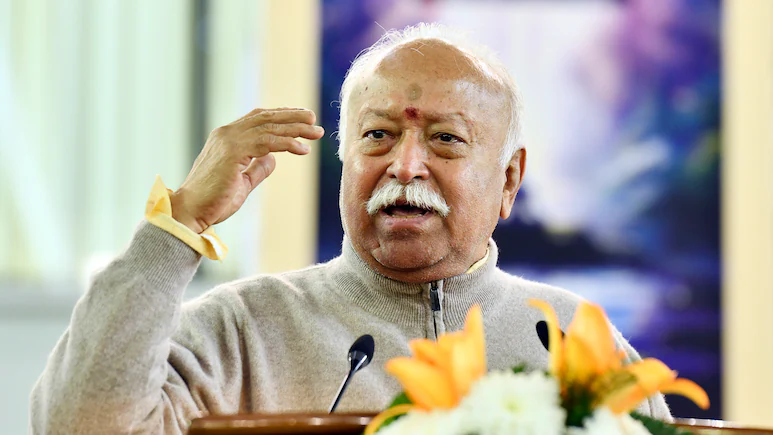
RSS chief Mohan Bhagwat, during his meeting with tribal leaders in Imphal amid his three-day visit to Manipur, stated that Maoism in India is nearing its end because society collectively decided it would no longer tolerate such violence. He emphasized that the Rashtriya Swayamsevak Sangh is dedicated to strengthening society through unity, cultural pride and constitutional solutions, and that social cohesion has played a decisive role in weakening Maoist ideology across the country.
Calls for unity in Manipur, RSS role clarified and community-driven solutions highlighted
During his first visit to Manipur since the eruption of the Meitei–Kuki conflict in May 2023, Mohan Bhagwat addressed community leaders in Imphal and stressed that strengthening society requires dialogue, cooperation and mutual understanding. He reiterated that the RSS is not against anyone, nor is it an organisation created to destroy others. Instead, he described it as a social force committed to upliftment, harmony and national integration.
He clarified that the RSS does not engage in politics nor does it remote-control any organisation. According to him, the Sangh’s aim has always been to cultivate discipline, strength and unity in society. He noted that social coherence is essential at a time when historical tensions, colonial-era divisions and regional mistrust continue to influence the social landscape of several Indian states, including Manipur.
Bhagwat said that issues raised by tribal communities are not merely local challenges but concerns that carry national significance. He emphasized that family disputes, community disagreements and regional conflicts must be resolved within the framework of unity rather than transactional negotiation. “Issues in a family must be solved within the family. Dialogue must be based on oneness, not contractual bargaining,” he said.
The RSS chief also urged tribal leaders to embrace their indigenous languages, traditions and scripts with pride. According to him, cultural identity is an essential element of self-confidence, and adopting a swadeshi lifestyle rooted in one’s heritage strengthens social resilience. He observed that while colonial policies in the past sought to divide communities, present times demand social reconnection and rebuilding trust among groups who share common histories.
In his interaction, Bhagwat stressed self-reliance and insisted that stable and sustainable solutions must emerge from constitutional processes. He encouraged the leaders to view their concerns within the broader national narrative and to work collectively toward unity and peace.
While discussing the situation in Manipur, he acknowledged that communities across the state have experienced long-standing divisions. These divisions, he said, need healing through dialogue, respect and cultural assertion rather than confrontation. Bhagwat added that India’s strength lies in its diversity, and Manipur’s unique traditions and indigenous heritage represent an important part of the country’s cultural wealth.
Society’s rejection of violence credited for the decline of Maoism and recent developments in anti-Naxal operations
On the question of Maoism in India, Bhagwat offered a strong analysis of why the insurgency has weakened significantly. He said that Naxalism was once at its peak, but it began to decline when people across affected regions refused to accept its violent approach. “Naxalism was at an all-time high; has it ended or not? Why did this end? It ended because the society made up its mind that it had enough and would not let it continue anymore,” he said.
He explained that society did not remain passive. Instead, it stood with the forces fighting Maoist extremism. This alignment between communities and security forces provided a morale boost to the latter and enabled them to take stronger, more coordinated action against the insurgents. Bhagwat stressed that when society decides to reject a harmful ideology, its influence diminishes naturally because it loses social legitimacy.
His comments come soon after the killing of top Maoist commander Madvi Hidma in an encounter with security forces in Andhra Pradesh. Hidma, one of the most feared leaders of the Maoist movement, was associated with several major attacks in central India. His death has been seen as a major setback for the Maoist network, signaling a rapid decline in its organisational strength.
The central government has set March 31, 2026, as the deadline to eliminate Maoism from the country. Bhagwat suggested that the ongoing progress against the insurgency is proof that society’s collective will, combined with security operations, is capable of curbing long-standing internal security threats.
He argued that solutions to deep-rooted issues like Maoism must come from a synergy between public awareness, community engagement and institutional strength. According to him, people in affected regions began to understand not only the destructive nature of Maoism but also the futility of violence as a means to achieve any meaningful change. When citizens begin to hope for development, peace and constitutional governance, insurgent ideologies lose their appeal and their capacity to recruit.
Bhagwat also highlighted that national problems cannot be solved by force alone. Sustainable solutions emerge when society collaborates with institutions and upholds constitutional processes. The decline of Maoism, he said, is an example of how unity, social consciousness and national resolve can transform a seemingly insurmountable challenge.
He urged tribal leaders in Manipur to take inspiration from this shift and apply similar principles of unity and dialogue to their own regional issues. Only through social cohesion, mutual trust and cultural self-respect can communities overcome divisions and move toward a stable future.
Bhagwat further emphasized that indigenous heritage plays a crucial role in building self-confidence among communities. Preserving languages, scripts and traditions, he said, strengthens identity and connection with one’s roots. He reiterated that embracing these values is essential for both local harmony and national stability.