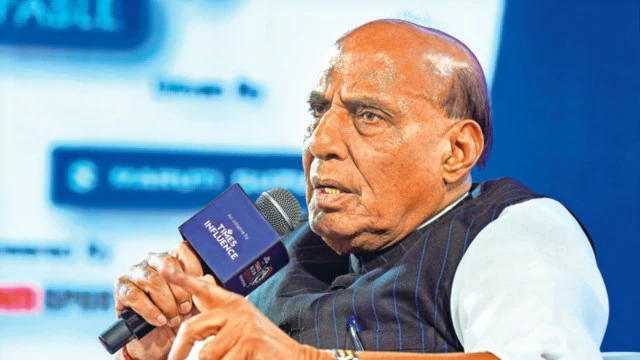
Defence Minister Rajnath Singh, speaking at the twenty-sixth International Conference of Chief Justices of the World in his parliamentary constituency Lucknow, said that today’s deeply interconnected world urgently requires a renewed United Nations and a more balanced global order. He argued that the United Nations could have played a stronger, more decisive role in handling modern conflicts such as the Israel–Hamas war, the Russia–Ukraine conflict, and humanitarian emergencies emerging in Sudan and several African regions. Singh stressed that the UN’s limitations are not due to a lack of intent but because of political complexities, selective interpretation of global rules by major powers, and institutional inertia that weakens its ability to act effectively.
Rajnath Singh calls for a stronger, reformed and more representative United Nations for today’s geopolitical challenges
Addressing the global gathering of chief justices and legal scholars, Rajnath Singh said that numerous conflicts across the world reveal gaps in international governance and collective decision-making. He pointed out that ongoing hostilities—from the Israel–Hamas conflict to the Russia–Ukraine war—have created prolonged instability, while humanitarian tragedies in Sudan and other African regions continue without adequate global interventions. According to Singh, these crises expose the shortcomings of current international structures.
He said that under ideal circumstances, the United Nations should have taken a more powerful and visible role in crisis resolution and peacebuilding, especially given its historic mandate for global peace and justice. Singh stated that the world “could have expected” a stronger role from the UN, indicating that the organisation’s diminished impact has become increasingly evident.
Singh clarified, however, that the lack of effective global intervention should not be interpreted as a lack of intent within the United Nations. Instead, he identified several challenges holding the institution back. Among them are the complexities of global politics, the influence and dominance of powerful nations, and the slow pace of institutional functioning, which often hinders timely responses to global emergencies. These factors, he said, frequently raise doubts about the UN’s authority and capability.
He criticised powerful nations for selectively applying international norms based on their strategic preferences. When global rules are enforced inconsistently, Singh noted, the credibility of institutions like the UN weakens. He also pointed out that limited financial and logistical resources further restrict the UN’s ability to deliver meaningful results in conflict zones and humanitarian scenarios.
Singh asserted that the world needs a “new United Nations,” though he clarified that he does not advocate for the creation of a new organisation altogether. Instead, he called for revitalising the existing UN by returning it to its original principles of peace, justice and equal global representation. He emphasised that reforms must ensure the UN reflects the realities of the twenty-first century, not the geopolitical world of 1945.
He stated that only through structural reform, transparent decision-making, and equal participation of all nations can the United Nations fulfil its foundational objectives. According to Singh, a reimagined UN is essential for restoring global trust, preventing conflict escalation and addressing new-age challenges such as hybrid warfare, cyber threats and climate-driven instability.
In his remarks, Singh highlighted that the credibility of global institutions depends on the consistency and fairness with which global rules are enforced. Without reforms that address power imbalances and institutional stagnation, he said, global organisations risk becoming ineffective in moments when they are needed most.
Yogi Adityanath stresses need for global cooperation on climate change, cyber threats and terrorism at UN platforms
During the same event, Uttar Pradesh Chief Minister Yogi Adityanath addressed international delegates and drew attention to the rising dangers of climate change, cybercrime and terrorism—issues he said now pose universal threats that no nation can afford to ignore. He emphasised that these challenges are global in nature and must be addressed at international platforms, particularly through the United Nations.
Adityanath noted that the world cannot treat these crises as localised or regional issues. Climate change, he said, is already affecting every continent, increasing the frequency of extreme weather events, threatening food security and destabilising economies. Cybercrime, meanwhile, has created vulnerabilities for governments, industries and individuals, with attacks now capable of disrupting national infrastructure. Terrorism, he added, continues to evolve and remains a significant threat to peace and security worldwide.
He stated that any society or country choosing to ignore these emerging dangers risks endangering not only itself but also humanity as a whole. Adityanath’s remarks reflected the urgent need for collaborative global mechanisms that can anticipate and address multidimensional threats.
The chief minister also referred to the Covid–19 pandemic as a powerful example that proved no global crisis remains limited to a single nation for long. He pointed out that the pandemic showed how interconnected the world has become, and how challenges in one part of the globe can rapidly affect people everywhere. He argued that the pandemic taught the world an essential lesson: global problems require global solutions, and cooperation must replace isolation.
Adityanath stressed that climate resilience, cyber security frameworks and counter-terror strategies must involve international dialogue and shared responsibility. He suggested that the United Nations should provide more robust leadership in guiding countries toward coordinated global responses. According to him, these issues cannot be solved by isolated national policies alone but require multilateral cooperation, improved global governance and long-term policy vision.
He emphasised that the United Nations must be revitalised to address the twenty-first century’s most pressing threats with clarity and urgency. He supported Rajnath Singh’s call for strengthening the international system and argued that the UN’s role in global governance should reflect modern realities, where technological threats and environmental challenges transcend borders.
Both Singh and Adityanath underscored that the world stands at a critical crossroads where global institutions must evolve quickly. Their remarks reflected growing concerns that international bodies need to be more responsive, equitable and strategically aligned with emerging threats. They argued that the time has come for collective change, stronger global governance frameworks and renewed commitment to international cooperation.