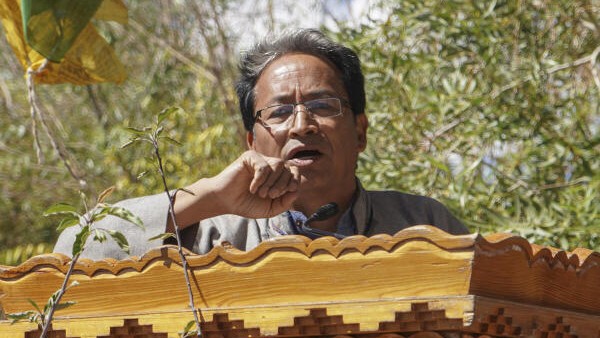
The Supreme Court of India on Wednesday raised serious concerns over the central government’s interpretation of statements made by environmentalist and education reformist Sonam Wangchuk, who is currently detained under the National Security Act (NSA) in Ladakh. The bench, comprising Justices Aravind Kumar and P.B. Varale, observed that the Centre appeared to be reading “too much” into Wangchuk’s comments, suggesting that the government may have exaggerated the potential threat posed by his speech. Wangchuk’s preventive detention has been challenged by his wife, Gitanjali Angmo, in a petition seeking relief from the Supreme Court, arguing that his detention lacks justification and is based on an overreach of authority. The hearing, which resumed on Wednesday, witnessed a detailed discussion on the nature of Wangchuk’s remarks, the alleged threat perception, and the government’s rationale for denying his release, even on health grounds, highlighting the complex interplay between civil liberties, national security concerns, and judicial scrutiny.
Centre’s Interpretation of Wangchuk’s Remarks and Government Arguments
During the proceedings, the counsel representing the Centre argued that Wangchuk had made statements that could potentially incite unrest in Ladakh, drawing parallels to violent agitations that occurred in neighboring Nepal. The government contended that the youth in the region were expressing dissatisfaction with existing methods of protest and might resort to violent methods if their concerns were not addressed, using Wangchuk’s statements as indicative of rising tension. Solicitor General Tushar Mehta emphasized that Wangchuk’s speech included “hybrid expressions” that could be interpreted as a warning, suggesting a possible threat to public order. However, the bench critically analyzed this argument, noting that Wangchuk had primarily expressed concern over potential unrest rather than actively calling for violence. The court remarked that the government was possibly overstating the implications of his speech and treating expressions of concern as incitement, thus questioning the proportionality and legality of the preventive detention imposed under the NSA.
The bench highlighted that while the government has the responsibility to maintain public order and ensure national security, it is equally imperative that preventive detention measures are not based on exaggerated interpretations of statements that may merely convey worry or hypothetical scenarios. Observing that Wangchuk’s remarks had been misconstrued as a potential blueprint for violent activity, the court emphasized the need for careful and objective assessment before applying strict security laws. The judges underlined that preventive detention, particularly under statutes like the NSA, requires precise evaluation of intent and context rather than broad or speculative inferences, pointing out the delicate balance between safeguarding individual freedoms and ensuring state security.
Health Grounds, Detention Conditions, and Judicial Oversight
In addition to questioning the interpretation of Wangchuk’s statements, the Supreme Court also addressed the government’s stance regarding his health and detention conditions. Solicitor General Mehta informed the bench that Wangchuk is “fit, hale, and hearty,” and that while he had experienced minor digestive issues, medical attention was being provided. The government, according to Mehta, had decided that releasing him on health grounds “may not be desirable,” implying that the decision was primarily guided by administrative and security considerations rather than medical necessity. The bench’s comments implicitly highlighted concerns about the proportionality of denying relief despite minor health concerns, emphasizing the need for transparency and adherence to procedural safeguards when enforcing preventive detention measures.
The hearing brought attention to broader questions regarding preventive detention under the NSA, including the criteria for assessing threats, the interpretation of statements, and the judicial oversight required to prevent arbitrary deprivation of liberty. Observers noted that the court’s comments reflected a nuanced understanding of the tension between security measures and civil liberties, recognizing that while authorities must act to prevent potential disturbances, the law also demands that detention be justified, reasonable, and based on clear evidence rather than speculative assumptions. The judges’ remarks underscored the importance of distinguishing between actual incitement to violence and expressions of concern about social or political developments, signaling a cautious approach to evaluating claims that invoke national security concerns.
The case also brings into focus the legal and constitutional safeguards afforded to individuals detained under preventive detention laws. The Supreme Court’s scrutiny of the Centre’s interpretation of Wangchuk’s statements reflects an emphasis on proportionality, fairness, and evidence-based decision-making. By questioning the government’s narrative, the bench indicated that preventive detention should not serve as a tool for silencing dissent or constraining legitimate expression, especially when the statements in question reflect hypothetical worries or professional commentary rather than explicit advocacy of unlawful activities.
As the proceedings continue, the case is likely to set important precedents regarding the application of preventive detention under the NSA, particularly in relation to environmental activists, public intellectuals, and civil society leaders. The scrutiny by the Supreme Court signals the judiciary’s commitment to maintaining checks and balances on executive powers, ensuring that preventive detention is not applied arbitrarily or excessively. The hearings also underscore the need for government authorities to substantiate claims of threat with clear evidence, distinguishing between genuine risks to public order and speculative interpretations that may overstate the potential for unrest.
The debate surrounding Sonam Wangchuk’s detention has drawn widespread attention, highlighting the delicate equilibrium between safeguarding national security and upholding individual freedoms. Analysts and legal experts note that while governments have a duty to prevent potential disturbances, there must be careful calibration in applying preventive detention laws to avoid undermining democratic principles. The Supreme Court’s oral observations suggest that a more nuanced approach is required, one that assesses statements in context, considers intent, and evaluates the actual risk posed before imposing restrictive measures.
The case also illuminates the challenges of governing regions like Ladakh, where socio-political dynamics, youth aspirations, and environmental concerns intersect. Wangchuk, known for his activism and engagement with youth and education reforms, has been perceived by authorities as potentially influential in shaping public opinion. The government’s decision to detain him, citing preventive measures, raises questions about the threshold for action under security laws and the criteria used to evaluate the influence of prominent social figures. The court’s remarks underscore the necessity of separating legitimate activism and public discourse from genuine threats to security, reinforcing the principle that preventive detention should be an exception rather than the norm.
As deliberations continue, the Supreme Court’s engagement with the matter signals a vigilant approach to protecting civil liberties while acknowledging the state’s role in maintaining order. The observations that the government may be “reading too much” into Wangchuk’s statements indicate judicial caution against excessive or arbitrary use of preventive detention. This nuanced stance reflects the judiciary’s responsibility to ensure that security laws are applied judiciously, in a manner that balances individual rights with broader public interest considerations.
The proceedings also explore procedural aspects of detention under the NSA, including the communication of reasons for detention, the role of advisory committees, and the possibility of judicial review. Experts suggest that cases like Wangchuk’s may serve as reference points for future litigation involving preventive detention, helping to define the limits of executive power, the evidentiary standards required, and the interpretation of speech-related concerns in sensitive regions. The court’s observations may have far-reaching implications for law enforcement, administrative decisions, and the protection of civil liberties across India.
By critically examining the Centre’s approach, the Supreme Court demonstrates the importance of transparency, proportionality, and accountability in matters of national security. The case highlights the need for authorities to differentiate between expressions of concern, professional assessments, and genuine calls for unlawful activity, ensuring that preventive detention measures are not misused or applied excessively. Wangchuk’s detention, the ongoing petition, and the court’s scrutiny collectively emphasize the judiciary’s role in safeguarding constitutional rights while enabling the state to fulfill its security responsibilities in a measured and balanced manner.
The hearing also underscores the significance of public debate and legal scrutiny in maintaining democratic norms. By raising questions about the government’s interpretation, the Supreme Court reinforces the principle that executive actions, even in matters of national security, are subject to legal and constitutional review. This judicial oversight ensures that preventive detention laws, while providing necessary tools for maintaining order, do not become instruments of overreach or suppression of dissenting voices.
The case, while focused on Sonam Wangchuk, represents broader concerns about governance, freedom of speech, and the scope of preventive detention laws in India. It highlights the need for authorities to act judiciously, avoid over-interpretation of statements, and respect the boundary between hypothetical concern and actionable threat. The Supreme Court’s oral observations provide guidance on the careful evaluation of risk, the context of statements, and the proportionality of detention, signaling an approach that could influence future preventive detention cases across the country.
The discussion of Wangchuk’s detention also sheds light on the challenges faced by individuals engaged in activism and public service in sensitive regions. It emphasizes the need for legal safeguards, transparency, and accountability when invoking preventive detention powers, ensuring that such powers are exercised responsibly and in accordance with the principles of justice. The Supreme Court’s remarks implicitly caution the government against overreach and underscore the judiciary’s role in maintaining checks and balances on executive authority while protecting fundamental rights.