As efforts to implement U.S. President Donald Trump’s plan for ending the Gaza conflict stall, the risk of a de facto partition between Israel-controlled areas and Hamas-ruled zones has grown significantly. Multiple sources and European officials indicate that reconstruction efforts are likely to be limited to Israeli-held territories, potentially locking Gaza into prolonged separation. The fragile balance between military control, humanitarian needs, and political negotiations underscores the precarious situation for Gaza’s population, who continue to face immense hardships amid stalled diplomatic efforts and ongoing uncertainty about the future of the region.
Ground Realities and Stalled Reconstruction Efforts
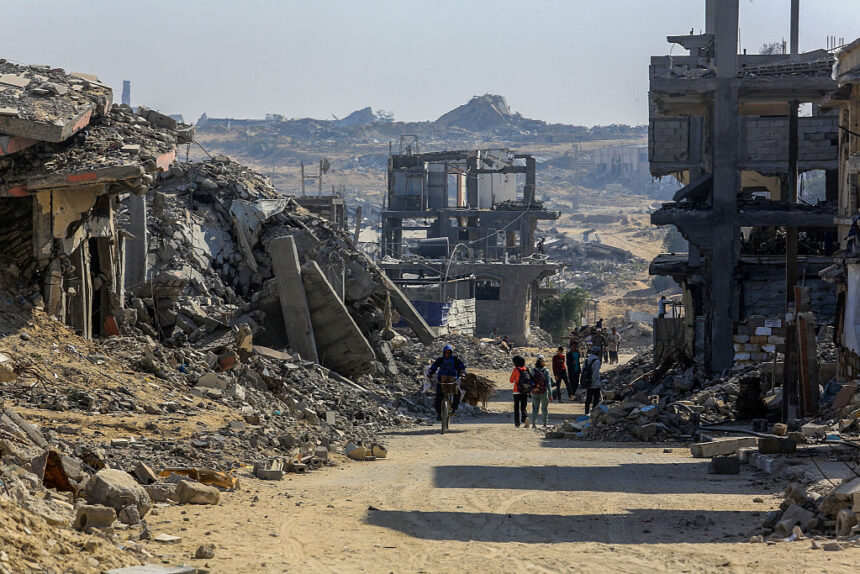
Following the October 10 implementation of the first stage of Trump’s plan, Israeli forces currently control approximately 53 percent of Gaza, including farmland, parts of Gaza City, and the southern region of Rafah. Meanwhile, Hamas retains authority over the remaining territory, where nearly all of Gaza’s two million residents live in tent camps and amidst the ruins of destroyed urban areas. Reuters drone footage from November captures the scale of devastation in the northeast of Gaza City, showing the aftermath of Israel’s final assault prior to the ceasefire. The area remains divided between Israeli and Hamas control, reflecting the fragmented reality that the Trump plan sought, but has so far failed, to resolve.
The next stage of the plan envisions a phased Israeli withdrawal from the so-called yellow line, the establishment of a transitional authority to govern Gaza, deployment of a multinational security force, the disarmament of Hamas, and the initiation of reconstruction. However, the plan lacks clear timelines or mechanisms for implementation. Hamas has refused to disarm, Israel rejects involvement of the Palestinian Authority, and the multinational force remains uncertain. These obstacles have left European and Arab diplomats increasingly concerned that the conflict’s current resolution could solidify into a long-term territorial and political division.
Israeli Prime Minister Benjamin Netanyahu has repeatedly stated that Israel has no intention of re-occupying or directly governing Gaza. Despite calls from far-right cabinet ministers to revive settlements dismantled in 2005, the military has resisted such measures, instead maintaining a buffer zone along the border to prevent another attack similar to Hamas’ October 2023 offensive. In practice, Israel has constructed defensive infrastructure, including large yellow cement blocks marking the withdrawal line, and fortified outposts in key zones such as the Shejaiya neighborhood of Gaza City. Satellite imagery shows mounds of earth and rubble arranged to create protected vantage points, while new asphalt has been laid to reinforce these strategic positions.
Israeli military officials have stated that further withdrawals will only occur once Hamas fulfills conditions, including disarmament and the deployment of an international security force. According to government sources, Israel accuses Hamas of stalling, while Hamas insists it is ready to transfer power to a Palestinian technocrat authority to enable reconstruction. Despite this, uncertainty persists over financing, international oversight, and the role of the Palestinian Authority, leaving reconstruction plans largely in limbo.
Political Impasse and Humanitarian Concerns
The ongoing political deadlock in Gaza highlights the broader challenge of balancing reconstruction, sovereignty, and security. European and Arab states have proposed a multinational approach, involving the Palestinian Authority and trained police forces from Egypt and Jordan, to replace Hamas’ control. However, Israel continues to oppose Palestinian Authority involvement, citing security concerns and political disagreements over sovereignty and statehood. Without a major shift in either Hamas or Israel’s stance, or significant U.S. diplomatic pressure, the Trump plan is unlikely to progress beyond the ceasefire stage, leaving the population caught between a humanitarian crisis and stalled political processes.
Gaza’s residents face a stark reality: widespread destruction, limited access to basic services, and dependence on international aid. Reconstruction costs are estimated at $70 billion, yet questions remain about who would finance rebuilding under Israeli occupation, particularly without Palestinian Authority involvement. Any de facto territorial split risks undermining Palestinian aspirations for statehood, complicating peace negotiations and perpetuating humanitarian suffering. Residents like Salah Abu Amr have expressed uncertainty over the practical implications of a divided Gaza, including access, family separation, and the fairness of entry restrictions into Israeli-controlled areas.
The risk of renewed conflict looms if Hamas regains strength in areas where governance is weak. German Foreign Minister Johann Wadephul emphasized the need to fill security vacuums swiftly to prevent resurgence that could trigger another Israeli military offensive. Meanwhile, Hamas continues to assert influence in Gaza City, deploying police and civil workers to manage local security, guard food distribution points, and clear rubble from streets, reflecting a self-administered but fragile governance system.
Negotiations under Trump’s framework have suggested alternative disarmament strategies, including international supervision of Hamas’ weapons rather than complete surrender to Israel. Such proposals aim to create a practical pathway for reconstruction without compromising Israel’s security concerns. Yet, these measures remain largely theoretical, as Israel’s insistence on limiting Palestinian Authority involvement blocks broader regional cooperation and delays reconstruction. The uncertainty also exacerbates the humanitarian situation, leaving millions of civilians dependent on aid while living amidst rubble and limited infrastructure.
The challenge of rebuilding Gaza is further complicated by competing regional and international interests. Gulf nations have been reluctant to finance reconstruction without Palestinian Authority involvement, while Israel resists any concessions that could enhance Palestinian sovereignty. This stalemate highlights the broader geopolitical complexity, where local, regional, and international actors’ priorities intersect with the immediate humanitarian needs of Gaza’s population. Analysts warn that without coordinated efforts and a clear operational framework, Gaza risks becoming a permanently divided territory, with long-term consequences for regional stability and Palestinian statehood aspirations.
The humanitarian stakes are immense. With reconstruction stalled and governance fragmented, residents face inadequate shelter, disrupted livelihoods, and limited access to health, water, and electricity. The ongoing uncertainty also undermines social cohesion and contributes to increased frustration and instability. Calls from international leaders stress that Gaza should not be trapped in a “no man’s land” between conflict and peace, as prolonged separation would entrench divisions and complicate future reconciliation efforts.
The tension between security, reconstruction, and sovereignty also plays out in symbolic and practical ways. Israel has reinforced its controlled areas with fortified infrastructure and continues to manage border security aggressively, while Hamas maintains administrative functions and local policing in its territories. This dual system creates a fragmented reality that is difficult to navigate, both for civilians and international actors attempting to facilitate humanitarian assistance or political negotiations.
The ongoing stalemate also underscores the need for coordinated international engagement. U.S., European, and Arab officials continue to explore pathways for phased reconstruction, disarmament, and security arrangements. Proposals include temporary technocratic governance, supervised disarmament, and deployment of trained multinational police to bridge the gap between Hamas control and Israeli security concerns. However, the lack of enforceable timelines and political consensus has prevented progress, leaving Gaza in a state of uncertainty.
The implications of a de facto partition extend beyond immediate humanitarian concerns. A divided Gaza risks entrenching political divisions, creating parallel governance structures, and undermining prospects for Palestinian national unity. It also complicates efforts to establish a functional and equitable reconstruction process, as financing, resource allocation, and international oversight remain contentious. Palestinian authorities, regional powers, and international organizations all emphasize that reconstruction and long-term stability require full Palestinian sovereignty and involvement, highlighting the deep challenges of implementing Trump’s plan effectively.
Residents and analysts alike express concern over the psychological and social impact of prolonged separation. Families divided by territorial lines, restricted movement, and uncertainty over access to services contribute to a sense of instability and insecurity. For many, the fear that a divided Gaza could become permanent is as acute as the immediate threat of renewed violence.
Experts warn that without substantial diplomatic intervention and pressure on both Hamas and Israel, the current status quo may harden, effectively locking Gaza into a long-term division. The fragmented reality of governance, combined with stalled reconstruction and ongoing humanitarian crises, risks creating entrenched inequalities and perpetuating cycles of instability.
Efforts to move forward require addressing several intertwined challenges: establishing a credible security framework, defining timelines and responsibilities for reconstruction, ensuring Palestinian participation, and garnering sufficient international funding. Until these factors are resolved, the possibility of a de facto partition remains high, leaving Gaza’s residents in a state of prolonged uncertainty and hardship.
The situation in Gaza illustrates the complex interplay of diplomacy, security, humanitarian needs, and regional politics. While the ceasefire has reduced immediate violence, the absence of actionable steps toward reconstruction and political reconciliation continues to jeopardize both stability and the prospects for a sustainable resolution. Observers warn that without urgent intervention, Gaza’s division may become a long-term reality, with severe implications for regional peace, Palestinian statehood, and the well-being of millions of civilians living under precarious conditions.
In the absence of coordinated action, the risk of fragmentation, stalled reconstruction, and prolonged humanitarian crisis remains high. The current stalemate highlights the urgent need for political consensus, clear implementation mechanisms, and international support to ensure that Gaza does not remain trapped between peace and conflict indefinitely.
The de facto partition of Gaza, if realized, would not only alter the political landscape of the region but also exacerbate the humanitarian catastrophe, undermine Palestinian statehood aspirations, and challenge international efforts to secure lasting peace. As diplomats, regional actors, and international organizations continue to navigate the complexities of the Trump plan, the people of Gaza remain in a precarious position, dependent on uncertain political outcomes and the fragile promise of reconstruction under constrained conditions.
Without decisive political progress, Gaza risks becoming a permanently divided territory, locked in a prolonged state of uncertainty that threatens both human security and the broader prospects for peace in the region. The international community faces the challenge of balancing Israel’s security concerns with the urgent need for Palestinian sovereignty, effective reconstruction, and sustainable humanitarian relief.
Gaza’s future remains uncertain, with stalled negotiations and competing political agendas complicating efforts to implement the Trump plan, leaving millions of civilians in a precarious and fragile situation while the risk of de facto partition grows.
The evolving reality in Gaza highlights the urgent need for coordinated diplomatic efforts, international support, and actionable plans to prevent long-term division and address the humanitarian needs of the population effectively.
The coming months will likely determine whether Gaza moves toward reconstruction, sustainable governance, and renewed stability—or becomes locked in a de facto partition that could define the region for years to come.