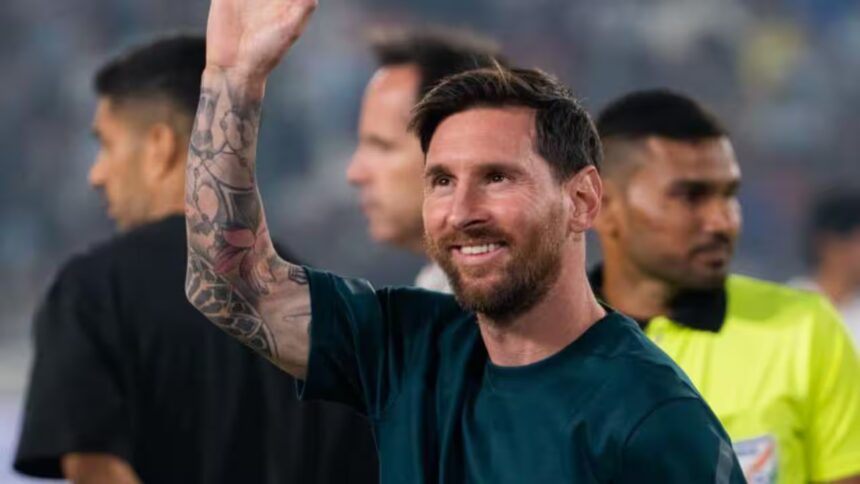
Global football icon Lionel Messi received a rousing welcome in New Delhi on the final day of his three-day “GOAT India” tour, as fans, athletes and sports administrators gathered at the Arun Jaitley Stadium to celebrate his legacy and the growing cultural exchange between football and cricket in India.
Messi, widely regarded as one of the greatest footballers of all time, was felicitated at the historic stadium alongside his former Argentina and club teammates Luis Suarez and Rodrigo De Paul. The event marked the concluding chapter of Messi’s India visit, which began with appearances in Kolkata and Hyderabad before taking him to Mumbai and finally the national capital. The tour generated massive excitement among Indian fans, reflecting Messi’s immense popularity across the country and the expanding footprint of global football in India’s sporting imagination.
Celebrations at Arun Jaitley Stadium and interaction with the Indian sports fraternity
The final day of the GOAT India tour saw the Arun Jaitley Stadium transformed into a venue of cross-sport celebration. Messi, Suarez and De Paul arrived to loud cheers, waving to fans who had gathered in large numbers to catch a glimpse of the Argentine stars. The trio spent time interacting with supporters, signing autographs, posing for photographs and acknowledging the affection shown by Indian fans.
A key highlight of the event was the meeting between Messi and ICC chairman Jay Shah. In a symbolic gesture reflecting the bond between two of the world’s most followed sports, Jay Shah presented Messi, Suarez and De Paul with Indian cricket team jerseys. He also gifted them tickets for the India vs USA match of the ICC Men’s T20 World Cup 2026, an act that delighted fans and underscored cricket’s central place in India’s sporting culture.
Messi addressed the crowd at the stadium, expressing gratitude for the warmth and enthusiasm he experienced throughout his visit. He spoke about the passion for sport he witnessed in India and acknowledged the love he has received from Indian fans over the years. The interaction was marked by loud applause, chants of his name, and a festive atmosphere rarely seen for a football event at a cricket stadium.
During the stadium visit, Messi also interacted with former India women’s football team goalkeeper Aditi Chauhan, highlighting the growing recognition of Indian footballers on the global stage. The moment symbolised the connection between international icons and domestic players, inspiring young athletes watching from the stands and online.
Originally, Messi was scheduled to meet Prime Minister Narendra Modi during his Delhi visit, but the meeting could not take place as the Prime Minister was travelling abroad. Despite this, the Delhi leg of the tour retained its prominence due to the scale of fan engagement and the presence of top sports administrators and former athletes.
Throughout the event, Suarez and De Paul shared smiles and conversations with supporters, reinforcing the idea that the visit was not just about Messi alone but about celebrating football as a global language. The presence of multiple Argentine stars added to the excitement and gave fans a rare opportunity to see several world-class footballers together on Indian soil.
GOAT India tour journey, Mumbai meeting and Vantara visit
Messi’s India tour began with high-profile stops in Kolkata and Hyderabad, cities known for their deep-rooted football culture. In Kolkata, often referred to as India’s football capital, Messi’s arrival was met with emotional scenes as fans turned out in huge numbers to welcome the Argentine legend. Hyderabad provided another enthusiastic reception, reflecting football’s growing popularity beyond traditional strongholds.
On Sunday, Messi travelled to Mumbai, where he met two of India’s most celebrated sports figures, Sachin Tendulkar and Sunil Chhetri. The meeting between Messi and Tendulkar, icons of football and cricket respectively, quickly captured public imagination, symbolising mutual respect between legends of different sports. Messi’s interaction with Chhetri, India’s most capped footballer, was equally significant, highlighting the bridge between global football excellence and Indian football aspirations.
The GOAT India tour was designed not only as a fan engagement initiative but also as a platform to promote broader themes beyond sport. Following the Delhi event, Messi and his entourage were scheduled to travel to Vantara, a wildlife rescue and conservation centre hosted by Anant Ambani. The visit, which included Suarez and other members of Messi’s group, was expected to blend football’s global appeal with awareness around wildlife conservation and environmental responsibility.
The Vantara stop was positioned as a key highlight of the tour, showcasing how sports icons can lend visibility to causes beyond the field. By associating Messi’s visit with conservation efforts, the organisers aimed to underline the role of global athletes in promoting social and environmental awareness.
Messi’s India tour, though brief, carried symbolic weight. It marked one of the most high-profile visits by an active global football superstar to India and demonstrated the country’s growing relevance as a destination for international sporting engagement. The tour also reflected how Indian audiences are increasingly embracing football alongside cricket, creating space for multi-sport celebrations.
Across all cities, the response to Messi’s presence was marked by enthusiasm, emotion and admiration. Fans of different ages gathered to catch a glimpse of the Argentine star, many wearing his jerseys and carrying banners celebrating his achievements, including his World Cup triumph and multiple Ballon d’Or titles.
As Messi concluded his India visit in Delhi, the images of him holding an Indian cricket jersey, receiving a T20 World Cup ticket and waving to fans at a packed stadium captured the essence of the tour. It was a moment where football and cricket intersected, where global and local sporting cultures met, and where fans experienced a sense of connection with a player they had admired from afar for years.
The GOAT India tour has been widely seen as a milestone in India’s engagement with global football icons, setting a precedent for future visits by international stars. While the tour ended with Messi’s departure from Delhi, its impact on fans, aspiring footballers and the broader sporting ecosystem is likely to be felt long after.