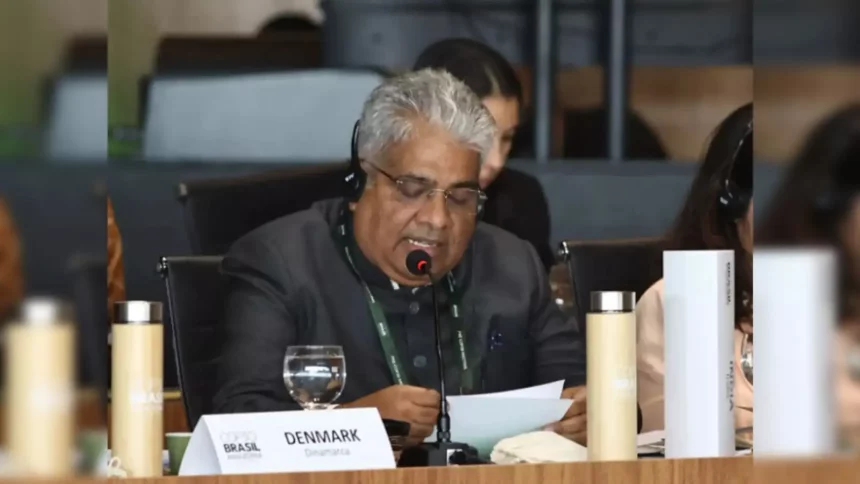
As the 30th United Nations Climate Change Conference (COP30) opened in Belém, Brazil, India made a strong and determined appeal for global climate justice, urging developed nations to deliver a fifteen-fold increase in adaptation finance for vulnerable countries. Speaking on behalf of the BASIC group—comprising Brazil, South Africa, India, and China—and the Like-Minded Developing Countries (LMDC) grouping, India highlighted the persistent gap between promises and actual financial flows, calling it one of the biggest obstacles to effective global climate action. The Indian delegation’s intervention underscored the urgent need to support billions of people in developing nations who contribute the least to global emissions yet bear the harshest consequences of the climate crisis.
India’s statement at the opening plenary was both assertive and empathetic, reflecting its role as a bridge between the Global South and the international community. The country reiterated that adaptation financing must be drastically scaled up—fifteen times the current level—to meet the pressing needs of developing nations as they face rising temperatures, erratic weather patterns, and increasing climate-induced disasters. India called for a universally agreed definition of “climate finance” to ensure transparency, accountability, and fairness in global commitments, while also urging developed nations to fulfil their legal obligations under Article 9.1 of the Paris Agreement.
The Paris Agreement enshrines the responsibility of developed countries to provide finance, technology, and capacity-building support to developing nations, and India stressed that this legal and moral obligation must now translate into measurable action. According to India’s statement, public finance flows for adaptation must be strengthened and scaled up significantly to prevent the growing financial inequality between developed and developing countries from undermining climate goals. Adaptation, India said, is not a luxury but a necessity for survival—particularly for vulnerable populations living in low-lying coastal regions, arid zones, and small island states that face existential threats from global warming.
Equity and Climate Justice Take Centre Stage
India’s address also placed strong emphasis on the principles of equity, fairness, and historical responsibility, reminding the global community of the moral imperative to act with justice. Speaking on behalf of the BASIC and LMDC blocs, India reaffirmed that developed nations must not only achieve net-zero emissions earlier than the rest of the world but also ensure that developing countries are not burdened with the same timelines and targets that disregard historical emissions. The statement made clear that climate justice cannot exist without acknowledging the disproportionate contributions and vulnerabilities of nations.
In its intervention, India noted that the global climate architecture must continue to be guided by the principles of Common but Differentiated Responsibilities and Respective Capabilities (CBDR-RC), which form the backbone of the Paris Agreement. These principles recognise that while all countries share a collective responsibility to combat climate change, developed nations—owing to their historical emissions and greater financial and technological capacity—must lead the way in both mitigation and adaptation efforts.
India’s statement also reiterated its unwavering support for multilateralism, warning against the rise of unilateral and protectionist measures such as climate-related trade restrictions that could distort international cooperation. The delegation emphasised that the global transition to a low-carbon economy must be fair, inclusive, and rooted in justice, ensuring that no country or community is left behind.
India further cautioned that the growing geopolitical tensions and emerging trade barriers risk turning climate action into a tool for economic domination rather than collective survival. The country argued that only through cooperative, transparent, and equitable mechanisms can the international community preserve trust and deliver meaningful progress on climate goals.
The statement also called for a robust outcome on the Global Goal on Adaptation (GGA), an important process under the Paris Agreement that aims to enhance adaptive capacity and strengthen resilience across all nations. India expressed strong support for advancing the UAE–Belém Work Programme and launching the Baku Adaptation Roadmap, both of which seek to operationalise adaptation measures at scale and ensure inclusive implementation. These initiatives, India said, must focus on empowering local communities, supporting traditional knowledge systems, and providing resources to countries most in need.
India also underlined that the UNFCCC’s Just Transitions Work Programme must guarantee that the shift to green economies remains equitable and people-centred. A just transition, India argued, means that workers, industries, and regions dependent on fossil fuels must be supported through skill development, financial aid, and social safety nets so that the transition to cleaner energy does not lead to job losses or economic hardship.
India’s Stand at COP30: A Voice for the Global South
The COP30 summit, which brings together representatives from more than 195 countries, scientists, and civil society organisations, marks a crucial moment in the global climate journey. It also commemorates a decade since the signing of the 2015 Paris Agreement, a historic accord that set the goal of limiting global temperature rise to well below 2°C above pre-industrial levels, with an aspirational target of 1.5°C. Yet, despite this commitment, global emissions continue to rise, and adaptation financing remains far below the promised levels.
India’s call for a fifteen-fold increase in adaptation finance reflects the growing frustration among developing nations that have repeatedly warned that without adequate financial support, climate resilience efforts will fall short. The statement pointed out that while developed nations had earlier pledged to double international public finance for adaptation by 2025, progress on this front has been dismal. The gap between rhetoric and action, India said, continues to undermine trust and delay meaningful outcomes.
At the conference’s opening ceremony, Simon Stiell, Executive Secretary of UN Climate Change, acknowledged both the progress and the challenges ahead. He said that for the first time, the world is beginning to bend the curve of planet-heating emissions downward, crediting the Paris Agreement as the engine that has enabled this shift. However, he stressed that greater acceleration is needed—particularly in regions like the Amazon—to prevent irreversible damage. He noted that global emissions are projected to fall by about 12 per cent by 2035 compared to 2019 levels, based on updated Nationally Determined Contributions (NDCs) recently submitted by several countries.
India, however, emphasized that such global progress must not come at the expense of the developing world’s growth aspirations. The delegation argued that climate finance, technology transfer, and capacity-building remain critical for countries in the Global South to pursue low-carbon development pathways while ensuring social and economic stability.
The Indian statement further highlighted that adaptation finance is not only about disaster management but about long-term transformation—creating climate-resilient infrastructure, promoting sustainable agriculture, strengthening health systems, and empowering local communities to respond effectively to climate shocks. India reiterated that adaptation must be treated as an equal priority to mitigation, given that the impacts of climate change are already being felt across the developing world.
India also linked the adaptation debate to the larger issue of equity in global governance. The statement urged developed nations to take greater responsibility in supporting the Global South through predictable and transparent funding mechanisms. It called for an end to fragmented approaches and the establishment of a global monitoring framework that ensures accountability in climate finance flows.
By championing the voices of developing countries, India positioned itself as a key advocate for fairness in international climate negotiations. The country’s intervention resonated with several other delegations that share similar concerns about the imbalance between mitigation and adaptation financing. Many nations from Africa, Asia, and Latin America echoed India’s demand for clarity on the definition of climate finance and for genuine progress in meeting the financial pledges made under the Paris Agreement.
India’s approach to climate diplomacy has consistently been one of constructive leadership—balancing its domestic commitments with its global responsibilities. Domestically, India has launched ambitious renewable energy programmes, expanded its solar power capacity, and undertaken large-scale initiatives in afforestation, electric mobility, and sustainable agriculture. Internationally, it has emerged as a voice for developing countries, advocating for a fair and just global climate order that supports sustainable growth rather than stifling it.
At COP30, India’s stance also reflected a broader geopolitical understanding—that climate cooperation must transcend political rivalries and trade conflicts. The delegation warned that using environmental policies as instruments of economic coercion could erode the very foundations of global unity. Instead, India urged countries to build an inclusive and transparent multilateral system that supports innovation, green technology, and equitable access to resources.
As the conference continues over two weeks, India’s call for reform in adaptation finance and its emphasis on justice, equity, and inclusiveness have set a powerful tone for negotiations. By aligning the priorities of the BASIC and LMDC blocs, India has once again positioned itself as a leading advocate for the developing world, reaffirming its belief that climate action must be rooted not only in science and economics but also in fairness and shared humanity.
Through its impassioned plea for a fifteen-fold increase in adaptation finance, India reminded the global community that the fight against climate change will only succeed when the most vulnerable are empowered, the most responsible are held accountable, and the promise of a sustainable future is shared by all.