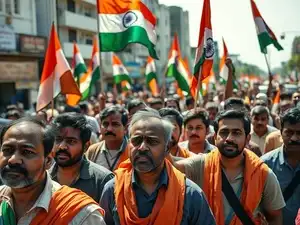
In the first week following the implementation of India’s new labour codes, large-scale demonstrations across the country have revealed the depth of discontent among workers, labour organisations, and union leaders who argue that the sweeping reforms compromise decades of hard-won rights and protections. The nationwide protests, organised by ten of India’s major trade unions, have brought renewed attention to questions of job security, industrial relations, and the future of collective bargaining in one of the world’s largest labour markets.
Growing Frustration Across India as Workers Reject Framework They Call Disempowering and Unfair
The protests that erupted across multiple states marked the first widespread public response since the new labour codes took effect on November 21. Thousands of workers took to the streets in organised rallies, marches, and demonstrations supported by labour groups, farmer organisations, and members of the unorganised sector. Their unified message reflected a deep fear that the new policies have tipped the balance of power decisively toward employers, leaving workers with diminished rights at a time of increasing job insecurity and economic flux.
Labour leaders have voiced alarm over what they describe as a troubling shift in the legal and regulatory landscape. They argue that the reforms, introduced by the central government as a modernisation effort, instead represent a regressive move that could dismantle institutional safeguards put in place over several decades.
Tapan Sen, general secretary of the Centre of Indian Trade Unions, expressed strong criticism of the overhaul, calling it a deliberate attempt to weaken worker protections under the guise of simplification. He argued that the reforms remove crucial legal mechanisms designed to protect labourers, creating a climate of vulnerability at a time when economic challenges are already undermining job security. His remarks highlight a larger concern among unions that the consolidation of labour laws threatens to undo the steady progress made by organised labour movements since independence.
Amarjeet Kaur, general secretary of the All India Trade Union Congress, voiced similar views. She stated that the new codes not only weaken worker protection but actively suppress the ability of labourers to organise, protest, or form unions—a comparison she framed as a return to colonial-era constraints on worker rights. According to her, the intention behind the reforms appears to be the dilution of collective bargaining power, which she believes is fundamental to maintaining a fair labour environment.
Trade unions have emphasised that employers now stand to gain significantly from provisions that allow for greater flexibility in hiring and firing, longer working hours, and restrictions on union organising. Meanwhile, workers face increased challenges to raise grievances or initiate strikes without risking legal penalties.
The discontent is compounded by a widespread perception that the reforms were introduced without adequate consultation. Gautam Mody of the New Trade Union Initiative expressed frustration that unions were not meaningfully included in the discussions leading up to the legislative overhaul. He argued that workers across sectors were blindsided by changes that dramatically reshape the labour regulatory framework, reducing their ability to negotiate or safeguard their interests.
The government, however, maintains that the reforms will streamline compliance requirements, reduce bureaucratic burdens, enhance investment prospects, and bring India’s labour framework in line with global economic standards. Officials have said that consolidating 29 labour laws into four codes clarifies responsibilities, reduces redundant regulations, and creates a more efficient system for both employers and employees. They highlight sections of the reforms that mandate written appointment letters, define wage payment timelines, and expand social security coverage to gig workers, platform workers, and contract-based employees.
While employers and industry associations have welcomed the reforms as a long-overdue effort to modernise labour regulation, unions argue that these benefits come at the cost of worker empowerment. For instance, the increase in the threshold for requiring government approval for layoffs—from 100 workers to 300—has been described by labour leaders as a significant erosion of job security. By allowing mid-sized companies to retrench staff without oversight, unions fear that the new codes pave the way for widespread layoffs in volatile economic conditions.
Workers also expressed concern over the new restrictions on strikes and union formation. The codes introduce stricter prerequisites for initiating industrial action, including longer notice periods and limitations on who can participate. Unions argue that these measures weaken one of the most fundamental tools available to labourers for negotiating better wages, conditions, or safety standards. The fear is that the new restrictions may not just delay but effectively prevent workers from organising collective protests when employers fail to address grievances.
Another point of contention is the extension of permissible shift lengths, which unions argue could lead to unsafe working conditions, fatigue, and exploitation, particularly in industries with long-standing issues of worker burnout, such as manufacturing, textiles, and construction. Although the codes require safety measures and welfare provisions, union leaders worry that enforcement may remain weak in workplaces already struggling with compliance.
These tensions reflect deeper anxieties about India’s rapidly changing labour market, in which informal and precarious employment is rising, and automation threatens to reshape traditional industries. In this context, unions fear that regulatory reforms favouring employers could accelerate job insecurity rather than provide the economic stability the government promises.
Labour Code Consolidation Sparks Debate Over Rights, Regulation, and the Future of Industrial Relations
The new labour codes consolidate 29 existing laws into four major categories: wages, industrial relations, social security, and occupational safety. According to government officials, this restructuring is designed to reduce compliance burdens, limit bureaucratic fragmentation, and make regulatory processes simpler and more predictable. They argue that the overhaul enables businesses to expand more efficiently, attract investment, and generate employment.
The codes include provisions intended to modernise labour administration. For example, they extend social security benefits to gig and platform workers, who make up an increasingly large and underprotected segment of the workforce. The reforms also mandate written contracts for employees, which advocates say will increase accountability and reduce disputes. Women are permitted to work night shifts, provided employers institute adequate safety measures—a change meant to increase workforce participation and gender inclusion.
Supporters argue that the codes are crucial for integrating India’s labour regulations into a modern economic framework, especially as the country aspires to become a global manufacturing hub. They claim that overly rigid or outdated labour laws have historically discouraged businesses from expanding or hiring, contributing to high unemployment and informality.
However, union leaders insist that these supposed benefits mask deeper structural inequities. They argue that the consolidation of laws into fewer codes gives employers greater freedom while reducing workers’ leverage in disputes and negotiations. Critics say the removal of mandatory government oversight in layoffs, retrenchments, and factory closures eliminates essential protections that prevent arbitrary dismissal.
Concerns have also been raised about provisions that restrict strikes. The codes require workers to give extended notice before initiating industrial action, even in sectors where immediate response is crucial to address safety risks or exploitation. Critics fear this makes it effectively impossible for workers to protest against unfair labour practices in real time.
For many labour organisations, the reforms represent not merely a legal shift but a fundamental ideological divergence between the government’s development agenda and the lived realities of India’s working class. They argue that the changes prioritise economic growth and corporate flexibility over the social welfare of workers, potentially harming long-term productivity by undermining morale and workplace stability.
The protests illustrate the widening gap between workers and policymakers at a moment when economic inequality, rising inflation, and job insecurity are pressing national concerns. Unions worry that without robust checks on employer power, India could see increasing workplace disputes, strikes, and instability in the industrial sector.
The coming months will likely determine whether the new codes can coexist with demands for labour justice or whether tensions will deepen as industries and workers adjust to the changing landscape. For now, the protests have set the stage for an ongoing national debate about the balance between economic reform and worker protection in a rapidly evolving India.