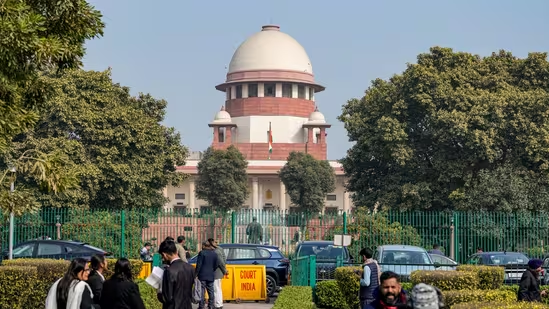
The Supreme Court’s decision to allow both Hindus and Muslims to offer prayers at the Bhojshala–Kamal Maula complex in Madhya Pradesh on the same day has brought national attention back to one of India’s most sensitive religious disputes, highlighting the judiciary’s role in balancing faith, law and public order during moments of potential communal tension.
The order came as Basant Panchami, a significant Hindu festival dedicated to Saraswati, coincided with Friday congregational prayers for Muslims, creating a rare overlap that has historically triggered unrest in the region. Recognising the risk of conflict, the apex court intervened to permit worship by both communities through a time-sharing arrangement, emphasising peaceful coexistence while the long-pending legal dispute over the site continues. The ruling was framed as a temporary administrative measure rather than a determination of ownership or religious character, reinforcing the court’s intent to prioritise harmony and constitutional rights.
The decision reflects a broader judicial effort to prevent flashpoints from escalating into communal confrontations, especially at contested heritage sites where history, belief and identity intersect. By allowing both sets of prayers under regulated conditions, the court sought to reaffirm the principle that religious freedom must coexist with public order and mutual respect.
The bhojshala dispute and the court’s balancing approach
The Bhojshala–Kamal Maula complex, located in Dhar district of Madhya Pradesh, has for decades remained a focal point of competing religious claims. Hindus believe the site to be an ancient place of learning and worship associated with Raja Bhoj and dedicated to Saraswati, while Muslims regard it as the Kamal Maula mosque, a site of prayer linked to a revered sufi saint. These overlapping narratives have shaped administrative and legal arrangements governing access to the complex since the early 2000s.
Under existing arrangements, Hindus are permitted to perform worship on specific days such as Basant Panchami, while Muslims traditionally offer prayers at the site on Fridays. Tensions arise when these observances coincide, as happened this year, raising concerns about crowd management, symbolism and communal sensitivity. Anticipating unrest, petitions were moved seeking exclusive access by one community, prompting judicial intervention.
The Supreme Court, while hearing the matter, made it clear that its role was not to adjudicate the historical or religious merits of the competing claims at this stage. Instead, it focused on preventing disorder and safeguarding the right to worship for both communities. The court directed that Hindus be allowed to perform Basant Panchami rituals from morning to evening, while Muslims be permitted to offer Friday namaz during a specified afternoon window, ensuring that neither group was denied its customary practice.
In framing this arrangement, the bench stressed restraint and compliance with law and order directives. It instructed local authorities to ensure separate entry and exit routes, controlled access and strict adherence to timings. The court also underlined that the arrangement should not be interpreted as precedent or recognition of exclusive rights, reiterating that the substantive dispute would continue to be examined by lower courts based on evidence, including archaeological findings.
This approach aligns with the judiciary’s broader pattern of managing sensitive religious disputes through interim measures aimed at de-escalation. Rather than allowing administrative paralysis or unilateral action, the court stepped in to provide clarity and structure, reinforcing the idea that constitutional remedies exist to manage even the most emotionally charged conflicts.
Administration, security measures and wider social implications
Following the court’s order, district authorities moved swiftly to implement extensive security and administrative arrangements at the Bhojshala site. Police forces, rapid response units and local administration coordinated to manage anticipated crowds, install surveillance measures and enforce the time-sharing formula laid down by the court. Officials emphasised that the objective was not only to prevent violence but also to ensure that worshippers from both communities could perform their rituals with dignity.
The administration’s role became especially crucial given the symbolic weight attached to the site. In past years, even minor deviations from agreed arrangements have led to protests and clashes, making the successful execution of the court’s directive a test of governance and community cooperation. Authorities appealed to religious leaders and local residents to maintain calm, framing the day as an opportunity to demonstrate peaceful coexistence rather than confrontation.
The Supreme Court’s intervention also carries broader social implications. In a country where religious identity often intersects with politics and public life, judicial decisions at disputed sites are closely scrutinised for their messaging. By permitting shared worship rather than privileging one claim over another, the court reinforced the constitutional principle of equality before the law, even as it navigated deeply entrenched beliefs.
At the same time, the order has renewed public debate about how long-standing disputes over religious sites should be resolved. Some voices argue that interim arrangements, while effective in preventing immediate conflict, delay definitive legal clarity and prolong uncertainty. Others contend that such measures are essential in a diverse society, allowing time for evidence-based adjudication without sacrificing public peace.
The Bhojshala case also illustrates the evolving role of the judiciary in managing social harmony. Beyond interpreting statutes, courts are increasingly called upon to act as mediators in disputes that blend law, history and collective memory. In doing so, they face the challenge of balancing firmness with sensitivity, ensuring that constitutional values are upheld without inflaming passions.
As worship concluded under tight security, the immediate outcome of the court’s order was measured not in legal victories but in the absence of violence. Whether this approach can translate into lasting resolution remains uncertain, but the episode stands as a reminder of the judiciary’s capacity to navigate complex social realities through measured, principle-based intervention.