New Delhi, January 14, 2026
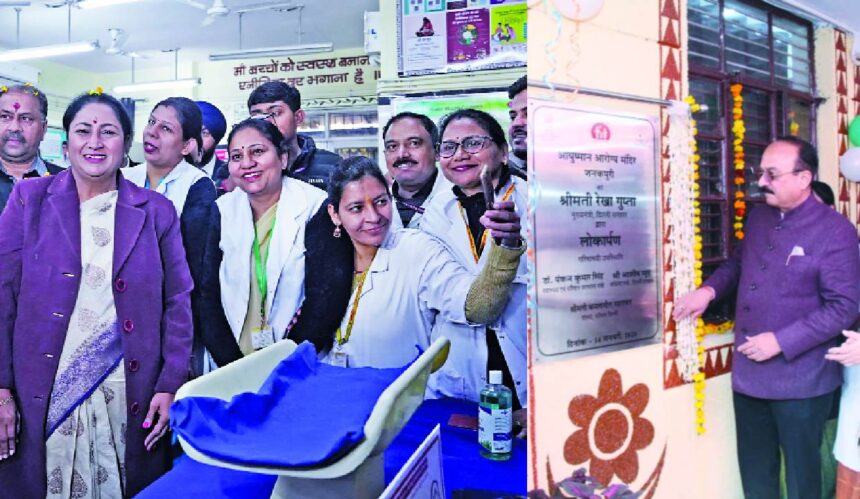
Delhi Chief Minister Rekha Gupta on Wednesday dedicated 81 new Ayushman Arogya Mandirs to the people of the capital on the occasion of Makar Sankranti. The new centres were inaugurated from the Hari Nagar Assembly constituency, marking a significant expansion of Delhi’s primary healthcare network. With the addition of these facilities, the total number of operational Ayushman Arogya Mandirs in Delhi has increased to 319. The government has set an ambitious target of establishing at least 15 such centres in every Assembly constituency and a total of 1,100 Ayushman Arogya Mandirs across the city, aimed at ensuring free and accessible healthcare close to people’s homes.
During the inauguration, the Chief Minister carried out a detailed inspection of the healthcare facilities available at the Ayushman Arogya Mandir. She reviewed the functioning of OPD rooms, laboratories, medicine distribution counters, vaccination units and mother-and-child care centres. Rekha Gupta assessed the quality of services and operational systems in place and interacted with doctors, nurses and paramedical staff to understand their work experience and the challenges faced in delivering healthcare services to patients. She also reviewed the health record management system, examining the process of patient registration, maintenance of medical records and data management. Officials were directed to ensure that the system remains transparent, accurate and user-friendly for citizens. Hari Nagar MLA Shyam Sharma and other dignitaries were present during the programme.
Addressing the gathering, the Chief Minister said dedicating 81 new Ayushman Arogya Mandirs to the public on the auspicious occasion of Makar Sankranti and Lohri was a matter of pride and satisfaction for the government. She described these centres as more than just healthcare facilities, stating that they represent a guarantee of dignified, accessible and free treatment for the people of Delhi. Rekha Gupta said that neglect of the healthcare sector by previous governments had led to several hospital projects remaining stalled for years. She added that the present government is now completing all pending health infrastructure projects in a transparent and time-bound manner.
The Chief Minister said the central government has been extending continuous support for strengthening Delhi’s healthcare infrastructure. As part of this effort, new Ayushman Arogya Mandirs, modern laboratories and other health infrastructure are being developed across the capital. She highlighted that over the past 11 months, the Delhi government has undertaken several major initiatives, including the establishment of 319 Ayushman Arogya Mandirs, expansion of Jan Aushadhi centres, construction of new blocks in five major hospitals, installation of additional dialysis machines and complete digitisation of government hospitals. As a result, patients can now book OPD appointments and access medical records through mobile phones, significantly improving transparency and convenience in healthcare delivery.
Rekha Gupta further said that more than six lakh citizens in Delhi have been registered under the Ayushman Bharat scheme so far, with thousands of families already benefitting from free treatment. She announced that the income limit for availing treatment under the economically weaker section category has been increased from ₹2.5 lakh to ₹5 lakh, enabling a larger number of needy families to access quality healthcare services without financial burden.
Expressing confidence in the expanding network of Ayushman Arogya Mandirs, the Chief Minister said the initiative would help reduce pressure on major hospitals by addressing primary healthcare needs at the local level. She said residents would no longer need to travel long distances or depend on large hospitals for treatment of minor ailments. According to her, the vision of free treatment near home is steadily becoming a reality, strengthening Delhi’s primary healthcare network and improving overall public health outcomes. She reiterated that building a developed Delhi in line with the vision of a developed India remains the government’s priority.
Ayushman Arogya Mandirs offer a wide range of healthcare services to citizens. These include consultation services by doctors and trained nursing staff, nearly 80 types of diagnostic tests, free distribution of essential medicines, maternal and child healthcare services, vaccination and growth monitoring for children, mental health support, nutrition counselling and day-care treatment facilities. The government believes that these services will not only ensure timely treatment but also promote disease prevention and health awareness among citizens.
The expansion of Ayushman Arogya Mandirs is being seen as a major step towards building a strong, accessible and people-centric healthcare system in Delhi. By bringing essential medical services closer to residential areas, the initiative is expected to improve early diagnosis, reduce healthcare costs for families and enhance the overall quality of life for residents across the capital.