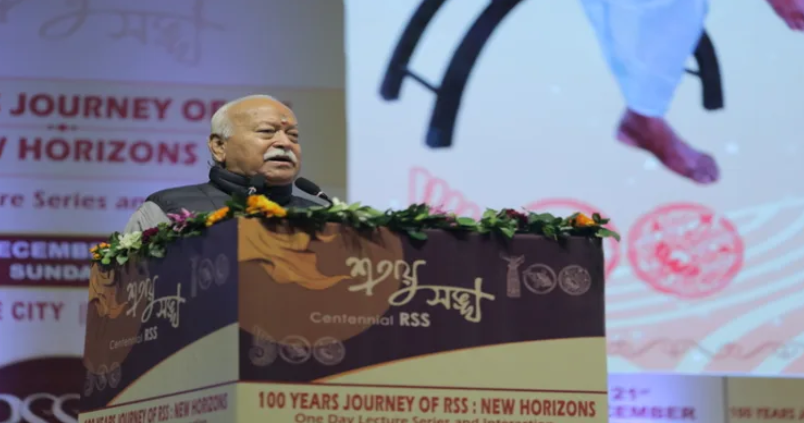
Kolkata, 21 December 2025:
The first session of the Kolkata Lecture Series on the centenary of the Rashtriya Swayamsevak Sangh (RSS), titled “New Horizons,” explored the vision, history, and societal philosophy of the Sangh. Speakers emphasized that the RSS, far from being merely a service organization, is a comprehensive social movement dedicated to the holistic organisation of Hindu society.
The session clarified that the Sangh does not consider anyone as its enemy. Opposition arises only from those whose personal or selfish interests may be threatened by the organisation’s growth. Speakers underscored that the Sangh should not be compared to any other organisation to understand its purpose. While public processions are often observed, referring to these as paramilitary activities is misleading.
Tracing the origins, the lecture noted that Dr. K. B. Hedgewar, the founder of RSS, was not sent to Kolkata’s National Medical College to pursue a medical career. Rather, his mission was to establish connections with the Anushilan Samiti and contribute to revolutionary activities in western India. Hedgewar’s devotion to Bharat Mata was rooted in a pledge he took before Goddess Kali as a member of the Anushilan Samiti.
Speakers highlighted India’s historical experiences of foreign invasions, noting that the British were not the first to subjugate the country. Prior invaders included Islamic rulers, Shakas, Kushans, Alexander, and the Huns. Hedgewar pondered whether freedom would endure, given divisions within society. Before independence, India had been ruled by eight invaders, including the Mughals and the British. After a decade of reflection, Dr. Hedgewar founded the Sangh on Vijayadashami in 1925, aiming not to compete, oppose, or destroy, but to fulfil the mission of societal organisation.
The Sangh’s core mission, speakers stressed, is the organisation of the entire Hindu society, without the intention of opposing others. They challenged the notion that India became a nation only after British rule, citing historical references including Sri Aurobindo’s Uttarpara speech and communist leader Rajani Palme Dutt, which affirm that democratic and self-governance principles existed in India long before colonial rule.
The lecture further explored the concept of “Hindu” as a way of being rather than merely a religious identity. Anyone in Bharat who respects its culture, honours the motherland, and embodies the spirit of Vasudhaiva Kutumbakam—the belief that the world is one family—is considered a Hindu. Speakers highlighted the unity in diversity among Hindus despite differences in language, attire, worship practices, or food habits.
Scientific perspectives were also referenced, noting that the DNA of people on the Indo-Iranian plate has remained largely unchanged for 40,000 years, reinforcing a shared heritage. Participants were encouraged to rediscover this identity, whether proudly declared, quietly acknowledged, or forgotten over time. The Sangh’s focus, the lecture concluded, is on cultivating “Vyakti Nirman” (personal development) to strengthen society. An hour of selfless contemplation for the nation, as practiced in the Sangh Shakha, embodies the essence of the organisation.
The session reaffirmed that the Sangh is a lifelong mission dedicated to nation-building through societal organisation, unity, and fostering a collective consciousness rooted in India’s civilizational values.