Kolkata, 21 December 2025:
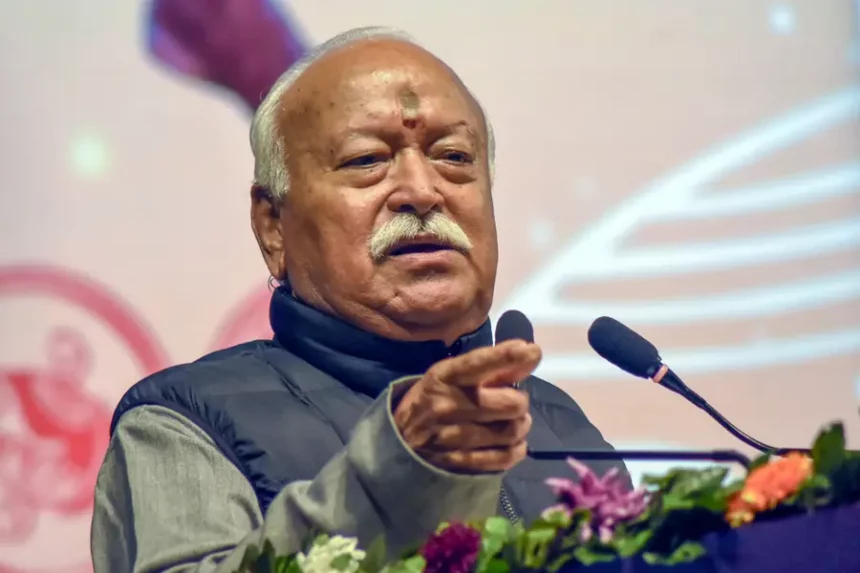
In the third session of the Kolkata Lecture Series on the centenary of the Rashtriya Swayamsevak Sangh (RSS), held at 2:45 PM, RSS Chief Dr. Mohan Bhagwat conducted a detailed question-and-answer session, sharing insights on social transformation, Hindu society, and national priorities. The discussion highlighted the Sangh’s vision, values, and its approach toward societal organisation without political competition.
Dr. Bhagwat emphasized that true change in society comes through friendship and personal conduct. Swayamsevaks, including youth, engage with society using this principle, reflecting the Sangh’s approach to social transformation. While the Sangh itself conducts only the Shakhas, its volunteers carry out a wide range of activities for society.
He explained that Hindutva is a system of values, whereas secularism is a governance framework. In India, secularism as a concept is largely irrelevant in the cultural context. Religion and dharm are not synonymous; absence from temples does not imply irreligiosity, and rituals, though important, are not the entirety of dharm. Secularism should be understood as non-sectarianism, not as absence of dharm. The four pillars of dharm—truth, compassion, purity, and austerity—have guided India’s continuous progress.
Dr. Bhagwat stressed that cleanliness begins with the individual, urging citizens to maintain their homes and nearby areas, avoid littering, and encourage friends to do the same, thus fostering a culture of sanitation. On education and cultural preservation, he highlighted the efforts of organizations like Sanskrit Bharati, which conduct workshops to promote spoken Sanskrit, noting examples such as Muttur village in Karnataka, where Sanskrit is widely spoken.
The Chief further underscored the importance of knowledge combined with wisdom, asserting that nurturing traditional values is not outdated. He encouraged youth to combine patriotism and cultural devotion with modern technology for the welfare of the world. Access to primary and secondary healthcare at village and district levels was also emphasized.
On global affairs, Dr. Bhagwat pointed to conflicts in Russia, Ukraine, and Israel, noting that nations preaching peace often engage in wars, highlighting the need for India to achieve full sovereignty and secure a permanent seat on the UN Security Council. He advocated stronger people-to-people relations with neighbouring countries and more proactive, agile foreign policy. Regarding minority communities, he stressed support for Hindus in Bangladesh while urging cooperation without overstepping boundaries.
Dr. Bhagwat addressed the perception of RSS as Muslim-opposed, clarifying that visitors often find otherwise when they witness the work firsthand. On Ayodhya, he affirmed that the Ram temple construction followed judicial approval, and any claims based on Babri Masjid are politically motivated. He urged understanding that cultural differences among communities should not overshadow shared heritage.
The session also addressed societal cohesion, encouraging engagement with communities undergoing religious conversions to foster harmony and encourage return to their roots. Dr. Bhagwat highlighted the Hindu foundations of the Indian Constitution, emphasizing freedom, justice, and equality, rooted in Sanatan values. He stressed the importance of national unity, gender inclusion, and ethical conduct to combat corruption and maintain societal integrity.
He clarified that RSS maintains independence from political parties, though it supports individuals aligned with its values, including BJP leaders Narendra Modi and Amit Shah, while continuing its mission to organise the Hindu society comprehensively. The Chief concluded by reiterating that RSS’s sole purpose is national and societal welfare, not political power or competition, and its enduring mission is to preserve India’s cultural and spiritual heritage.
This session reinforced the Sangh’s commitment to long-term societal organisation, moral development, and the cultivation of national pride rooted in India’s civilizational ethos.