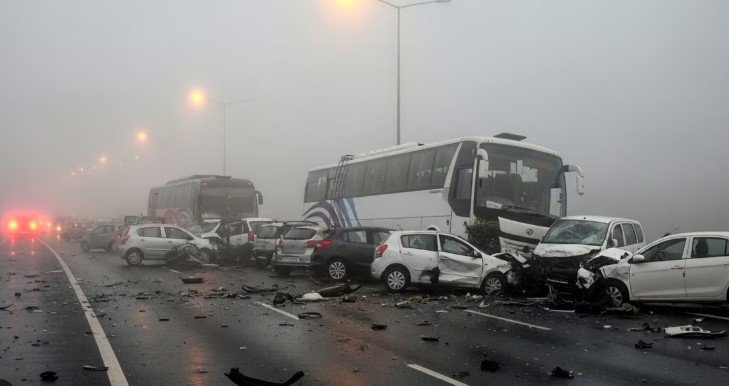
New Delhi: Severe fog conditions on Sunday led to a series of major road accidents at multiple locations across the National Capital Region (NCR) and parts of Uttar Pradesh, resulting in hundreds of vehicles colliding and causing widespread traffic disruption. Poor visibility during early morning hours emerged as the primary cause behind these incidents, prompting authorities to take emergency traffic management measures on several expressways.
One of the most serious incidents was reported from Faridabad, where more than 100 vehicles were involved in a massive pile-up on the Delhi–Mumbai Expressway. According to officials, extremely low visibility prevented drivers from spotting vehicles ahead in time, triggering a chain-reaction crash. Cars, trucks, and other heavy vehicles were damaged in the incident, leading to prolonged traffic congestion on the expressway.
In another incident, nearly a dozen vehicles collided on the Eastern Peripheral Expressway near Greater Noida. The accident occurred when dense fog sharply reduced visibility, leaving drivers with little reaction time. Traffic movement on the stretch was temporarily disrupted as emergency teams worked to clear the damaged vehicles and restore normal flow.
Similar fog-related accidents were also reported at two other locations in Uttar Pradesh, indicating that the impact of the dense fog was widespread. Authorities said that such chain collisions are common during winter months when visibility drops drastically, particularly during early morning hours.
On the Yamuna Expressway, traffic movement was significantly affected due to near-zero visibility. Vehicles were allowed to move only from the Zero Mile point during morning hours under strict monitoring by traffic police. Officials implemented controlled vehicle movement to prevent further accidents and ensure commuter safety.
Meanwhile, on the Noida–Greater Noida Expressway, authorities reduced the permissible speed limit as a precautionary measure. Traffic police deployed additional personnel along vulnerable stretches and advised drivers to maintain safe distances, use fog lights, and avoid overspeeding.
Emergency response teams, including traffic police, highway patrol units, and local administration officials, were deployed across affected areas. Tow trucks and cranes were used to remove damaged vehicles, while traffic was diverted where possible to ease congestion. In some areas, commuters remained stranded for hours as clearance operations continued.
Officials said that despite repeated advisories, many drivers continued to travel at unsafe speeds in foggy conditions, contributing to the scale of the accidents. They reiterated that fog drastically reduces braking distance and reaction time, making cautious driving essential.
Road safety experts stressed that winter fog poses one of the biggest risks to highway travel in northern India. They advised motorists to delay travel during extreme fog conditions whenever possible and strictly follow traffic advisories. Experts also highlighted the importance of proper vehicle maintenance, including functional headlights, fog lamps, and brakes.
Traffic conditions gradually improved as visibility increased later in the day. However, authorities warned that foggy conditions may persist in the coming days and urged commuters to stay updated on weather alerts before planning journeys.
The administration appealed to motorists to cooperate with traffic authorities and follow safety guidelines to prevent further accidents. Officials emphasised that responsible driving, especially during adverse weather conditions like dense fog, is critical to avoiding large-scale mishaps and ensuring public safety.