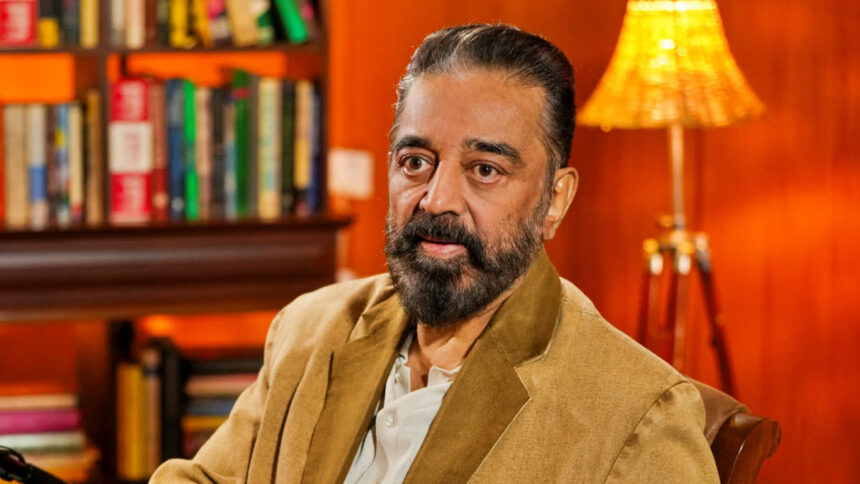
In a significant intervention into India’s ongoing education debate, Rajya Sabha MP and Makkal Needhi Maiyam (MNM) chief Kamal Haasan voiced strong support for Tamil Nadu’s State Education Policy (SEP) while sharply criticising the National Education Policy (NEP) 2020, particularly its three-language formula. Speaking on Sunday, Haasan stressed the importance of restoring education to the State List from the Concurrent List, arguing that education governance should be primarily a matter of state jurisdiction to ensure relevance, inclusivity, and cultural appropriateness. Emphasising the need for autonomy, he highlighted that states are better positioned to understand local cultures, languages, and practical realities, and that attempts to impose additional languages through national frameworks could undermine both student learning and regional diversity.
Kamal Haasan Champions Tamil Nadu’s State Education Policy and State Autonomy
Kamal Haasan, the actor-turned-politician who leads the MNM, strongly endorsed the State Education Policy (SEP) recently introduced by Tamil Nadu Chief Minister M.K. Stalin. Haasan highlighted that the SEP’s focus on a two-language formula—Tamil and English—strikes the right balance between regional identity and global competitiveness. According to him, education is not merely about following national prescriptions, but about equipping students with the skills, knowledge, and contextual understanding necessary to thrive in a rapidly changing world. “Education must be restored to the State List,” Haasan said, framing the argument around the principle of cooperative federalism, which he believes begins with allowing states greater autonomy in policy-making.
Haasan underscored that states are better attuned to the linguistic, cultural, and socio-economic realities of their population. By decentralising education governance, policies can be tailored to the needs of students, families, and local communities, enhancing learning outcomes and ensuring inclusivity. He criticised central directives that impose uniform language requirements, noting that language, while important as a medium of communication, should not become a tool of political imposition. “Language is only a medium, not the purpose of education,” Haasan remarked, stressing that curriculum design and pedagogical approaches should focus on skills, knowledge, and cognitive development rather than linguistic conformity.
The MNM leader argued that Tamil Nadu’s SEP embodies these principles, offering a curriculum that includes financial literacy, environmental studies, constitutional awareness, and other practical subjects, thereby preparing students for real-world challenges. Haasan emphasised that reducing curricular pressure and making education relevant were critical to fostering creativity, critical thinking, and holistic development. “Let us not trouble our children,” he said, highlighting the importance of a curriculum that empowers rather than overwhelms students.
By advocating for state autonomy in education, Haasan positioned himself as a defender of regional languages and cultural identity, while also stressing the need for modern pedagogical practices. He pointed out that real-time translation technologies now make rigid language requirements unnecessary, allowing students to learn additional languages based on practical need rather than compulsory imposition. In this framework, Tamil and English form the foundation for learning, while other languages can be adopted organically as per context and relevance.
Critique of NEP 2020 and the Three-Language Formula
Kamal Haasan’s critique of the National Education Policy 2020 focused primarily on its three-language formula, which mandates students to learn their mother tongue, English, and a third Indian language, often interpreted as Hindi. He expressed concern that such policies could undermine regional autonomy, linguistic diversity, and student well-being, particularly in states like Tamil Nadu where the imposition of Hindi has historically been resisted. Haasan highlighted that Tamil Nadu’s SEP deliberately adheres to a two-language formula, reflecting the state’s commitment to preserving Tamil language and culture while equipping students with English proficiency for global opportunities.
Haasan argued that NEP’s three-language formula may create unnecessary confusion, additional workload, and educational stress for students. Rather than fostering multilingual proficiency, it risks turning language learning into a burdensome requirement that detracts from the acquisition of critical thinking, scientific reasoning, and practical skills. He emphasised that students should develop mastery over two languages and acquire other languages based on practical needs and contextual relevance, not central mandates. This approach, according to Haasan, respects both regional identity and the pragmatic demands of modern education, where technological tools and translation software increasingly diminish the necessity of compulsory multilingualism.
The actor-politician further highlighted that education policy must adapt to contemporary realities, including technological advancements, evolving job markets, and global interactions. He criticised the NEP for not adequately factoring in state-specific conditions and local cultural priorities, arguing that a one-size-fits-all approach risks alienating students and undermining the effectiveness of teaching-learning processes. Haasan’s position reflects a broader debate within India’s federal system, where states have historically asserted the right to design education policies that reflect local languages, traditions, and socio-cultural contexts.
Haasan also drew attention to the importance of a relevant, less burdensome curriculum. He noted that Tamil Nadu’s SEP includes elements such as environmental literacy, financial awareness, and constitutional education, creating a holistic framework that goes beyond rote learning. By prioritising knowledge that is immediately applicable and contextually meaningful, the SEP aims to reduce academic stress while preparing students to navigate complex societal challenges. Haasan warned that centralised frameworks, like NEP’s three-language formula, could detract from these goals by imposing uniform requirements that may not align with local needs or realities.
In defending Tamil Nadu’s SEP, Haasan positioned himself as a proponent of both educational reform and linguistic autonomy. He stressed that cooperative federalism in education requires recognising the capacity of states to make informed decisions for their populations. By devolving educational authority to the state level, policies can remain relevant, inclusive, and culturally sensitive while still meeting national standards and global benchmarks. Haasan’s remarks thus framed the SEP not merely as a political stance, but as a comprehensive framework for empowering students and protecting regional diversity.
Furthermore, Haasan emphasised that the focus of education must shift from language imposition to meaningful learning outcomes. He noted that contemporary technological solutions, such as real-time translation tools, diminish the necessity of rigid language requirements, allowing students to access knowledge in multiple languages without compromising their learning experience. This, he argued, makes Tamil Nadu’s two-language formula both practical and forward-looking, ensuring that students can thrive academically and professionally while maintaining strong ties to their linguistic and cultural heritage.
Through his intervention, Haasan also highlighted the broader principles of educational governance. He argued that policy-making should prioritise relevance, inclusivity, and reduced academic pressure, ensuring that children are not burdened with unnecessary stress or rote memorisation. The SEP’s framework reflects these principles, combining traditional subjects with practical knowledge, ethical awareness, and skills necessary for modern life. By contrast, Haasan suggested that NEP 2020’s approach risks diluting the educational experience by imposing additional linguistic obligations without corresponding benefits.
Kamal Haasan’s advocacy for Tamil Nadu’s SEP and critique of NEP’s three-language formula underscores the ongoing debate about federalism, state autonomy, and the future of education in India. His remarks highlight the need for policies that balance linguistic diversity, regional identity, and global competencies, while ensuring that students are prepared for contemporary challenges without being overburdened by centrally imposed mandates. By positioning the SEP as a model for relevant, inclusive, and forward-looking education, Haasan emphasises the importance of state-led innovation in education policy and the role of autonomy in shaping meaningful learning experiences for students.