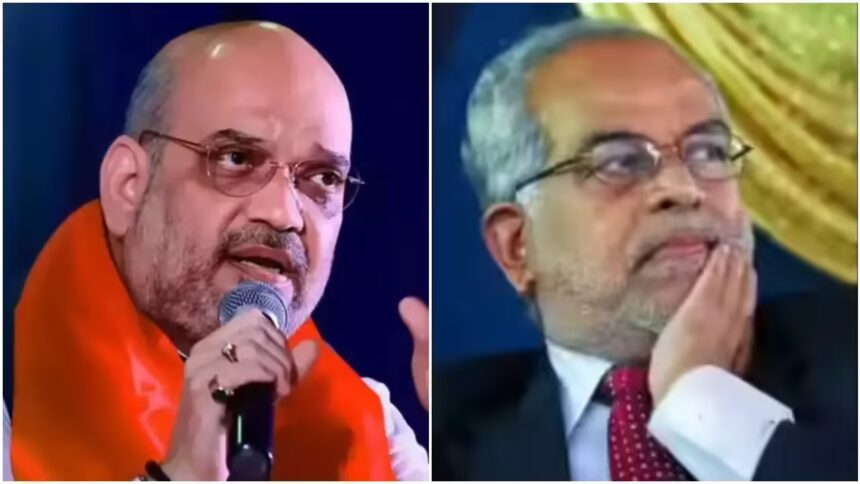
The political discourse in India has once again collided with the judiciary after Union Home Minister Amit Shah’s remarks targeting the opposition’s vice-presidential candidate, retired Supreme Court judge B Sudershan Reddy. A group of eighteen former judges, including some of the most respected names who once adorned the benches of the Supreme Court of India, released a joint statement denouncing Shah’s interpretation of a decade-old judgement related to the controversial anti-Naxal militia movement known as Salwa Judum. Their statement not only refuted Amit Shah’s claims but also warned of the chilling effect such misrepresentations could have on the judiciary’s independence. The episode, unfolding against the backdrop of the upcoming vice-presidential elections, has ignited a wide-ranging debate about the relationship between politics, the judiciary, and the sanctity of judicial pronouncements.
The Controversy Over Amit Shah’s Comments and the Salwa Judum Case
The controversy began when Amit Shah, during a campaign stop in Kerala, accused B Sudershan Reddy of aiding Naxalism through his 2011 judgement in the Salwa Judum case. According to Amit Shah, Reddy was “the person who helped Naxalism” by authoring the verdict that disbanded Salwa Judum, an armed movement in Chhattisgarh originally presented as a civilian resistance against Maoist insurgents. Amit Shah further argued that if not for the Salwa Judum judgement, the Maoist insurgency would have ended by 2020, thereby directly attributing the persistence of Naxal violence to the judicial order.
His remarks were unmistakably pointed at delegitimising Reddy’s candidacy for the office of Vice-President of India, portraying him as someone influenced by ideologies sympathetic to Naxalism. Shah asserted that the ruling was “inspired by the ideology that gave Salwa Judum judgement,” suggesting a partisan bias in judicial decision-making and questioning the patriotism of a retired Supreme Court judge who had once taken the constitutional oath to defend the rule of law.
The reaction was swift and sharp. Reddy himself clarified that the judgement was not a unilateral decision authored solely by him, but a verdict passed by a bench of the Supreme Court comprising him and Justice SS Nijjar. The decision, delivered in 2011, held that the deployment of tribal youths as Special Police Officers under Salwa Judum was unconstitutional, illegal, and violative of human rights. The court highlighted the danger of arming untrained civilians and using them in an armed conflict against seasoned insurgents. It underscored that the state cannot abdicate its responsibility to maintain law and order by delegating violent power to private militias, especially when such measures expose vulnerable communities to further exploitation and violence.
Salwa Judum, since its inception in 2005, had been controversial. While its proponents in the Chhattisgarh government and the central leadership argued that it was a grassroots resistance against Maoist violence, human rights groups and international observers condemned it as state-sponsored vigilantism that led to forced displacement, unlawful killings, and the militarisation of civilian populations. The Supreme Court’s 2011 ruling dismantled Salwa Judum and ordered the state to cease funding, arming, or supporting such militias. It was hailed at the time by civil liberties activists as a landmark judgement protecting tribal rights and ensuring constitutional governance in conflict regions.
By portraying this judgement as support for Naxalism, Amit Shah not only attacked Reddy personally but also implicitly questioned the court’s authority to check excesses of state power. It was this interpretation that provoked the unprecedented intervention of former judges.
Judges’ Collective Response and the Broader Implications
Eighteen retired judges, including eminent figures such as Kurien Joseph, Madan B Lokur, and J Chelameswar, came together to issue a joint statement condemning Amit Shah’s remarks. Their statement categorically described his interpretation as “prejudicial misinterpretation” and “unfortunate.” According to them, such mischaracterisation by a political leader of Amit Shah’s stature risks creating a chilling effect, making sitting judges hesitant in delivering verdicts that might go against the executive’s preferences.
The statement emphasized that the 2011 verdict nowhere endorsed, directly or indirectly, Naxalism or its ideology. On the contrary, the court had been careful to root its reasoning in constitutional principles, human dignity, and the obligation of the state to act within the law. “While the campaign for the office of the Vice-President of India may well be ideological, it can be conducted civilly and with dignity. Criticising the so-called ideology of either candidate should be eschewed,” the judges’ statement said, effectively drawing a line between legitimate electoral debate and personal vilification of judicial decisions.
The judges who signed this letter included not just former Supreme Court justices but also three retired Chief Justices of High Courts—Sanjib Banerjee, Govind Mathur, and S. Muralidhar. Their intervention represents one of the rare occasions in which a collective of retired judges has felt compelled to publicly challenge the statements of a serving Union Minister. This underscores the seriousness of the matter. For many, it is not merely about defending one retired colleague but about safeguarding the judiciary itself from political appropriation and misrepresentation.
The episode reflects a recurring tension in India’s democracy: the uneasy relationship between political leaders and judicial independence. While judges, once retired, often retreat into relative silence, their public re-emergence signals moments when they believe the credibility of the judiciary as an institution is at stake.
The broader implications of Amit Shah’s remarks and the judges’ rebuttal go beyond the immediate controversy. By suggesting that judicial pronouncements can be equated with ideological leanings, Amit Shah’s statement blurs the distinction between legal reasoning and political partisanship. It implicitly demands that judges consider the executive’s political goals while deciding cases, something fundamentally at odds with the separation of powers enshrined in the Constitution.
Moreover, the use of “name-calling,” as the judges noted, corrodes public respect for judicial institutions. When senior political figures frame judicial verdicts as acts of betrayal or ideological bias, it fosters cynicism among citizens, weakening faith in the judiciary’s neutrality. This is particularly dangerous in a country where the Supreme Court has historically served as the guardian of fundamental rights and the arbiter of checks and balances.
The political timing of the remarks also cannot be overlooked. With the vice-presidential election approaching, in which B Sudershan Reddy is the opposition’s candidate, Amit Shah’s attack was aimed at casting doubt on his moral and political credibility. In doing so, the campaign rhetoric has effectively dragged a constitutional office into a battlefield of accusations linked to insurgency, terrorism, and loyalty to the nation. Critics argue that such rhetoric demeans the dignity of high offices and risks normalising a culture where judicial verdicts are weaponised in electoral campaigns.
The Salwa Judum case itself stands as a reminder of the complexities of governance in conflict zones. The ruling did not romanticise Maoist violence nor ignore the plight of civilians caught in the crossfire. Instead, it sought to place limits on how far the state could go in combating insurgency, reminding the government that the Constitution does not permit the suspension of rights or the creation of lawless militias in the name of security. To call such a judgement “support for Naxalism” is to erase its nuance and reduce it to political sloganeering.
Reddy’s own defence of the judgement pointed to this nuance. By clarifying that the ruling was a product of the Supreme Court and not an individual act of judicial sympathy, he placed the onus back on Amit Shah to engage with the text of the judgement rather than caricaturing it. His statement that Amit Shah might have understood the context had he read the full judgement is both a rebuke and a reminder of the intellectual rigour that underpins judicial reasoning.
The current debate thus forces a reconsideration of how political leaders engage with judicial verdicts. Criticism of judgements is not only permissible but essential in a democracy. What becomes problematic is when criticism turns into distortion, when verdicts are portrayed as ideological acts rather than constitutional reasoning, and when judges are personally vilified as sympathisers of anti-national elements. The intervention of former judges is significant precisely because it seeks to hold political discourse accountable to these distinctions.