Iran is witnessing a deepening political and social crisis as nationwide protests intensify and the country’s leadership issues its strongest warning yet, declaring that those challenging the state risk being treated as enemies of God and could face the death penalty under Islamic law.
The warning, attributed to Iran’s highest leadership, has sent shockwaves through the country at a time when public anger is already running high due to economic hardship, political repression, and long-standing frustrations with governance. Demonstrations that began as protests over inflation and unemployment have gradually transformed into a broader expression of dissent, questioning the authority of the clerical establishment and demanding fundamental change. As security forces tighten their grip on streets and communication networks, the government has made it clear that it views the unrest not as a social grievance but as a direct challenge to the Islamic Republic itself.
At the centre of this escalating confrontation is Ayatollah Ali Khamenei, whose remarks and stance have reinforced a zero-tolerance approach toward protests. By invoking religious and legal concepts that equate dissent with sacrilege, the leadership has elevated the crisis beyond politics, framing it as a moral and existential battle for the survival of the state. This framing has profound implications for how protesters are treated and how the unrest is likely to unfold in the coming weeks.
Harsh warnings, religious law, and an expanding crackdown
Iranian authorities have warned that individuals involved in protests, as well as those accused of supporting or organising them, could be charged with “enmity against God,” a grave offence under Iran’s penal code that carries the possibility of execution. This legal classification, historically reserved for armed rebellion or severe crimes against the state, is now being applied to mass demonstrations, signalling a dramatic escalation in the government’s response.
Officials have justified this stance by claiming that protests are being manipulated by foreign enemies seeking to destabilise Iran. According to the government narrative, dissent is not organic but part of a coordinated effort to weaken national unity and undermine the Islamic system. This argument has been repeatedly echoed by state media, senior clerics, and members of Iran’s security establishment, all of whom insist that uncompromising action is necessary to prevent chaos.
The response on the ground has matched the severity of the rhetoric. Security forces have been deployed in large numbers across major cities, including Tehran, Mashhad, Isfahan, and Shiraz. Protesters report the use of tear gas, batons, and live ammunition to disperse crowds, while mass arrests have become a defining feature of the crackdown. Detention centres are reportedly overcrowded, and families of detainees often struggle to obtain information about their loved ones.
One of the most striking aspects of the government’s strategy has been its effort to control information. Internet services have been restricted or shut down entirely in several regions, limiting access to social media and independent news sources. International phone calls have also been disrupted, isolating the country from global scrutiny. These measures have made it difficult to verify casualty figures or document alleged abuses, contributing to an atmosphere of fear and uncertainty.
Despite the heavy-handed response, protests have continued, driven by a combination of economic despair and political alienation. Iran’s economy has been under severe strain, with soaring inflation, a collapsing currency, and limited job opportunities affecting millions of citizens. For many protesters, the demonstrations represent a final outlet for frustration after years of declining living standards and unfulfilled promises of reform.
The government’s decision to invoke religiously framed charges has drawn particular concern from legal observers and human rights advocates. The concept of “enmity against God” is broad and loosely defined, giving authorities wide discretion in determining who qualifies as a criminal. Critics argue that this ambiguity enables arbitrary arrests and harsh sentences, undermining basic principles of justice and due process. Within Iran, however, the judiciary remains closely aligned with the clerical leadership, leaving little room for independent legal challenge.
State officials have defended their actions by pointing to past instances where protests escalated into violence, insisting that strict measures are required to maintain order. They argue that allowing demonstrations to continue unchecked would embolden opposition groups and invite foreign interference. In speeches and official statements, leaders have repeatedly emphasised national security, portraying the unrest as a battle between loyal citizens and those seeking to destroy the Islamic Republic.
Society under pressure as dissent grows despite repression
As the crackdown intensifies, Iranian society finds itself under immense strain. The threat of capital punishment has not only raised the stakes for protesters but has also deepened divisions within the country. Some citizens, particularly those aligned with conservative religious institutions, support the government’s firm approach, viewing protests as destabilising and disrespectful to Islamic values. Others see the response as evidence of a leadership disconnected from the realities of everyday life and unwilling to tolerate even peaceful dissent.
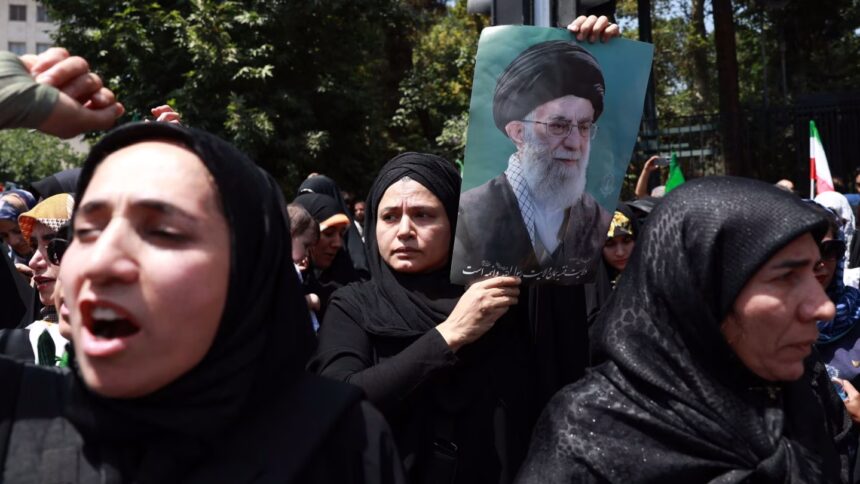
The protests have drawn participants from a wide range of backgrounds, including students, workers, professionals, and retirees. Women and young people have played a prominent role, reflecting generational discontent with social restrictions and limited economic prospects. Slogans heard at demonstrations increasingly go beyond economic demands, calling for political accountability, civil liberties, and an end to authoritarian rule.
Families of those killed or detained during the unrest have emerged as a powerful, if vulnerable, voice within this movement. Reports of funerals turning into fresh protests illustrate how grief and anger are fuelling further mobilisation. At the same time, fear of severe punishment has forced many to retreat from public spaces, creating a tense balance between resistance and survival.
The use of religious authority to suppress dissent has also sparked debate within Iran’s clerical circles. While senior figures have largely backed the supreme leader, some lower-ranking clerics and religious scholars have expressed discomfort with equating political protest with blasphemy. These internal debates rarely surface openly, given the risks involved, but they reflect underlying tensions within the ideological foundations of the state.
Internationally, Iran’s handling of the protests has drawn widespread attention. Governments and human rights organisations have expressed concern over reports of excessive force, mass detentions, and the potential use of the death penalty against protesters. Iranian officials, however, have rejected external criticism, accusing foreign powers of hypocrisy and interference. They argue that Western countries tolerate similar or worse actions when it suits their interests, and that Iran has the sovereign right to defend its system.
Exiled opposition figures have sought to capitalise on the unrest by calling for sustained demonstrations and civil disobedience. From abroad, they urge Iranians to remain resilient and to view the current moment as a turning point. While their influence inside the country is difficult to measure due to communication restrictions, their statements contribute to the broader narrative that the Islamic Republic is facing one of its most serious challenges in decades.
The economic roots of the protests remain unresolved. Sanctions, mismanagement, and corruption have all contributed to a prolonged crisis that shows little sign of easing. For many Iranians, daily life has become a struggle to afford basic necessities, eroding trust in institutions and leaders. As long as these conditions persist, the underlying causes of unrest are likely to remain.
By framing dissent as a religious crime punishable by death, Iran’s leadership has signalled that it is prepared to go to extraordinary lengths to maintain control. This approach may deter some from protesting, but it also risks deepening resentment and radicalising opposition. The coming period will test the resilience of Iranian society and the durability of a system that relies increasingly on coercion rather than consent.