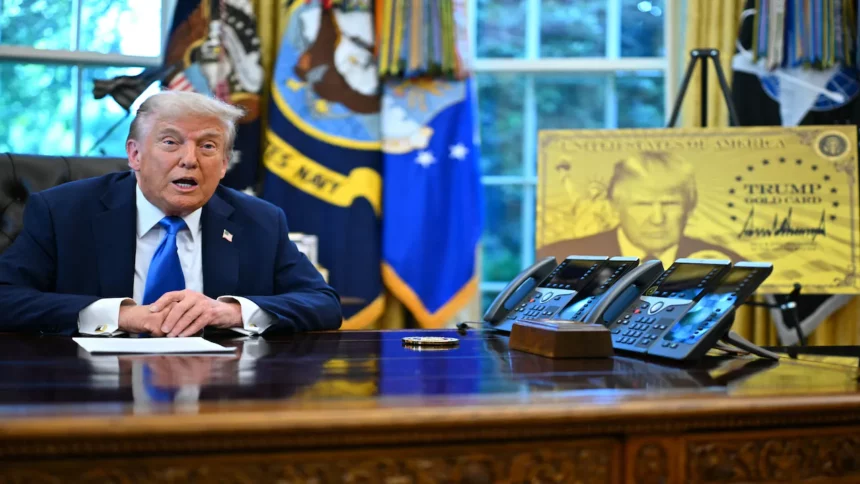
The announcement of the Gold Card visa by the Trump administration has triggered global debate over whether this high-cost path to United States residency represents innovation, inequality or a strategic recalibration of immigration policy. Introduced as a premium alternative to the traditional investor visa, the programme requires a substantial financial contribution from applicants in exchange for a streamlined route to permanent residency and, eventually, citizenship. Coming at a time when the international movement of skilled talent is reshaping economic competition among nations, the Gold Card reflects a broader transformation in how countries evaluate migrants—not only for their skills but for their financial capacity. Its unveiling marks a significant moment in the administration’s efforts to redefine U.S. immigration priorities while raising questions about accessibility, fairness and long-term geopolitical implications.
A High-Value Visa Promising Residency Through Wealth as the US Reconfigures Immigration Strategy
The Gold Card visa has been presented as an ambitious attempt to modernise immigration frameworks that were previously dominated by employment-based quotas, family sponsorship routes and the longstanding EB-5 investor programme. The EB-5 pathway, best known for allowing foreign nationals to secure green cards through substantial investments that create American jobs, has often been criticised for cumbersome processes, delays and susceptibility to misuse. The new Gold Card seeks to reduce bureaucratic friction by shifting from investment-driven requirements to direct contributions to the American government, positioning itself as a more predictable and transparent route.
Under the structure outlined by the administration, individual applicants must contribute around one million dollars, while corporations seeking to sponsor foreign employees are expected to provide up to two million. An additional vetting fee is charged for rigorous background checks, making the programme accessible only to the wealthiest global citizens and firms. The administration has argued that this high financial threshold will ensure that the programme attracts individuals with substantial global influence, entrepreneurial capability or high-value talent that benefits domestic interests.
President Trump has framed the programme as a way to attract exceptional graduates, innovators and specialists who, he claims, might otherwise take their skills to competing nations. According to the administration, the United States must develop new tools to draw and retain global talent in a landscape increasingly shaped by technological rivalry and shifting economic centres of gravity. The Gold Card is thus portrayed not merely as a source of revenue but as a strategic initiative embedded within national competitiveness.
Yet the programme has been met with scepticism in policy circles. Critics argue that replacing investment requirements with a direct financial transfer may weaken accountability mechanisms that previously ensured applicants contributed to local economic development. Others contend that the programme risks creating a two-tier immigration system: one where affluent applicants can buy their way into residency while others face long wait times, procedural hurdles and increasingly restrictive rules. The tension between opportunity and inequality forms a central part of the debate surrounding the Gold Card, raising questions about the future character of American immigration.
Compounding this is the parallel tightening of various other immigration channels, which critics say reveals inconsistencies in the administration’s broader strategy. While premium routes for wealthy applicants expand, pathways for workers, students and family-sponsored migrants have confronted greater constraints. Proponents of the Gold Card, however, view it as complementary rather than contradictory, arguing that attracting high-value individuals strengthens national capability in ways that indirectly support broader economic opportunities.
An Emerging Global Market for Wealth-Based Migration and the Uncertain Road Ahead
The Gold Card also positions the United States within an expanding global marketplace of investment-linked residency programmes. Countries such as Portugal, the UAE, the United Kingdom, Australia and Singapore have all introduced high-tier immigration options for wealthy individuals, reflecting a worldwide trend of using residency and citizenship as economic instruments. These programmes appeal to high-net-worth applicants seeking mobility, stability or better financial infrastructures, and they appeal to governments seeking capital, innovation and international credibility.
By entering this market with one of the most expensive residency options in the world, the United States signals its intent to compete aggressively for global wealth and corporate influence. Policymakers argue that the country’s long-term economic security depends on attracting individuals who can accelerate technological development, contribute to industrial leadership and support the nation’s strategic ambitions in areas such as artificial intelligence, defence innovation and biotechnology.
Nevertheless, significant questions remain about how the programme will be implemented, regulated and politically received. Without clear caps on the number of Gold Cards available, concerns have surfaced about transparency, equitable access to services and the potential for exploitation of loopholes. The absence of job creation requirements, while simplified, also eliminates safeguards that previously tied residency benefits to broader economic outcomes.
Another major area of uncertainty lies in public perception. Immigration has long been one of the most polarizing issues in American politics. While some voters welcome policies that attract wealth and elite talent, others view such programmes as evidence of an immigration system favouring the affluent. The tension between nationalist rhetoric and market-driven immigration reform fuels debates about which values should guide modern immigration policy.
Diplomatically, the programme’s reception has been mixed. Countries with strong outbound investor flows view the Gold Card as a new opportunity for mobility. Others worry about potential brain drain or capital flight among their highest earners. For India—one of the world’s largest sources of skilled migrants—the programme prompts questions about whether affluent applicants may gain easier access while others face longer waits under tightened rules. The juxtaposition of opportunity and exclusion creates a complex picture of how the programme will shape migration patterns.
Economists note that the one million dollar contribution threshold places the United States in a unique position. While many nations offer residency or citizenship at far lower investment levels, the U.S. may leverage its global influence, economic scale and cultural power to attract applicants despite the cost. Yet high prices may also deter potential candidates, especially if competing countries offer more attractive benefits, such as favourable tax regimes or faster processing times.
As details of the programme continue to unfold, corporations are evaluating whether the Gold Card can serve as a reliable tool for retaining international employees who face restrictive work visa caps under existing systems. For businesses dependent on global talent—particularly in technology and research sectors—the ability to sponsor employees through direct contribution could reshape recruitment strategies.
Ultimately, the Gold Card initiative is emerging during a transformative moment in global migration policy. As countries increasingly treat immigration as a strategic asset rather than a mere administrative process, wealth-based pathways are becoming central to national economic planning. The United States, through this programme, is signalling its readiness to play a leading role in this emerging landscape. Whether it becomes a long-term pillar of immigration reform or an experiment shaped heavily by political shifts will depend on evolving public sentiment, regulatory frameworks and global economic trends.