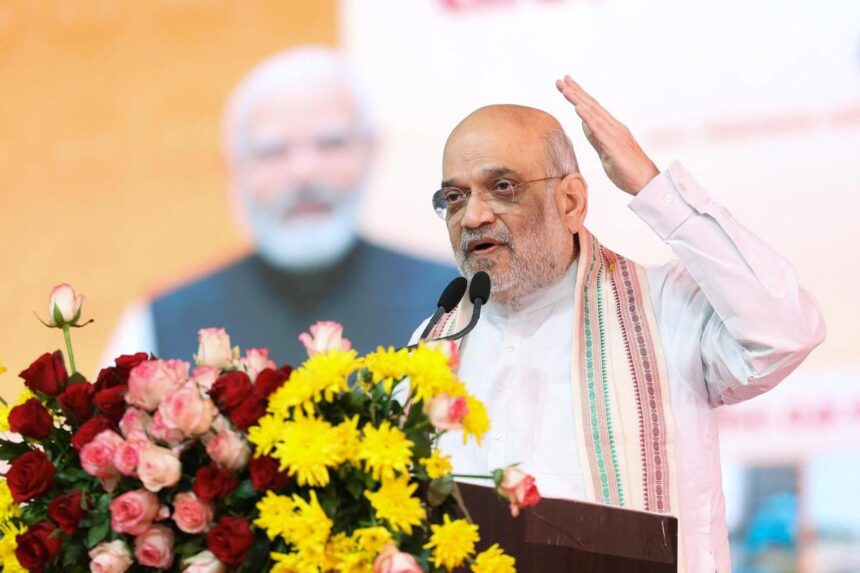
Amit Shah’s Kolkata-centric target underlines the BJP’s determination to reshape West Bengal’s political balance ahead of 2026.
As West Bengal moves steadily toward the 2026 assembly elections, the political atmosphere across the state is becoming increasingly charged, with parties recalibrating their strategies and sharpening their messages. Against this backdrop, Union Home Minister Amit Shah has issued a clear and ambitious directive to the Bharatiya Janata Party’s Bengal unit, placing Kolkata and its surrounding assembly constituencies at the heart of the party’s electoral plan. Addressing party leaders and grassroots workers, Shah set a bold target of winning at least 22 out of the 28 assembly seats in and around the Kolkata region, a statement that goes beyond routine election rhetoric and reflects a strategic intent to challenge entrenched political equations in the state’s most influential urban belt.
This declaration is significant not only because of the numerical goal involved, but also because of what it represents politically. Kolkata has long been the nerve centre of West Bengal’s political, cultural, and economic life, and success in the city and its adjoining areas often shapes the broader narrative of power in the state. By urging party workers to internalise this target and treat it as a personal commitment, Amit Shah signalled that the BJP views the coming election as a decisive contest rather than a symbolic battle. The message was unambiguous: the party aims to move from being a strong challenger to a credible contender for power in West Bengal.
kolkata as the strategic fulcrum of bjp’s bengal campaign
Amit Shah’s emphasis on Kolkata and the surrounding 28 assembly constituencies highlights the BJP’s belief that urban and semi-urban regions will play a decisive role in determining the outcome of the 2026 elections. These constituencies span key areas across Kolkata city, parts of North and South 24 Parganas, and neighbouring regions such as Howrah, all of which together form a dense political and demographic cluster. The BJP’s leadership believes that a strong showing here would have a cascading effect, boosting the party’s morale, visibility, and credibility across the rest of the state.
In his interaction with party cadres, Shah stressed that the BJP’s organisational structure in Bengal has evolved considerably over the past few years. Compared with earlier election cycles, the party now claims a deeper reach at the booth level, a broader volunteer base, and a more structured mechanism for voter outreach. This organisational confidence forms the backbone of the ambitious target he has set. Shah urged workers to focus on voter list verification, sustained public engagement, and the articulation of local issues that resonate with urban residents, arguing that consistent groundwork would be essential to converting ambition into electoral success.
Urban voters in and around Kolkata present a complex challenge. They are diverse in terms of socio-economic background, political awareness, and expectations from governance. Amit Shah’s strategy reflects an understanding that these voters respond strongly to issues such as law and order, employment opportunities, infrastructure development, public transport, and civic services. The BJP’s campaign narrative is expected to highlight concerns around urban governance while simultaneously projecting the central government’s policies as models of efficiency and development. Shah underlined that party workers must be able to explain how national-level decisions and schemes translate into tangible benefits for city residents.
Another important element of this Kolkata-centric strategy is the emphasis on unity and discipline within the party ranks. Senior leaders, including former state president Dilip Ghosh, have been encouraged to play active roles in strengthening organisational cohesion. The presence of experienced leaders alongside newer faces is being projected as a way to balance institutional memory with fresh energy. Amit Shah made it clear that internal differences or factionalism would only weaken the party’s prospects, and that achieving a target of this scale would require collective effort and unwavering focus.
By framing Kolkata as the primary battleground, the BJP is also attempting to counter a long-standing perception that it struggles in urban Bengal compared with rural and semi-urban areas. The party leadership believes that shifting this perception is crucial to its long-term ambitions in the state. A strong performance in Kolkata would not only deliver seats but also serve as symbolic proof that the BJP can appeal to the state’s urban middle class and professional communities, groups that often shape public opinion beyond their numerical strength.
opposition response and the intensifying political contest in bengal
Amit Shah’s announcement has inevitably triggered sharp reactions from the ruling Trinamool Congress, which has dismissed the BJP’s target as unrealistic and disconnected from ground realities. Leaders of the Trinamool Congress argue that Kolkata and its surrounding areas have consistently supported their party, citing its deep organisational roots and long-standing engagement with urban voters. They contend that the BJP’s numerical ambition overlooks the social and political fabric of the city, where local networks and historical loyalties continue to play a significant role.
The opposition has also questioned the BJP’s claims of organisational strength, suggesting that internal contradictions and leadership disputes within the party could undermine its campaign. According to Trinamool leaders, the BJP’s focus on ambitious targets is more about energising its cadre than reflecting a genuine assessment of voter sentiment. They maintain that urban voters in Kolkata prioritise stability and continuity, and are wary of what they describe as confrontational politics imported from outside the state.
Despite these criticisms, the BJP remains confident that the political mood in urban Bengal is shifting. Party leaders argue that dissatisfaction over issues such as governance, civic infrastructure, and employment opportunities has created space for an alternative political narrative. Amit Shah’s remarks framed the 2026 elections as a referendum on the state’s direction, suggesting that voters would be asked to choose between competing visions of development and administration. This framing is designed to elevate the stakes of the election and position the BJP as a party offering structural change rather than incremental reform.
The significance of Kolkata in this political contest cannot be overstated. Historically, electoral outcomes in the city have carried symbolic weight, often influencing perceptions of legitimacy and momentum across West Bengal. A strong showing in Kolkata would allow the BJP to claim that it has broken through a psychological barrier, while a poor performance could reinforce existing doubts about its ability to expand beyond certain pockets of support. Amit Shah’s 22-seat target therefore serves both as a rallying cry and as a high-risk gamble, tying the party’s broader narrative to its performance in a relatively compact but politically potent region.
As the election season gradually gathers pace, both the BJP and the Trinamool Congress are expected to intensify their efforts in and around Kolkata. Public meetings, targeted outreach programmes, and issue-based campaigns are likely to dominate the political landscape in the months ahead. Amit Shah’s intervention at this early stage indicates that the BJP intends to keep Kolkata at the centre of its campaign discourse, using the city as a platform to project its broader ambitions for the state.
The coming months will reveal whether the BJP’s organisational confidence and strategic focus can translate into electoral gains, or whether the Trinamool Congress will succeed in defending its urban stronghold. What is already clear is that Kolkata and its surrounding constituencies will be among the most closely watched arenas in the 2026 West Bengal assembly elections, with each party viewing success here as crucial to shaping the state’s political future.