Artificial Intelligence (AI) has emerged as one of the most transformative technological revolutions in recent decades, promising to redefine industries, professions, and the way humanity approaches innovation. As AI systems evolve and their applications expand across multiple domains, debates have intensified around their potential to both automate existing jobs and create new avenues of opportunity. Globally, thought leaders such as Sam Altman, Elon Musk, Mark Zuckerberg, and Bill Gates have been actively shaping the conversation on AI’s implications, emphasizing both its transformative potential and the ethical responsibilities that come with deploying these systems.
In India, leading tech figures have also weighed in, offering nuanced perspectives that reflect not only the potential of AI to accelerate productivity but also the challenges it presents in terms of workforce adaptation, reskilling, and the broader economic landscape. These Indian leaders are providing guidance on how organizations, professionals, and society can harness AI while mitigating the associated risks.
Building Human Resilience and Ethical Leadership Alongside AI Integration
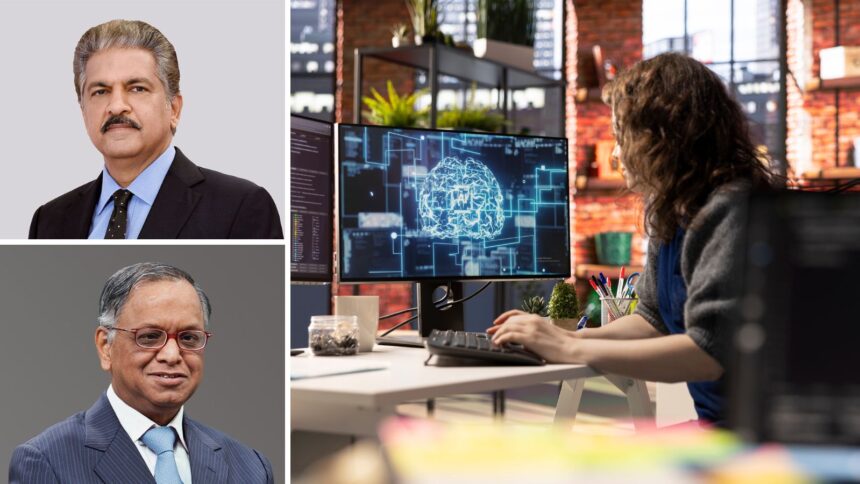
Anand Mahindra, chairperson of the Mahindra Group, has consistently highlighted the intersection of technology, human values, and leadership. Speaking at IIT Bombay, he urged students and young professionals to cultivate resilience, emotional intelligence, and integrity alongside technical expertise. Mahindra’s message underscores a vital point: while AI may automate repetitive and even complex cognitive tasks, it cannot replicate the character, vision, and moral judgment that define human leadership. “AI can write code, but it can’t write character,” Mahindra emphasized, advocating for a holistic approach to education and professional development that balances technological prowess with ethical responsibility. He believes that future leaders must possess curiosity and character to guide organizations and society in a rapidly changing technological environment.
Mahindra’s perspective reflects a broader Indian viewpoint that sees AI not simply as a tool of automation but as an enabler of human potential when combined with critical soft skills. By integrating AI into business processes and decision-making frameworks, organizations can enhance productivity and innovation, but the ultimate measure of success remains the human ability to interpret, adapt, and act with foresight. This vision is echoed by other prominent tech leaders who stress that AI should complement human intelligence rather than replace it entirely, ensuring that ethical considerations remain central to technology deployment.
AI as an Economic Challenge and a Catalyst for New Opportunities
Sridhar Vembu, CEO of Zoho Corporation, offers a perspective grounded in economic reasoning. On his social media platform X, he addressed concerns that AI could displace millions of jobs, arguing that the fear of widespread unemployment is often overstated. Vembu explained that even in a scenario where software development and production were fully automated—a situation still far from reality—humans would still have work to do, particularly in areas such as caregiving, creative endeavors, and services that AI cannot fully replicate. He framed the challenge as primarily economic: if automation reduces the need for human labor, questions arise about income distribution, affordability, and access to goods and services.
Lower production costs may initially appear beneficial, but without proper mechanisms to ensure equitable distribution, the societal impact could be adverse. Vembu’s argument emphasizes the importance of viewing AI adoption through a macroeconomic lens. Automation is not merely a technological shift but a structural change that can redefine labor markets, production models, and economic relations. In this context, human ingenuity and adaptive skills remain crucial to ensure that technological advances translate into inclusive growth rather than exacerbating inequality. His reflections highlight that AI is both a challenge and an opportunity: while it has the power to displace certain tasks, it simultaneously creates space for entirely new roles, industries, and innovations that were previously unimaginable.
Bhavish Aggarwal, CEO of Ola and founder of AI startup Krutrim, expands the conversation into philosophical and strategic dimensions. He argues that AI, while increasingly capable, cannot achieve consciousness in the human sense. According to Aggarwal, consciousness cannot be codified if it is inherently experiential rather than descriptive, and therefore, AI will never fully replicate human awareness. This distinction is critical, as it underscores the ongoing necessity of human oversight, judgment, and creativity in AI-driven systems. Aggarwal also stresses India’s potential to emerge as a global hub for AI development, highlighting the need for domestic innovation and investment in AI research and infrastructure. His perspective reflects a dual focus on leveraging AI for economic growth while maintaining ethical boundaries and ensuring human-centric applications. NR Narayana Murthy, co-founder of Infosys, addresses concerns surrounding AI’s impact on employment from a historical and practical standpoint. Murthy observes that fears of job displacement are not new and have often accompanied technological shifts.
Drawing parallels with the introduction of computers in India’s banking sector in the 1970s, he notes that initial anxieties about job losses proved unfounded. In fact, technological integration led to an exponential increase in employment opportunities, with job numbers multiplying 40 to 50 times in the sector over subsequent decades. Murthy asserts that AI will follow a similar trajectory, creating new categories of employment while transforming existing roles. Programmers, analysts, and other professionals will need to adapt to more complex and nuanced requirements, developing expertise in collaboration with AI rather than being replaced by it. Murthy’s insights emphasize a central tenet of India’s approach to AI: the technology should be seen as an augmentation of human capability rather than a substitute. By redefining tasks and creating new career pathways, AI can enhance productivity and contribute to economic expansion while encouraging professionals to cultivate higher-order skills, including problem-solving, strategic thinking, and interdisciplinary knowledge.
These changes necessitate a proactive approach to workforce development, ensuring that educational systems, vocational training programs, and professional upskilling initiatives are aligned with emerging technological demands. Arundhati Bhattacharya, CEO of Salesforce India, underscores the inevitability of technological change and the necessity of preparing for it. She emphasizes that AI, much like the internet before it, will fundamentally transform the way people work, collaborate, and innovate. Bhattacharya frames AI as “augmented intelligence,” a tool that enhances human decision-making and problem-solving capabilities rather than replacing them. While acknowledging potential downsides, she asserts that judicious use of AI can improve lifestyles, productivity, and economic outcomes, provided individuals and organizations embrace reskilling and continuous learning. The perspectives of these Indian tech leaders converge on several key themes. First, AI is a transformative force that will alter job structures, industry standards, and economic models.
Second, human adaptability, ethical reasoning, and continuous learning remain critical to maximizing the benefits of AI. Third, historical precedents indicate that technological disruption, rather than reducing employment, often leads to new forms of work and economic growth. Finally, India’s position as a rising AI hub underscores the need for proactive policy, investment, and innovation to ensure that the country benefits from global technological trends. Reskilling and upskilling are recurring motifs in discussions around AI’s impact. Leaders agree that education systems, professional development initiatives, and corporate training programs must evolve to equip individuals with the skills necessary to collaborate with AI systems effectively. These include technical proficiency, data literacy, creative problem-solving, and emotional intelligence. By fostering a workforce capable of navigating complex technological landscapes, India can leverage AI not just for productivity gains but also for broader societal and economic advancement. The economic implications of AI adoption also extend beyond individual employment.
Automation can influence pricing, production, and market dynamics, as Sridhar Vembu highlighted. Policymakers, business leaders, and social organizations must address questions of equitable distribution, access, and sustainability to ensure that AI-driven productivity gains benefit society broadly rather than concentrating wealth and opportunity in a limited segment. By combining technological deployment with thoughtful economic planning, India can harness AI to drive inclusive growth while minimizing potential social dislocations. Ethics, governance, and societal impact are further dimensions emphasized by these leaders. Anand Mahindra and Bhavish Aggarwal, among others, have highlighted that while AI is a powerful tool, its applications must be guided by human values, responsibility, and accountability.
Ensuring that AI supports human welfare, protects privacy, and mitigates unintended consequences requires robust regulatory frameworks, corporate governance standards, and public discourse. These measures are essential to maintain public trust and ensure that AI adoption aligns with societal interests. Finally, the dialogue around AI is not limited to technological possibilities but encompasses broader philosophical and strategic questions. Leaders such as Bhavish Aggarwal challenge assumptions about machine consciousness, while Murthy and Mahindra focus on the integration of ethics and character into professional development. By engaging with AI critically and creatively, India’s technology ecosystem can chart a path that balances innovation, human welfare, and global competitiveness.