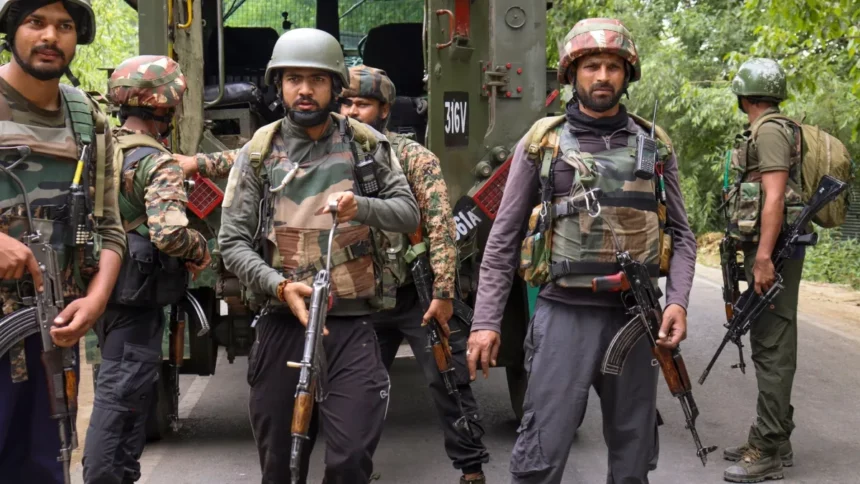
In the restive region of South Kashmir, security forces on Monday launched yet another high-stakes counterterrorism operation, leading to the death of one terrorist and injuries to a Junior Commissioned Officer (JCO) of the Indian Army. The encounter, which broke out in the dense Gudar forest area of Kulgam district, was triggered after troops initiated a cordon and search operation based on specific intelligence regarding the movement of terrorists. The exchange of fire between terrorists and security forces underscored the continuing volatility of the region, where dense forests and mountainous terrain provide both cover and challenge during such prolonged encounters.
Details of the gunfight and security forces’ response
According to police officials, the operation began in the early hours after credible intelligence suggested that militants were taking shelter in the Gudar forest. The cordon laid by the forces prompted the terrorists to open fire, triggering an intense exchange of gunshots. In the ensuing gunfight, one terrorist was eliminated, while an Indian Army JCO sustained injuries. The soldier was immediately evacuated and is undergoing treatment.
The Srinagar-based Chinar Corps, which oversees counter-insurgency operations in Kashmir, confirmed the developments on its official account. In its statement, the Corps said, “Vigilant troops observed suspicious activity and, upon being challenged, terrorists opened fire, prompting a fierce exchange of gunfire during which one terrorist was eliminated and a Junior Commissioned Officer sustained injuries.” The Corps also clarified that the operation remains active as reinforcements continue to tighten the cordon around the forest area, ensuring no terrorist escapes the dragnet.
The operation is being carried out jointly by the Indian Army, the Jammu and Kashmir Police, and the Central Reserve Police Force (CRPF). This synergy among security agencies reflects the high level of coordination developed over years of counter-terrorism efforts in the valley. The use of advanced equipment, ground intelligence, and quick-response teams ensured that the situation was brought under relative control even in challenging forested terrain.
Encounters in forested areas often stretch longer due to poor visibility, thick foliage, and the natural cover that terrorists use to evade capture. Security forces in Kashmir have, over the years, adapted to these conditions by deploying drones, helicopters, and para-commandos in prolonged encounters.
The larger context of anti-terror operations in Kulgam and South Kashmir
Kulgam has increasingly become a focal point for counter-insurgency operations, given its proximity to infiltration routes and its dense, inaccessible terrain. Only last month, in August, the district witnessed one of the longest anti-terror operations in recent memory. That encounter lasted over eight days, with security forces battling terrorists who had entrenched themselves deep within the forests. The drawn-out confrontation highlighted both the persistence of militant groups in the region and the challenges that troops face in flushing them out.
During that operation, senior police and army officers monitored developments closely from the ground and from command centres. Director General of Jammu and Kashmir Police, Nalin Prabhat, personally visited the encounter site to assess the ground situation. Similarly, Lieutenant General Pratik Sharma, the Northern Army Commander, reviewed the counter-insurgency grid and security arrangements across South Kashmir. Such high-level oversight underscores the seriousness with which these operations are handled and the importance placed on precision to minimize casualties among security forces and civilians.
In that earlier Kulgam operation, drones and helicopters were deployed extensively to track the movements of terrorists across the forested terrain. Para commandos, trained in close-quarter battle and jungle warfare, were instrumental in neutralising militants who attempted to use the thick cover to their advantage. Two terrorists were ultimately killed in that prolonged encounter, though the scale of the operation indicated that multiple militants had initially attempted to evade capture.
The dynamics of these encounters also highlight the evolving strategy of militant groups. Unlike the earlier phases of militancy where insurgents often operated in villages or urban centres, recent trends show a shift towards forested areas and mountain hideouts. These terrains not only provide natural camouflage but also complicate operations for the forces, requiring sustained and prolonged efforts to achieve conclusive results.
Despite these challenges, security forces in Kashmir continue to maintain a high level of vigilance. Operations are often intelligence-driven, relying on human sources as well as technological surveillance to pinpoint militant movements. The continued collaboration between the Army, police, and CRPF has helped ensure that encounters, while dangerous, often result in the neutralisation of terrorists with limited collateral damage.
Kulgam’s Gudar forest encounter is thus not an isolated incident but part of a larger pattern of intensified anti-terror activity in South Kashmir. The killing of one terrorist in the current operation and the injury to a JCO serve as reminders of the risks faced by troops on the ground. Yet, they also reflect the determination of Indian security forces to ensure that militancy is contained and the region’s fragile peace is defended against those who seek to destabilise it.
For residents of Kulgam and surrounding areas, such encounters are both a source of anxiety and reassurance. While the sound of gunfire and prolonged cordons disrupt daily life, the sight of coordinated operations provides a measure of confidence that security forces remain committed to protecting the civilian population from militant threats. The ongoing nature of the present operation suggests that the area is still under watch, with the possibility of additional terrorists being present in the forests.
In recent years, the government has emphasised that militant recruitment in South Kashmir has declined due to sustained operations and outreach efforts. However, sporadic encounters such as the one in Kulgam indicate that small groups of militants continue to operate and seek refuge in forests and remote terrain. For the security establishment, each encounter is not just about neutralising individual terrorists but also about sending a broader message of deterrence to militant organisations and their backers across the border.
The Gudar forest operation, therefore, forms part of an ongoing narrative in Jammu and Kashmir, where the resilience of security forces is continually tested by militants seeking to exploit geography and terrain. While the elimination of one terrorist is a tactical success, the injury to a JCO underscores the ever-present risks inherent in such missions. With operations still underway, the coming days will reveal whether more militants are hiding in the dense forest and whether security forces can once again close an operation without further casualties.