India’s medical education has a rich history, evolving from ancient indigenous systems such as Ayurveda, Siddha, and Unani to a structured Western-style curriculum introduced during British colonial rule. The foundation of formal medical education in India was influenced by both the practical needs of the British administration and their mistrust of traditional medicine. While Indian medical practitioners had been serving communities for centuries, the colonial era introduced systematic training, examinations, and institutionalized curricula aimed at producing competent physicians who could meet the demands of the British East India Company. This transformation was not only a reflection of the colonial priorities but also laid the groundwork for the modern MBBS education system in India.
The journey of medical education, beginning with the first MBBS batch in 1839, demonstrates the intersections of culture, colonial policy, and the gradual incorporation of scientific methods into healthcare in India.
British Influence and the Establishment of Medical Colleges in India
In the era of Charaka and Sushruta, India’s healthcare landscape was dominated by indigenous medical systems, including Ayurveda, Siddha, and Unani. These systems emphasized holistic approaches to health, understanding the human body through humoral balances, herbal remedies, and traditional practices. However, the arrival of the British in India in the 18th and 19th centuries introduced new challenges and opportunities in medical education. A pivotal moment came in 1822 when the Medical Board of British Surgeons wrote to the Secretary to the Government of India advocating for a structured system of medical education for Indians. This initiative aimed to create qualified medical personnel who could serve the colonial administration while ensuring public health in India.
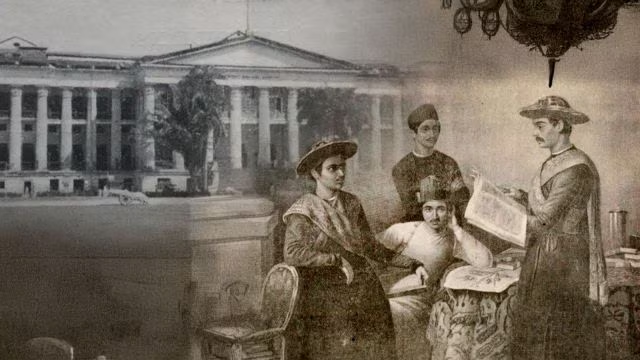
The British emphasis on Western medicine stemmed from both a lack of trust in traditional practices and the growing need for trained personnel in military and civil services. Initially, British doctors were largely engaged in military service due to frequent conflicts, leaving Indian soldiers with limited access to professional medical care. Resistance from high-caste Indian soldiers further complicated matters, as caste-based restrictions often prevented them from accepting treatments prepared by European doctors. To address these challenges, the British began employing Indian medical practitioners within Indian regiments to prepare and distribute medicines under the supervision of British surgeons. This approach laid the foundation for formal medical training for Indians and led to the establishment of India’s first medical college, the Calcutta Medical College, in 1835.
Strategically located in the colonial capital, Calcutta offered the British access to administrative resources, personnel, and infrastructure essential for the implementation of medical education reforms. The early years of Western medicine in India also saw interactions with indigenous practices. Scholars like Pati B. and Harrison M. note that while initial collaboration between Western medicine, Ayurveda, and Unani reflected some shared understanding of humoral imbalances, the growing emphasis on empirical observation and rationalism in Europe gradually positioned Western medicine as superior in the eyes of colonial authorities. Despite this, the coexistence of systems fostered a mutual respect among practitioners, allowing for gradual integration of traditional knowledge with scientific methods.
Structure and Curriculum of Early MBBS Education
The first MBBS courses in India, introduced at Calcutta Medical College, were designed to span three years, shorter than the modern 4.5-year curriculum followed by a year of internship. The initial curriculum focused on foundational subjects such as Anatomy, Physiology, and Pharmacology in the first year, followed by Medicine and Surgery in the second and third years. Practical training formed a critical component of education, with students attending hospitals, dispensaries, eye infirmaries, and vaccination departments for hands-on learning. English was the medium of instruction, reflecting the colonial objective of creating a workforce capable of serving the administrative machinery of the British Empire. The student cohort ranged in age from 14 to 20 years, highlighting the early integration of young scholars into professional training. Access to higher education and medical training was initially limited by caste-based and societal norms. As documented by Patterson T., high-caste Hindus were reluctant to engage with Western medicine due to prohibitions on human dissection.
This barrier was eventually overcome when Pandit Madhusudan Gupta, a Bengali Baidya and Ayurvedic practitioner trained in Western medicine, conducted the first human dissection in India. Gupta’s pioneering work encouraged students from diverse backgrounds to pursue medical education, drawn by the social prestige associated with becoming a doctor and the opportunity to join the Company’s medical services. The first MBBS batch graduated in 1839, and the college’s principal, Dr. M.J. Bramley, recognized the potential for some students to complete their education in England. Dr. S.C.G. Chuckerbutty emerged as one of India’s first medical graduates to join the Indian Medical Service in 1855, earning recognition in the Medical Times and Gazette, London, for his contributions to the advancement of medical science. Despite the lack of initial infrastructure, such as laboratories and libraries, the training program provided students with comprehensive knowledge, culminating in certificates authorizing them to practice both medicine and surgery. These practitioners, often referred to as ‘native doctors,’ were permitted to enter government service with modest salaries, gradually evolving into a professional cadre essential to India’s healthcare system. Over time, the curriculum expanded to incorporate additional subjects such as Midwifery, Physiology, Ophthalmology, and Chemistry.
New examinations and training modules were introduced to accommodate the growing number of hospitals and healthcare facilities. Separate apprenticeship programs for medical subordinates, known as dressers, ensured that lower-tier medical personnel received specialized training. By the mid-19th century, the Royal College of Surgeons recognized medical degrees awarded in India, and the registration of native doctors with the General Medical Council became mandatory after 1858, further institutionalizing professional medical standards. Advancements in Female Medical Education and Pioneers While male medical education flourished under British influence, women faced significant barriers to entry. The North India Medical School for Women, founded in 1894 in Ludhiana by Dr. Edith Mary Brown, became Asia’s first institution dedicated exclusively to female medical education. Starting with just four students, it evolved into the Women’s Christian Medical College and eventually the Christian Medical College (CMC) Ludhiana, setting a precedent for women’s participation in medicine.
Female pioneers such as Dr. Anandibai Joshi and Dr. Kadambini Ganguly played pivotal roles in advancing women’s medical education in India. Kadambini Ganguly, born in 1862 in Bihar, came from a supportive family that valued education. Completing her BA from Bethune College in 1882 alongside Chandramukhi Bose, she became one of the first female graduates in Bengal. Ganguly pursued her medical degree at Calcutta Medical College, graduating in 1886, and went on to serve as a trailblazer in Indian medicine. Anandibai Joshi, meanwhile, completed her medical education at the Women’s Medical College of Pennsylvania, breaking international barriers for Indian women in medicine. Their achievements not only challenged societal norms but also inspired generations of women to enter the medical profession.
The integration of women into medical education highlighted both the progressive aspirations of the colonial educational framework and the resilience of Indian pioneers. Women’s participation in medical training ensured that healthcare services could be more inclusive, addressing gender-specific medical needs and expanding the workforce in a rapidly developing healthcare system. Expansion and Standardization of Medical Education Across India Following the success of Calcutta Medical College, additional institutions were established in Bombay and Madras, with degrees recognized by the Royal College of Surgeons. These developments laid the foundation for a standardized system of medical education in India. As hospitals and healthcare facilities proliferated, the structure of examinations and the content of courses evolved to accommodate practical requirements and emerging medical knowledge. The British emphasis on formal education, certification, and regulated clinical practice helped establish medical professionalism and ensured consistent standards of care. Short-term courses were introduced to train subordinate medical personnel and apprentices, ensuring a steady supply of trained practitioners for government services. These courses supplemented formal medical education, providing specialized skills in pharmacy, nursing, and clinical assistance.
The diversification of training programs helped create a multi-tiered healthcare workforce capable of meeting the growing demands of urban and rural populations. By the late 19th and early 20th centuries, India’s medical education system had transformed significantly from its colonial beginnings. Standardized curricula, rigorous examinations, and practical training modules ensured the production of competent medical professionals. Registration with professional councils, including the General Medical Council, reinforced accountability and ensured that practitioners met internationally recognized standards. These reforms collectively contributed to the establishment of India’s modern MBBS education system, which continues to evolve and expand in the 21st century.
The trajectory of medical education in India reflects the interplay between indigenous knowledge systems, colonial priorities, and global medical advancements. From the early integration of Western medicine with Ayurveda and Unani to the establishment of medical colleges and structured curricula, India’s journey demonstrates resilience, adaptation, and innovation. By nurturing both male and female pioneers, incorporating practical training, and emphasizing ethical and professional standards, India developed a healthcare education system that laid the groundwork for contemporary medical practice. Through the vision of colonial administrators, pioneering Indian educators, and trailblazing students, medical education in India evolved from an informal, traditional framework into a structured, standardized system that continues to produce skilled physicians and healthcare professionals to this day. The lessons from this historical evolution underscore the importance of adaptability, inclusivity, and scientific rigor in sustaining a robust medical education infrastructure.