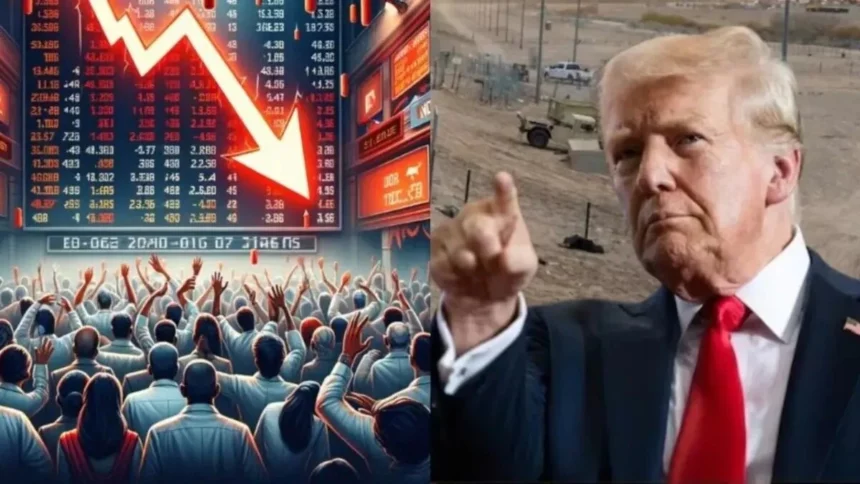
Indian stock markets witnessed a sharp early-morning downturn on Wednesday as investors reacted nervously to the United States’ sudden decision to impose a steep 25% tariff on goods imported from India starting August 1. The announcement, made by President Donald Trump, not only rattled investors but also risked derailing months of bilateral trade negotiations between New Delhi and Washington. As of 9:17 a.m. IST, the BSE Sensex plunged 0.71% to 80,888.01, while the Nifty 50 dropped 0.66% to 24,699.1. The market-wide impact was immediate and intense, with all 16 major sectoral indices slipping into the red and small-cap and mid-cap stocks falling around 1.25% each.
Markets Respond Sharply to Tariff Shock
The scale and timing of the US tariff announcement caught market participants off guard. While concerns over global trade tensions have lingered for months, the specificity of targeting India with a significantly higher import duty came as a surprise. Traders and institutional investors rushed to offload positions across the board, particularly in sectors highly exposed to exports.
Textile stocks were among the biggest casualties in early trade, reflecting investor fears that the 25% import duty could price Indian garments and fabrics out of the competitive US retail market. Pharmaceutical exporters also took a hit, with major players like Sun Pharma and Dr. Reddy’s Laboratories seeing a decline, given that the US remains one of the largest markets for Indian generic drugs.
Meanwhile, automotive component manufacturers—who depend heavily on US-based clients—registered losses as well. Analysts warned that a prolonged tariff regime could lead to a demand slump from American original equipment manufacturers (OEMs), adversely affecting India’s robust auto parts export industry.
The broader implications extended beyond individual sectors. The general market sentiment turned distinctly risk-averse, as the prospect of a deepening trade conflict between India and the US loomed large. Foreign institutional investors (FIIs), who have been net buyers in recent weeks, paused their equity accumulation, leading to a liquidity drag that further exacerbated the sell-off.
Trade Relations at a Crossroads
While President Donald Trump emphasized in his post-announcement remarks that negotiations with India were still ongoing, the decision to unilaterally impose punitive tariffs sent mixed signals about the future of the relationship. Washington has repeatedly voiced concerns over India’s trade practices and market access barriers, but Indian officials have maintained that ongoing discussions were progressing constructively.
The abruptness of the tariff rollout raised questions about the stability of diplomatic engagements. With elections approaching in both countries in the coming year, trade is increasingly becoming a politically sensitive issue. Donald Trump’s administration appears keen to demonstrate a tough stance on trade imbalances, while the Indian government may find itself under pressure to retaliate, especially in the face of domestic political criticism.
India’s commerce ministry has yet to issue an official statement in response, but senior officials have reportedly convened an emergency meeting to assess the economic and political fallout. According to trade experts, if New Delhi chooses to impose reciprocal tariffs or approach the World Trade Organization (WTO), it could escalate into a more protracted standoff.
From a policy standpoint, the sudden strain may push India to accelerate diversification of its export markets and reduce dependency on the US. Several trade bodies have already begun urging the government to provide fiscal support to impacted industries, including incentives and policy relief to mitigate short-term damage.
On the corporate front, companies heavily dependent on the US market are now revisiting their guidance for the current quarter. Many are expected to revise downward their revenue forecasts, and management commentary in upcoming earnings calls will likely reflect heightened caution.
Despite the morning plunge, some market analysts suggested that investor sentiment could stabilize in the coming days, provided there is clarity from both governments on the path forward. In the meantime, however, volatility is expected to remain elevated.
The Indian stock markets, which have remained resilient over the past few quarters despite global uncertainties, now face a stern test of endurance. Investors, policymakers, and exporters alike are watching closely to see whether this latest flashpoint in India-US trade relations is an isolated disruption or a harbinger of more structural tensions to come.