Amid escalating tensions between India and Pakistan following Operation Sindoor, Pakistan launched a Fatah-II ballistic missile, which India intercepted over Sirsa, Haryana. The missile was reportedly aimed at Delhi, and this incident has once again brought the spotlight on the missile capabilities of both nations.
What Are Ballistic Missiles?
Ballistic missiles are powered by rockets that follow a ballistic flight path after being launched. They are capable of carrying both conventional and nuclear warheads, and their trajectory is guided by gravity once they reach the highest point of their flight. They travel faster and farther than artillery rockets, and their target impact is significantly higher due to the force of gravity. Ballistic missiles are categorized based on their range, including short-range, medium-range, intermediate-range, and long-range missiles.
• Short-range ballistic missiles: These missiles travel less than 1,000 km.
• Medium-range ballistic missiles: These missiles travel between 1,000 and 3,000 km.
• Intermediate-range ballistic missiles: These missiles travel between 3,000 and 5,500 km.
• Long-range ballistic missiles: These missiles can travel over 5,500 km and are often classified as intercontinental ballistic missiles (ICBMs).
The Fatah-II Missile:
The Fatah-II is one of Pakistan’s most advanced missiles, developed as an improvement over the Fatah-I missile. It has a range of up to 400 km and is designed to hit military positions and radar installations with high precision. Equipped with sophisticated avionics, the missile employs a combination of inertial and satellite navigation systems, ensuring accurate targeting.
Pakistan claims that the Fatah-II missile can bypass missile defense systems, such as India’s S-400 air defense system. This missile serves as a key part of Pakistan’s deterrence strategy against India, providing it with a credible option for striking vital targets.
How Ballistic Missiles Like Fatah-II Work:
Ballistic missiles are launched from various platforms, including silos, mobile land-based launchers, aircraft, ships, and submarines. They go through three flight stages:
1. Boost phase: This is the initial stage of flight, lasting between three to five minutes, during which the rocket engine fires to propel the missile into space.
2. Midcourse phase: The missile ascends to the highest point of its trajectory, after which it descends toward its target. This phase is the longest, lasting up to 20 minutes for ICBMs.
3. Terminal phase: The warhead re-enters the atmosphere and travels at speeds greater than 3,200 km/h, hitting the target with deadly accuracy.
India’s Ballistic Missile Arsenal:
India has developed a wide array of ballistic missiles in its arsenal to counter regional threats, particularly from Pakistan and China. Some of India’s key ballistic missiles include:
1. Prithvi I and Prithvi II: Short-range ballistic missiles with ranges of 150 km and 350 km, respectively.
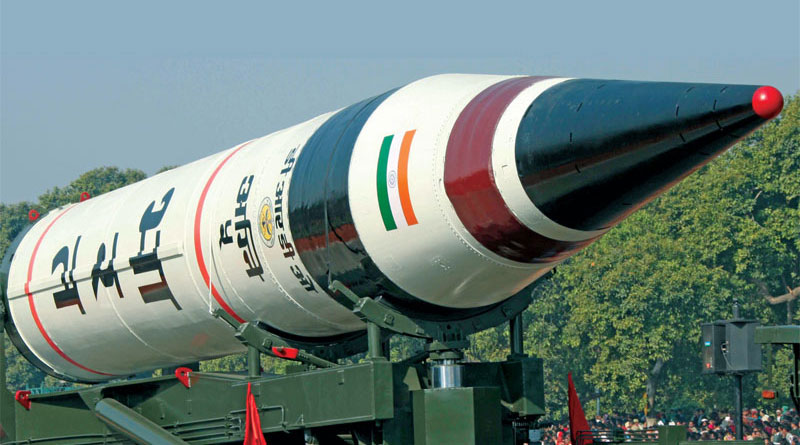
2. Agni Series: A series of medium to long-range missiles, including Agni I, Agni II, Agni III, and Agni V. The Agni V is an intercontinental ballistic missile (ICBM) with a range of over 5,000 km, making it capable of reaching targets deep inside enemy territory.
3. Nirbhay: India’s first indigenously developed long-range cruise missile with a range of 1,000 km. It can carry both conventional and nuclear warheads.
4. BrahMos: A supersonic cruise missile capable of being launched from land, air, or sea platforms, with a range of 300-500 km. It is known for its high speed and precision.
5. Pralay: A short-range ballistic missile with a range of 500 km, designed for quick strikes against enemy bases.
How India’s Missile Systems Compare to Pakistan’s:
While both India and Pakistan have sophisticated missile systems, India’s missile capabilities are generally considered more advanced. India’s Agni series of ICBMs, BrahMos supersonic missiles, and other advanced systems like Nirbhay give it a technological edge over Pakistan. India’s focus has been on developing a robust nuclear triad, which includes land-based, air-launched, and sea-based missile systems.
Pakistan’s missile arsenal, while formidable, is considered to lag behind India in terms of range and sophistication. Pakistan’s Shaheen III missile, with a range of 2,750 km, is one of its longest-range missiles, but India’s Agni V missile can reach targets over 5,000 km away, providing India with a clear strategic advantage. Pakistan’s missile defense system is also not as advanced as India’s S-400, which can intercept various incoming missile threats.
India’s Cruise Missiles vs. Pakistan’s Ballistic Missiles:
India’s cruise missiles, like the BrahMos, differ from Pakistan’s ballistic missiles in terms of their flight paths and capabilities. Cruise missiles are guided missiles that are powered by jet engines and follow a set flight path, whereas ballistic missiles follow a high arc, and their descent is governed by gravity. India’s BrahMos is known for its speed and precision, and it has been successfully deployed on land, air, and sea platforms. In contrast, Pakistan’s cruise missile capabilities, such as the Babur missile, have a shorter range and are less advanced than India’s BrahMos.
The missile capabilities of both India and Pakistan serve as a significant deterrent in the region. While Pakistan’s missile systems, like the Fatah-II, Shaheen, and Ghauri, are formidable, India’s advanced missile systems, including the Agni and BrahMos series, provide it with a strategic edge. The development of both nations’ missile arsenals reflects their ongoing arms race, with each country aiming to maintain a credible deterrence against the other. As tensions continue to rise, the role of these missile systems becomes even more critical in the evolving security dynamics of the region.