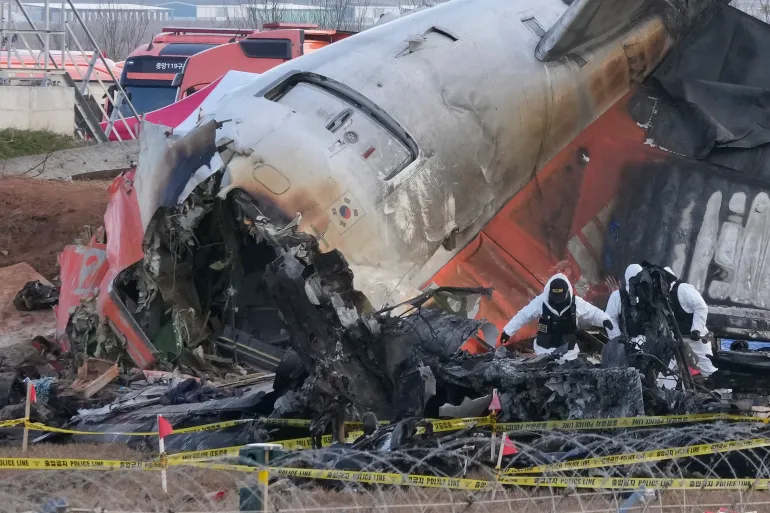
South Korean police have raided Muan International Airport, the offices of Jeju Air, and a regional aviation body as part of an investigation into the country’s deadliest air disaster. The Jeonnam Provincial Police Agency conducted the search and seizure operation on Thursday morning, intensifying scrutiny following the crash of Jeju Air Flight 2216 on Sunday, which claimed 179 lives out of 181 passengers and crew onboard.
The crash, involving a Boeing 737-800, occurred when the aircraft belly-landed on the runway without its landing gear deployed. Shortly after reporting a bird strike to air traffic control, the plane skidded into a hardened concrete embankment less than 300 meters (328 yards) from the runway’s end and exploded into flames. The disaster has been described as South Korea’s deadliest aviation accident since a Korean Air Boeing 747 crashed in Guam in 1997, killing 228 people.
South Korean authorities are working closely with international aviation experts, including officials from the United States, to determine the cause of the crash. Initial data has been retrieved from one of the plane’s two black boxes, while the other, damaged in the incident, is being sent to the United States for further analysis.
South Korean officials have launched inspections of all Boeing 737-800 aircraft currently in operation across the country and initiated a broader probe into the nation’s airline operations. Acting President Choi Sang-mok has called for urgent action should the inspections reveal safety concerns with the aircraft model. “As there’s great public concern about the same aircraft model involved in the accident, the transport ministry and relevant organizations must conduct a thorough inspection of operation maintenance, education, and training,” Choi stated on Thursday.
Aviation experts have proposed several potential causes for the crash, including a bird strike, mechanical failure, and the proximity of the hardened embankment to the runway. The sequence of events and contributing factors are being rigorously examined to prevent future disasters.
The tragedy has prompted both national and international responses, with safety experts urging enhanced protocols and stricter operational standards for airlines operating in the region. As investigations continue, the disaster serves as a somber reminder of the critical importance of aviation safety and rigorous oversight in ensuring passenger security.