As tensions between India and Pakistan continue to escalate, especially after India’s Operation Sindoor, which targeted terror camps in Pakistan and Pakistan-occupied Kashmir, the conversation around the two countries’ nuclear arsenals has once again come into focus. Both nations have developed nuclear capabilities over the years, and their strategic nuclear postures play a crucial role in shaping the military dynamics between them.
India’s Nuclear Doctrine vs Pakistan’s Approach
India adheres to a No First Use (NFU) policy, which means that it will not be the first to use nuclear weapons in a conflict. However, if attacked with nuclear weapons, India has pledged to retaliate with a massive and punitive strike. This policy emphasizes credible minimum deterrence, which ensures that India maintains enough nuclear weapons to deter any adversary but refrains from overbuilding its arsenal. Civilian control over the nuclear command structure is maintained under India’s Nuclear Command Authority.
On the other hand, Pakistan has opted for a Full Spectrum Deterrence doctrine, which means it reserves the right to use nuclear weapons at any stage of conflict, including against conventional military threats. Pakistan does not follow an NFU policy and has developed the capability to use tactical nuclear weapons. Its strategy aims to counter India’s conventional superiority, particularly addressing India’s rapid mobilization strategies such as the Cold Start doctrine. Like India, Pakistan’s nuclear command also operates under civilian oversight through its National Command Authority.
Nuclear Warheads: The Comparison
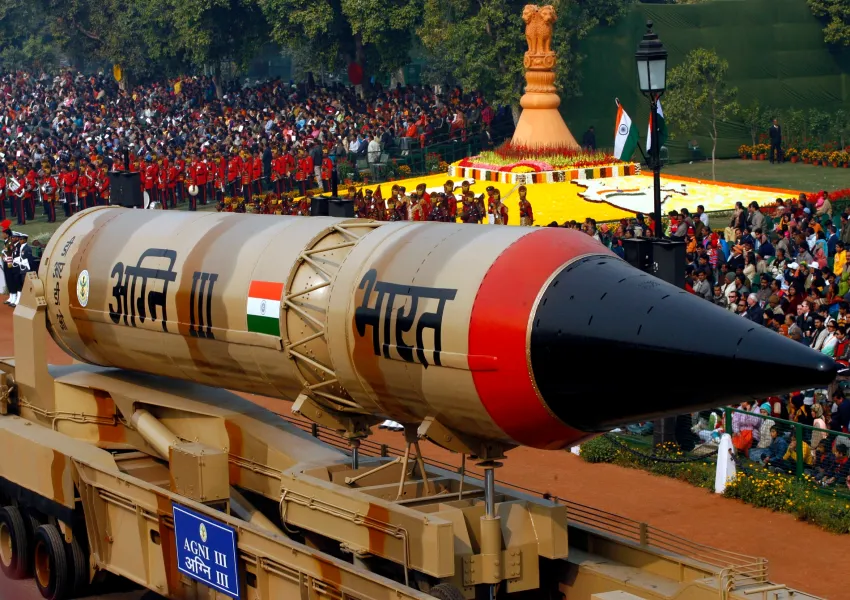
• India: As of 2025, India is estimated to have around 180 nuclear warheads. India has developed a nuclear triad, which means it can launch nuclear weapons from land-based missiles, aircraft, and submarines. The land-based missiles include the Agni series, which can carry nuclear payloads across long ranges. India’s Agni V intercontinental ballistic missile (ICBM) is capable of reaching targets over 5,000 kilometers away, giving it a strategic edge over Pakistan.
• Pakistan: Pakistan is reported to have around 170 nuclear warheads in its arsenal. While it has a significant stockpile of land-based missiles, including the Shaheen and Ghauri series, it has not yet fully developed a nuclear triad. Pakistan’s missile systems are capable of carrying both nuclear and conventional payloads over various distances. However, Pakistan’s focus on tactical nuclear weapons is a response to India’s conventional military strength, especially in terms of its ability to launch rapid offensive operations.
India’s Nuclear Evolution
India’s journey to becoming a nuclear power began after China’s nuclear test in 1964, which raised security concerns in New Delhi. India’s first nuclear test was conducted in Pokhran on May 18, 1974, code-named Smiling Buddha. This test, although labeled as a peaceful nuclear explosion, marked India’s entry into the nuclear club.
India conducted its first series of underground nuclear tests in 1998 under Operation Shakti, which demonstrated its capability for thermonuclear explosions. Since then, India has maintained its No First Use policy, emphasizing its commitment to peace while ensuring sufficient deterrence against any nuclear threat.
Pakistan’s Nuclear Journey
Pakistan’s nuclear ambitions were sparked by India’s first nuclear test in 1974. Under the leadership of Prime Minister Zulfikar Ali Bhutto, Pakistan accelerated its nuclear program, seeking to maintain strategic parity with India. The country’s covert nuclear program gained momentum with the help of scientists like Dr. Abdul Qadeer Khan, who played a pivotal role in bringing uranium enrichment technology to Pakistan.
On May 28, 1998, in response to India’s Pokhran-II tests, Pakistan conducted its own nuclear tests in the Chagai Hills of Balochistan, officially declaring itself as the world’s seventh nuclear power. Pakistan’s nuclear doctrine focused on credible deterrence, with an emphasis on maintaining a second-strike capability.
Missile Capabilities: India vs Pakistan
India’s missile systems are more advanced than Pakistan’s, especially in terms of long-range nuclear-capable missiles. India’s BrahMos and Agni V missiles are capable of carrying out precision strikes over long distances, and its BrahMos cruise missile is regarded as one of the world’s fastest. India also boasts air-launched Scalp missiles and Astra air-to-air missiles, giving it superior strategic flexibility.
Pakistan, while having a significant arsenal of missiles, has not yet achieved the same level of technological sophistication. Its Shaheen III and Ghauri missiles have a shorter range compared to India’s Agni series, but they still pose a threat in the region. Pakistan has also developed Fatah-II and Nasr missiles, designed for tactical battlefield use.
Nuclear-Related Diplomatic Efforts
Over the years, despite the adversarial relationship between India and Pakistan, both countries have engaged in several diplomatic efforts aimed at preventing nuclear conflict.
• Non-Nuclear Aggression Agreement (1988): Both countries agreed not to attack each other’s nuclear facilities and exchange lists of such installations annually.
• Lahore Declaration (1999): This agreement aimed to reduce the risk of accidental or unauthorized use of nuclear weapons and to promote mutual understanding of each other’s security concerns.
Despite these agreements, recent tensions, especially the ongoing conflict following India’s Operation Sindoor, have raised the stakes and put both nations on high alert regarding the use of their nuclear arsenals.
Both India and Pakistan have developed significant nuclear arsenals, but India’s missiles are generally considered more advanced and capable of striking targets at longer distances. India’s strategic nuclear posture, focused on No First Use and credible minimum deterrence, contrasts sharply with Pakistan’s approach of Full Spectrum Deterrence, which includes the potential use of tactical nuclear weapons.
As both nations continue to build their nuclear and missile capabilities, the risk of escalation remains high. The ongoing standoff and the potential for further military action underscore the delicate balance of nuclear deterrence in the region. Both India and Pakistan must tread carefully to avoid a catastrophic conflict while maintaining their respective nuclear postures.