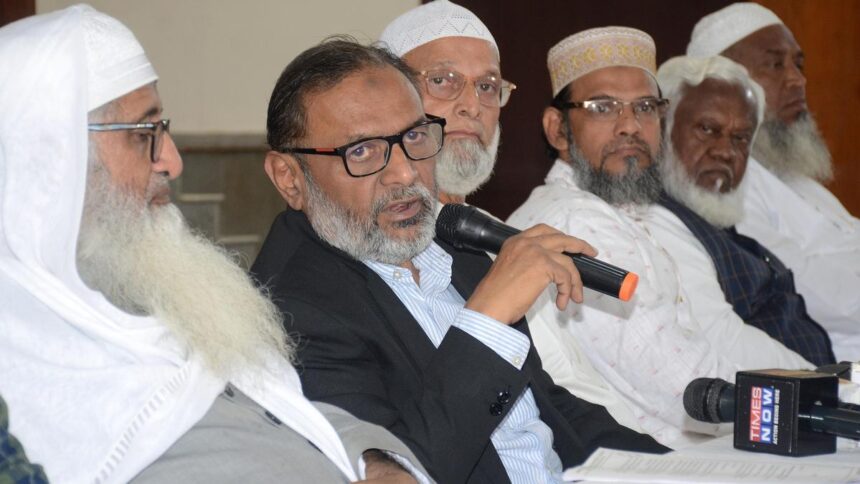
The Union Ministry of Home Affairs’ recent directive mandating that all six stanzas of Vande Mataram be sung first whenever the National Song and National Anthem are played at any official or public event has sparked widespread criticism from prominent Muslim organizations in India. Jamiat Ulama-i-Hind and the All India Muslim Personal Law Board (AIMPLB) have voiced strong opposition to the order, terming it “unilateral, unconstitutional, and a violation of secular principles.” Both organizations emphasized that the directive impinges upon the constitutional guarantee of freedom of religion and the fundamental rights of individuals, highlighting that certain verses of Vande Mataram ascribe divinity to the motherland, which conflicts with monotheistic beliefs central to Islam. Leaders from these bodies have stated that the order, if enforced, constitutes a serious infringement upon Article 25 of the Constitution and contradicts various Supreme Court rulings safeguarding religious freedom.
Religious Freedom and Constitutional Concerns Raised by Muslim Organizations
Jamiat Ulama-i-Hind, one of India’s most prominent Islamic organizations, expressed deep concern over the Home Ministry’s directive. Maulana Arshad Madani, the organization’s president, stated unequivocally that Muslims do not object to anyone singing or playing Vande Mataram. However, he stressed that several stanzas of the song contain imagery and references that portray the nation as a divine entity, which directly contradicts the core monotheistic principle that a Muslim worships only one Allah. According to Maulana Madani, compelling Muslims to sing or recite these stanzas under the pretext of national protocol constitutes a clear violation of constitutional protections regarding religious freedom. He emphasized that such enforcement disregards the plurality of India’s society, undermines secularism, and ignores judicial interpretations that protect the right of individuals to abstain from practices contrary to their faith.
The AIMPLB echoed these concerns in a detailed statement released on Thursday. General Secretary Maulana Mohammed Fazlur Rahim Mujaddidi described the government’s directive as “unconstitutional and completely unacceptable to Muslims.” He stressed that forcing adherents of one religion to follow practices rooted in another religion’s belief system directly undermines the secular foundations of India’s governance. Maulana Mujaddidi highlighted that the directive conflicts with Supreme Court judgments that have repeatedly upheld the right of religious minorities to practice their faith without coercion or imposition from the state. Both organizations emphasized that the policy, coming at a politically sensitive moment ahead of state elections, appears to be driven by considerations that prioritize political expediency over constitutional and social principles.
Political and Social Implications of the Vande Mataram Directive
The controversy surrounding the Vande Mataram directive has ignited debates across political and social spheres. Critics argue that mandating the song in full at all events places undue pressure on religious minorities, effectively marginalizing communities whose beliefs do not align with the imagery embedded in the lyrics. The directive has been perceived as an attempt to enforce cultural conformity, which not only undermines India’s pluralistic ethos but risks heightening tensions between different religious communities. Leaders of the Muslim organizations have emphasized that secular governance must refrain from imposing religious symbols or rituals on groups with differing beliefs. They argue that policies of this nature, particularly when introduced before elections, can be interpreted as politically motivated, further eroding trust in the impartiality of state institutions.
From a constitutional perspective, Article 25 guarantees all citizens the freedom to practice, profess, and propagate religion. Legal experts note that previous Supreme Court rulings have underscored the protection of individual conscience and the prohibition of compulsion in religious matters, including expressions of faith and participation in religiously-influenced cultural practices. By this measure, mandating that all six stanzas of Vande Mataram be sung at events may be viewed as overstepping the boundaries of legislative and administrative authority, imposing practices on individuals that directly conflict with their personal religious convictions. The government’s directive, while framed as a measure to promote patriotism and national cohesion, risks violating these well-established constitutional safeguards.
Both Jamiat Ulama-i-Hind and AIMPLB have underscored that their objection is not a rejection of patriotism or national symbols but a defense of religious freedom and constitutional rights. Maulana Madani noted that Muslims have historically respected national sentiments and contributed to the country’s progress without compromising their faith. The controversy, therefore, revolves not around the celebration of the nation but around the methods through which the state seeks to define and enforce expressions of nationalism. Leaders have warned that coercive measures in cultural or religious expression could set a dangerous precedent, potentially alienating minority communities and undermining the principles of inclusion and pluralism enshrined in the Constitution.
The political context of this directive has added further complexity to the issue. The rollout of the Vande Mataram order coincides with heightened political activity in regions with substantial Muslim populations, where electoral outcomes may influence policy priorities. Critics argue that linking patriotic expressions to political considerations risks eroding the secular character of governance. Maulana Mujaddidi emphasized that the directive, being implemented unilaterally without consultation with minority communities, signals disregard for India’s democratic and consultative traditions. By enforcing a practice that conflicts with the beliefs of a significant section of citizens, the policy threatens to deepen societal divisions at a time when national unity requires dialogue and respect for diversity.
Beyond immediate political concerns, scholars and civil society observers have weighed in on the broader cultural implications. Mandating a song with religious undertones can inadvertently create a hierarchy of acceptable national expressions, implicitly privileging certain cultural or religious narratives over others. Such a hierarchy risks marginalizing minority identities and fostering perceptions that loyalty to the nation is conditional upon adherence to specific religiously-infused cultural practices. Leaders of the Muslim organizations have maintained that true patriotism can coexist with religious diversity, and that forced conformity undermines both democratic principles and the inclusive spirit of the nation.
In response to the directive, Jamiat Ulama-i-Hind has called for open dialogue between the government and minority representatives to ensure that policies intended to promote national symbols do not infringe upon fundamental rights. Similarly, AIMPLB has urged the administration to consider the secular and pluralistic nature of India before implementing directives that compel participation in practices incompatible with the beliefs of certain communities. Both organizations maintain that respect for diversity is essential for sustaining social harmony and trust between the state and its citizens.
The controversy has also sparked wider public debate on social media, with legal experts, activists, and commentators highlighting the tension between cultural nationalism and constitutional freedoms. Many observers note that while national symbols like the National Song and Anthem are important for fostering a sense of collective identity, their implementation must be sensitive to the religious and cultural diversity of the nation. Imposing uniformity in expressions of patriotism through mandatory singing of Vande Mataram could generate resentment and reinforce societal divisions, contrary to the inclusive vision envisioned by India’s founders.
Moreover, this directive raises questions about the role of central authorities in balancing symbolic nationalism with constitutional safeguards. Analysts argue that policy measures designed to promote national unity should prioritize voluntary participation and inclusivity rather than coercion. The strong objections from Jamiat Ulama-i-Hind and AIMPLB demonstrate that policies perceived as encroaching upon religious freedom are likely to face sustained legal and social scrutiny. Experts emphasize that adherence to secular principles and constitutional protections is critical for maintaining legitimacy and trust in state policies, particularly those relating to national symbols and cultural practices.
As debates continue, leaders from Muslim organizations have reiterated their willingness to engage in constructive dialogue to address concerns while upholding their faith. They stress that patriotism and religious freedom are not mutually exclusive, and that the government can promote national pride without compelling citizens to compromise their beliefs. The current dispute highlights the delicate balance between cultural expression, political imperatives, and constitutional rights, illustrating the challenges inherent in policymaking within a diverse and pluralistic society.
The directive mandating the singing of all stanzas of Vande Mataram has become a flashpoint for discussions about constitutional freedoms, secular governance, and the proper ways to cultivate national identity. Prominent Muslim organizations, including Jamiat Ulama-i-Hind and AIMPLB, have raised constitutional objections, emphasizing that coercion in religious or cultural expression is incompatible with India’s democratic and secular principles. While the government maintains that the directive seeks to promote national symbols, its implementation has sparked concerns about minority rights, inclusivity, and the balance between patriotism and religious freedom. The ongoing discourse underscores the need for careful policymaking that respects diversity while fostering a shared sense of national identity.