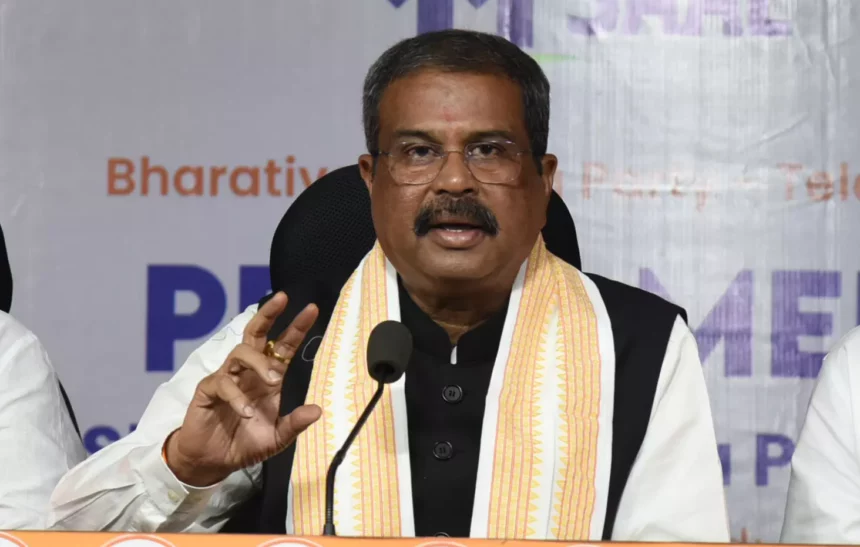
Union Education Minister Dharmendra Pradhan will appear as the guest on Express Adda, discussing India’s education reforms and the National Education Policy 2020, which has become a cornerstone of the NDA Government’s strategy to modernize the country’s education system in line with rapid technological and global shifts. As India adapts to a world transformed by technology and globalization, Pradhan’s tenure has seen significant policy interventions aimed at reshaping both school and higher education, while balancing accessibility, quality, and innovation. He will speak with Vandita Mishra, National Opinion Editor at The Indian Express, offering insights into ongoing and upcoming reforms, challenges faced by the system, and the government’s vision for India’s learning ecosystem. This conversation comes at a time when multiple policy reforms, from textbook overhauls to regulatory restructuring, are actively influencing the education sector, reflecting a blend of political experience, administrative guidance, and educational foresight.
NEP 2020 And Policy Reforms Transforming India’s Education System
Under the guidance of the National Education Policy 2020, India’s education system is undergoing substantial reforms designed to modernize curricula, reduce student stress, and create an ecosystem aligned with 21st-century skills. The NEP 2020 emphasizes flexibility in learning, interdisciplinary approaches, and the integration of technology into classrooms across urban and rural India. Union Minister Dharmendra Pradhan, who has overseen the implementation of these reforms, has focused on revising school textbooks to make them more student-friendly, reducing rote learning, and introducing competency-based assessments aimed at reducing board exam pressure. These measures seek to prepare students not only academically but also in practical, creative, and cognitive skills that will allow them to thrive in a globalized economy.
Beyond curricular changes, Pradhan has pushed for institutional restructuring and regulatory modernization. Proposed legislation seeks to merge key regulatory bodies such as the University Grants Commission and the All India Council for Technical Education, aiming for a unified framework that ensures quality assurance and streamlined oversight in higher education. This restructuring is expected to create a more agile and accountable system while providing universities and colleges with the autonomy to innovate. While the policy has faced contestation in some states like Karnataka and Tamil Nadu, where Opposition governments have charted independent education strategies, the central government’s emphasis remains on uniform standards, equitable access, and harmonization with international best practices.
During his tenure, Pradhan has also prioritized vocational training, skill development, and entrepreneurship education, linking academic learning with employable skills. Efforts to introduce technology-enabled learning platforms, digital classrooms, and AI-assisted learning solutions reflect the broader ambition of making education adaptive, scalable, and accessible to diverse socio-economic groups. Under his leadership, initiatives have been designed to ensure students gain practical exposure, critical thinking abilities, and problem-solving skills, preparing them for evolving global job markets and research opportunities.
Political Experience And Influence On Education And Governance
Dharmendra Pradhan’s role in education policy is complemented by his extensive political and administrative experience. Representing Sambalpur in Odisha, he first became Education Minister in 2021 and returned for a second term in 2024 in the NDA government’s third term. Beyond education, he has served as Minister of Petroleum and Natural Gas, Minister for Skill Development and Entrepreneurship, and Minister of Steel, bringing a multi-sectoral perspective to governance. His political career began with the Akhil Bharatiya Vidyarthi Parishad and Bharatiya Janata Yuva Morcha, organizations that laid the foundation for his long-term engagement with youth and policy leadership.
Pradhan’s strategic involvement extends to party organization and election management, contributing to BJP victories in states such as Bihar, Haryana, and Odisha. His administrative acumen has allowed him to navigate complex policy landscapes, integrating political objectives with systemic reforms, and ensuring alignment between central policies and state-level educational priorities. This ability to balance political leadership with policy innovation underlines his approach to driving systemic changes in education while maintaining stakeholder engagement.
In addition to shaping domestic education policies, Pradhan’s participation in forums like Express Adda allows for an open discourse with media, industry leaders, and the public, enhancing transparency and promoting awareness about the government’s educational vision. Previous guests of the Express Adda series include high-profile figures from politics, industry, philanthropy, and social leadership, reflecting the platform’s role in engaging decision-makers and changemakers in India’s development narrative. By sharing his experiences, Pradhan provides insight into the formulation and implementation of national policies, the interplay between education and governance, and the mechanisms by which reforms impact millions of students, educators, and institutions across India.
His tenure reflects a combination of inherited political insight—being the son of veteran BJP leader Debendra Pradhan—and hands-on experience in legislative, executive, and administrative roles. Elected to the Lok Sabha in 2004 and serving in the Rajya Sabha until his return to the Lok Sabha in 2024, Pradhan has witnessed multiple phases of India’s education, industrial, and policy evolution. This background informs his current leadership in implementing NEP reforms and navigating the challenges of balancing modernization with inclusivity, equity, and regional considerations.
The National Education Policy 2020 under his stewardship seeks to create a seamless integration between school and higher education, emphasizing skill acquisition, digital literacy, and flexible career pathways. Pradhan’s efforts include developing mechanisms for reducing bureaucratic barriers, supporting teacher training programs, and ensuring equitable distribution of resources, particularly in underrepresented regions. The focus on competency-based education, AI-driven learning platforms, and interdisciplinary curricula reflects a forward-looking approach that prioritizes student-centered learning and prepares India’s youth for emerging sectors and global competition.
Express Adda’s informal yet influential format allows leaders like Pradhan to discuss policy nuances, provide context on reform implementation, and engage with public queries about education policy. Through this dialogue, Pradhan is able to communicate the rationale behind reforms, address misconceptions, and encourage a culture of participatory engagement in shaping India’s educational future. His presence at the event reinforces the government’s commitment to transparency, continuous improvement, and alignment with both domestic priorities and global standards.
Moreover, Pradhan’s vision integrates technology, skill development, and regional education strategies to create an ecosystem capable of fostering innovation, research, and entrepreneurship. Initiatives aimed at reducing rote learning, introducing project-based education, and connecting schools with industry stakeholders are designed to enhance the practical relevance of education. Collaboration with private and international educational institutions, the introduction of digital classrooms, and the deployment of AI tools for personalized learning demonstrate the emphasis on modernizing pedagogy and improving learning outcomes for students across India.
His efforts also reflect an understanding of the intersection between education and employment, particularly in sectors requiring specialized skills. By aligning NEP reforms with vocational and technical education, Pradhan ensures that students not only gain academic knowledge but also develop competencies critical for employability, entrepreneurship, and leadership. The policy aims to empower educators, improve institutional governance, and provide students with access to a broader spectrum of learning opportunities, while remaining sensitive to social, cultural, and economic diversity across India.
Through his engagement in education reforms, political leadership, and governance, Dharmendra Pradhan has positioned himself as a key architect of India’s evolving education landscape. His initiatives under NEP 2020 seek to modernize teaching, enhance accessibility, foster innovation, and promote skill development, while also building public confidence and institutional accountability. By emphasizing transparency, collaboration, and strategic vision, Pradhan contributes to shaping India’s education system into a globally competitive and inclusive framework capable of addressing contemporary challenges and preparing students for future opportunities.