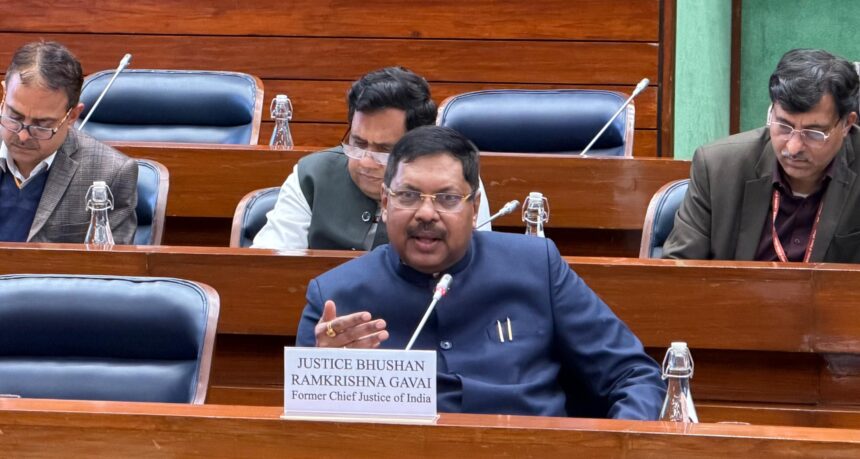
The Joint Committee of Parliament examining the One Nation, One Election Bills has received assurances from former Chief Justice of India B R Gavai that the proposed legislation does not violate the Constitution’s basic structure, federal principles, or democratic framework. During a detailed session on Thursday, Justice Gavai, who is the sixth former CJI to appear before the parliamentary panel, clarified that the Bills fall well within the legislative competence of Parliament under Article 368 and are aimed at synchronizing electoral cycles without undermining state autonomy. The hearing provided an in-depth discussion on the constitutional and legal dimensions of the Bills, following similar consultations with five other former Chief Justices, reflecting the government’s efforts to ensure a careful, legally robust approach to the simultaneous election proposal. The committee’s engagement with senior judicial figures underscores the importance of harmonizing parliamentary intent with constitutional safeguards while addressing logistical and governance challenges associated with staggered elections in India.
Constitutionality and Parliamentary Competence of the One Nation, One Election Bills
Justice Gavai elaborated on the constitutional framework within which the One Nation, One Election Bills are situated, emphasizing that Parliament has explicit authority to amend the Constitution under Article 368. He explained that the Bills do not diminish the powers of the states nor interfere with federal principles, but rather restructure the timing and conduct of elections to bring coherence to the electoral calendar. The former CJI noted that aligning state and national election cycles could reduce administrative burden, lower public expenditure on repeated polls, and provide a more efficient governance framework, all while remaining compliant with constitutional norms. He highlighted that previous amendments to the Constitution have routinely adjusted electoral procedures and terms of office without undermining the democratic fabric or altering the core structure of governance.
Justice Gavai also clarified that the legislation is focused solely on synchronizing elections and does not alter the substantive powers of legislatures, the judiciary, or the executive. He stressed that concerns regarding the potential weakening of states are unfounded, as the Bills maintain all legislative, executive, and fiscal powers of the state governments. According to Gavai, the amendment is technical and procedural in nature, and any perceived centralization is limited to electoral logistics rather than substantive governance. The former CJI further explained that the Bills preserve the accountability mechanisms, representative principles, and institutional checks envisioned by the Constitution, ensuring that simultaneous elections enhance democratic efficiency rather than diminish state autonomy or federal balance.
Judicial Consensus on Simultaneous Election Legislation
The committee, chaired by P P Chaudhary, has so far engaged six former Chief Justices of India in its examination of the Bills, including U U Lalit, Ranjan Gogoi, J S Khehar, D Y Chandrachud, Sanjeev Khanna, and B R Gavai. According to Chaudhary, all the former CJIs consulted have expressed that the legislation does not violate the Constitution’s fundamental principles, reaffirming the legal soundness of synchronizing parliamentary and state assembly elections. Justice Gavai echoed this consensus, noting that any structural adjustments to the election calendar fall squarely within Parliament’s competence and that the Bills do not disrupt federalism, democracy, or the separation of powers. He reiterated that ensuring administrative efficiency and electoral coherence is entirely compatible with India’s constitutional framework and the protections guaranteed to states under the federal arrangement.
The discussions also explored practical implications, including the procedural adjustments necessary to align legislative terms and electoral schedules, the potential challenges posed by mid-term dissolutions of assemblies, and the mechanisms for transitional arrangements to implement simultaneous polls effectively. Justice Gavai emphasized that such transitional measures are part of parliamentary prerogative and do not constitute a constitutional violation, underscoring that the legislation is designed to enhance governance efficiency rather than modify the foundational principles of India’s constitutional democracy. Furthermore, the session clarified that states retain full autonomy in legislative decision-making, budgeting, and administrative execution, with the Bills solely addressing the timing of elections rather than governance functions.
Justice Gavai’s assurances reinforce the broader narrative that the One Nation, One Election proposal is rooted in legal and constitutional reasoning, balancing the government’s objectives of streamlined electoral management with the preservation of democratic and federal principles. By situating the Bills within the scope of Article 368, the committee noted that Parliament possesses the authority to make temporal adjustments to electoral cycles without infringing on the Constitution’s basic structure. This legal validation addresses concerns raised by some critics about potential centralization of authority or erosion of state powers, highlighting that synchronization of elections is a procedural reform that does not diminish substantive rights or legislative competencies.
The session also touched upon public interest considerations, emphasizing that simultaneous elections could reduce voter fatigue, streamline political campaigns, and allow governments to focus on governance rather than continuous electoral cycles. Justice Gavai highlighted that these benefits support democratic functioning by ensuring that elected representatives can devote sustained attention to policy implementation, administrative continuity, and long-term planning. He stressed that these advantages, while practical in nature, do not impinge upon constitutional mandates or infringe upon citizens’ rights to representation and participation in governance.
By reaffirming the constitutional validity of the Bills, Justice Gavai has contributed to a foundation for informed parliamentary debate and evidence-based decision-making. The committee’s hearings with former Chief Justices underscore the government’s emphasis on constitutional compliance, legal clarity, and federal harmony in advancing the One Nation, One Election initiative. These deliberations provide an authoritative framework for addressing concerns about democratic legitimacy, state autonomy, and procedural integrity while exploring the potential benefits of electoral synchronization. The engagement with multiple former CJIs reflects a deliberate approach to policy formulation, ensuring that legislative initiatives respect constitutional boundaries while enabling effective governance and administrative efficiency.
The One Nation, One Election Bills aim to reduce the logistical and financial burdens associated with staggered elections, which currently require repeated mobilization of resources for separate parliamentary and state polls. Justice Gavai noted that aligning electoral cycles allows for optimal use of administrative machinery, minimizes disruptions in governance caused by election periods, and ensures that governments can function without the frequent interruptions inherent in staggered elections. He further observed that this approach could enhance voter participation by providing a predictable and coherent electoral schedule, fostering civic engagement and continuity of representation.
The committee hearing with Justice Gavai reinforced the principle that the One Nation, One Election legislation respects India’s constitutional framework while offering pragmatic solutions to recurring administrative and electoral challenges. By situating the Bills within the competence of Parliament, the discussions highlighted that procedural synchronization of elections does not compromise the federal structure, democratic ethos, or constitutional guarantees. The insights provided by Justice Gavai, supported by the broader consensus of former Chief Justices, offer a legal and practical roadmap for implementing simultaneous elections in India while preserving the foundational principles of governance, representation, and citizen participation enshrined in the Constitution.