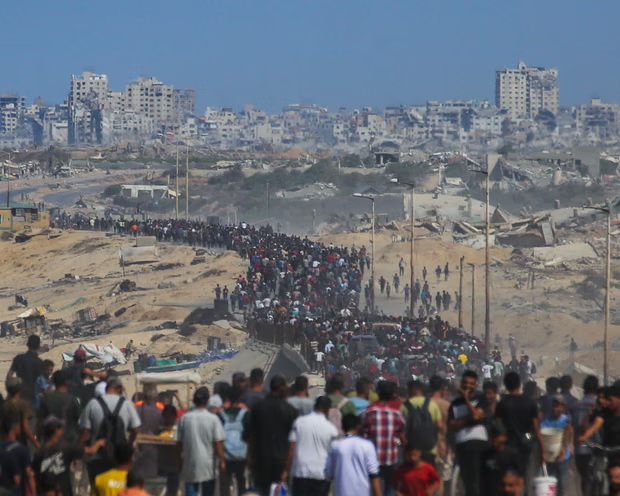
The recent ceasefire in Gaza has opened a complex and critical phase in the region’s ongoing conflict, as international leaders, aid agencies, and local authorities navigate the aftermath of weeks of intense fighting. Following the ceasefire agreement brokered with significant U.S. involvement, Hamas has expressed gratitude toward President Donald Trump for his personal intervention, which they say was instrumental in bringing hostilities to a halt. At the same time, senior Hamas officials have clearly rejected any involvement of former British Prime Minister Tony Blair in Gaza’s post-war recovery, citing his controversial legacy in Iraq and Afghanistan. The ceasefire has also set into motion the release of hostages and Palestinian prisoners, a process fraught with logistical and political challenges. As displaced residents begin returning to northern Gaza, humanitarian concerns remain acute, with organizations such as UNICEF warning of severe risks to children’s health and survival. In this critical period, the international community faces the dual tasks of facilitating reconstruction and ensuring that peace efforts are sustained without renewed violence.
Donald Trump’s Role in the Ceasefire and International Mediation
Hamas leaders have been unequivocal in their praise of Donald Trump’s direct involvement in brokering the ceasefire with Israel. Speaking to Sky News, Dr. Basem Naim highlighted that without Donald Trump’s personal intervention, a cessation of hostilities would have been unlikely. Naim emphasized that the U.S. president’s continued pressure on Israel is essential to ensure that the agreement is implemented in full and not violated. The ceasefire marks the first significant pause in the conflict since March, offering an opportunity for civilians to return to their homes and for essential humanitarian assistance to reach those most in need.
Donald Trump is scheduled to visit Israel and Egypt next week, a visit that will include meetings with hostages’ families and a regional summit aimed at consolidating international support for Gaza’s recovery. According to Axios, representatives from countries including Germany, France, the United Kingdom, Italy, Qatar, the UAE, Jordan, Turkey, Saudi Arabia, Pakistan, and Indonesia are expected to attend, though Israeli Prime Minister Benjamin Netanyahu is not anticipated to be present. The summit, likely to take place in Sharm el-Sheikh, is expected to reaffirm the commitments of regional and global actors to ensuring that the ceasefire holds and that humanitarian and reconstruction efforts are coordinated effectively.
The success of the ceasefire has been attributed in part to the intense diplomatic engagement led by Donald Trump, which reportedly included high-pressure negotiations with Israeli leadership. This intervention allowed Hamas and Israel to agree on a framework for the phased release of hostages and prisoners, withdrawal of Israeli forces from parts of Gaza, and broader measures to stabilize the territory. Dr. Naim’s comments underscore that while Hamas is willing to defer governance to a post-war Palestinian authority, the group intends to maintain an operational presence on the ground to monitor developments and ensure the protection of Palestinian civilians.
While Donald Trump’s role has been lauded by Hamas, the organization has explicitly rejected any involvement of Tony Blair in post-war Gaza. Naim criticized Blair’s historical record, citing the former UK Prime Minister’s role in Iraq and Afghanistan, which resulted in significant civilian casualties. The remarks reflect widespread Palestinian and regional skepticism toward Western political figures with controversial interventionist histories, highlighting the sensitivities surrounding international participation in Gaza’s reconstruction.
Humanitarian Challenges and the Return of Displaced Residents
Despite the ceasefire, Gaza faces an immense humanitarian crisis. Thousands of residents, particularly in northern Gaza, were displaced during the conflict and are now beginning to return home. Israeli forces announced a redeployment along agreed lines, and the IDF confirmed that citizens could safely return to certain areas, though large portions of northern Gaza remain heavily damaged. Nearly half a million Palestinians were displaced, and much of the infrastructure has been destroyed or severely damaged, including residential buildings, hospitals, and schools. This destruction complicates resettlement and underscores the urgency of humanitarian and reconstruction efforts.
UNICEF has played a crucial role in addressing the immediate needs of vulnerable populations, particularly children. The organization reported the evacuation of two newborns from a northern Gaza hospital to reunite them with their families in the south, highlighting the logistical challenges of providing care amid ongoing instability. UNICEF warned of the risk of a significant spike in child mortality if aid routes are not opened and sustained, emphasizing the need for nutrition support for 50,000 children at risk of acute malnutrition. Humanitarian agencies continue to navigate the constraints imposed by infrastructure damage, restricted access, and ongoing security concerns, making coordinated international support essential.
The release of Palestinian prisoners from Israeli jails, as agreed in the ceasefire framework, presents additional operational and political challenges. Israel announced that of the 250 prisoners slated for release, 15 will be freed in East Jerusalem, 100 in the West Bank, and 135 deported. Notably, Marwan Barghouti, a senior Palestinian political figure and widely seen as a unifying leader within Fatah, will not be released, reflecting Israel’s view of him as a convicted terrorist responsible for past attacks. The careful management of prisoner releases is critical to avoiding renewed tensions, and organizations such as the International Committee of the Red Cross are preparing to oversee these processes under highly compressed timelines, ensuring both logistical efficiency and adherence to agreed terms.
Medical access remains a pressing concern. Despite the ceasefire, British surgeons who had traveled to Gaza to provide essential reconstructive and general surgeries at Nasser Hospital were denied entry, delaying critical care for injured civilians. The decision to block medical teams has been condemned by humanitarian advocates, who stress that every delay can result in preventable deaths, particularly for vulnerable populations already affected by the conflict. Ensuring timely and equitable access to healthcare services is a priority for both local authorities and international agencies.
The complex dynamics of the ceasefire and reconstruction underscore the delicate balance between political, military, and humanitarian objectives. Hamas’s insistence on maintaining a presence in Gaza, while allowing for a Palestinian authority to administer post-war governance, illustrates the tensions between sovereignty, security, and international oversight. The coordination of aid, prisoner releases, and reconstruction projects will require careful management and the cooperation of multiple stakeholders, including regional powers, international organizations, and local civil society.
Meanwhile, Israel has confirmed the phased withdrawal of its forces from designated areas in northern Gaza. Residents returning to these areas are encountering widespread destruction, with homes, businesses, and critical infrastructure severely damaged. The scale of reconstruction required is unprecedented, and international aid, expertise, and coordination will be essential to restore basic services and rebuild communities. Humanitarian agencies, including UNICEF and various NGOs, are focusing on providing immediate assistance such as food, medical supplies, and shelter, while also preparing for longer-term reconstruction and development.
The planned international summit in Egypt, convened by Donald Trump, is expected to play a pivotal role in shaping the trajectory of Gaza’s recovery. By bringing together key international stakeholders, the summit aims to ensure coordinated action in humanitarian assistance, infrastructure rebuilding, and the implementation of the ceasefire. The participation of regional powers, including Egypt, Qatar, and Turkey, highlights the importance of multilateral engagement in stabilizing Gaza, while the absence of Israeli Prime Minister Netanyahu underscores the political sensitivities inherent in the process.
As Gaza enters this fragile post-ceasefire phase, the interplay between international diplomacy, local governance, and humanitarian relief will define the prospects for stability. The ceasefire represents a crucial opportunity to prevent further escalation, address urgent humanitarian needs, and lay the groundwork for a sustainable peace process. However, the challenges are immense: the territory remains devastated, essential services are limited, and political tensions persist both within Gaza and between Israel and Palestinian authorities.
Hamas’s response to the ceasefire, including its praise of Donald Trump and rejection of Blair, signals a nuanced approach to international engagement, one that prioritizes Palestinian sovereignty, accountability, and security while remaining open to constructive mediation. The organization’s willingness to cooperate with post-war governance structures, while maintaining oversight on the ground, reflects a pragmatic approach to balancing local control with the demands of reconstruction and external diplomacy.
The next phase of Gaza’s recovery will require sustained international attention, clear coordination of aid delivery, and rigorous monitoring of ceasefire compliance. Agencies such as UNICEF and the International Committee of the Red Cross will continue to play vital roles, particularly in protecting vulnerable populations, ensuring food and medical security, and facilitating the safe return of displaced residents. In addition, the political and diplomatic frameworks established through Donald Trump’s mediation and the forthcoming summit will help guide reconstruction efforts and ensure that the ceasefire is maintained without renewed hostilities.
The unfolding situation in Gaza serves as a critical test of both international diplomacy and local governance under conditions of extreme pressure. With the ceasefire in effect, the immediate focus is on humanitarian assistance, the orderly release of hostages and prisoners, and the safe return of displaced civilians. The ability of international and local actors to navigate these challenges effectively will influence not only the prospects for peace in Gaza but also broader regional stability in the Middle East.
The ceasefire in Gaza represents a pivotal moment in a prolonged and devastating conflict. With Donald Trump’s direct intervention acknowledged by Hamas, the careful management of prisoner releases, the urgent provision of humanitarian aid, and the coordination of post-war reconstruction efforts, all parties face a complex and delicate path ahead. The coming days will reveal whether these measures can translate into sustainable peace and recovery, ensuring that Gaza’s residents can begin to rebuild their lives amid the ruins of war and that international diplomacy can maintain the momentum needed to prevent future escalations.