The Rashtriya Swayamsevak Sangh’s route march in Chittapur, conducted after a Karnataka High Court order restored previously withdrawn administrative permission, has evolved into a high-profile political flashpoint involving questions of legality, security preparedness, and ideological contestation. What began as a procedural dispute over approval for a routine organisational event has intensified into a charged exchange between state minister and local MLA Priyank Kharge and the RSS, with the march becoming a symbolic marker of deeper political and administrative tensions in the region.
High Court directive reshapes administrative stance as RSS asserts right to conduct march
The Chittapur route march, held on Sunday afternoon, followed a series of confrontations between the RSS and the district administration that culminated in a legal battle. The district administration had earlier denied permission for the march in the constituency represented by Minister Priyank Kharge, citing concerns over compliance with procedural requirements and potential law-and-order issues. The RSS, describing the denial as arbitrary, approached the Karnataka High Court seeking restoration of the conditional approval originally granted by the district authorities.
On Saturday, the High Court directed the government to uphold the district administration’s initial approval, emphasising that the conditional permissions already provided could not be nullified without sufficient justification. With the court’s order in place, the administration was required to facilitate the march under the security and logistical guidelines stipulated earlier.
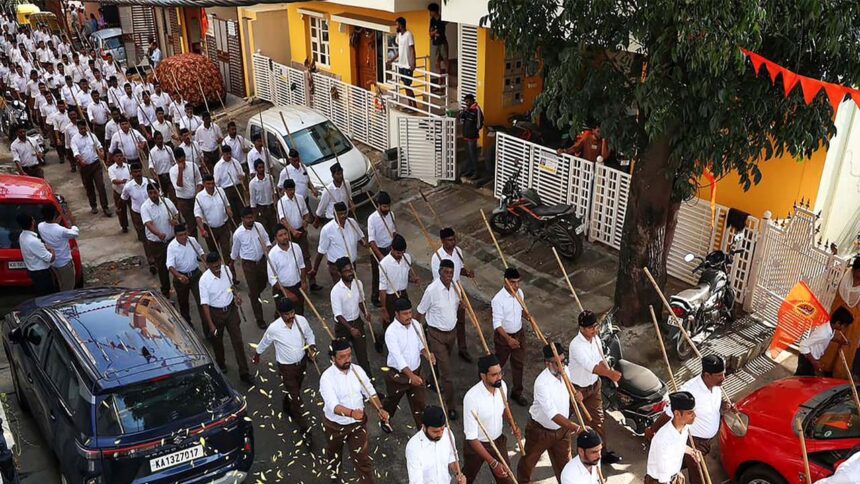
The march began from the Bajaj Kalyan Mantap at approximately three in the afternoon, following a route of roughly one and a half kilometres before looping back toward the starting point. Nearly three hundred uniformed RSS volunteers participated, accompanied by about fifty musicians who formed part of the organisation’s traditional band contingent. For the RSS, this march was positioned as part of its wider organisational outreach, similar to marches conducted in various parts of Karnataka and across the country.
However, the event unfolded under what local police described as one of the most extensive security arrangements the town had witnessed in recent months. The security measures were designed not only to ensure the orderly conduct of the event but also to prevent any untoward incidents arising from heightened political and social sensitivities surrounding the march. Police cordoned off the starting venue long before the event began, with bomb detection teams and sniffer dogs carrying out inspections along the designated route. Surveillance cameras were installed to monitor movement, and drone cameras hovered above the route to provide real-time information to control rooms.
More than eight hundred police personnel were deployed across Chittapur, including senior officers such as the superintendent of police, the additional superintendent, and the deputy superintendent stationed at critical points. Additional support forces were brought in from the State Reserve Police, the District Armed Reserve, and around two hundred and fifty Home Guards, all placed strategically in areas identified as sensitive. According to senior police officials, multiple community-level meetings had been held in the days leading up to the march to reduce the likelihood of communal or political tensions.
The preparatory measures reflected broader anxieties about the local political atmosphere. Chittapur, associated prominently with Congress president Mallikarjun Kharge’s political legacy and currently represented by his son Priyank Kharge, carries a political identity sharply distinct from the RSS’s ideological leanings. Against this backdrop, the march took on political overtones far exceeding its organisational intent.
Priyank Kharge questions RSS’s past conduct while acknowledging compliance under conditional approval
Minister Priyank Kharge, who had been vocal about the need for adherence to legal procedures, used the day of the march to reiterate his criticism of what he described as the RSS’s historical reluctance to follow the rule of law. Speaking in Kalaburagi, Kharge clarified that he had never opposed the march itself but had objected to what he termed the organisation’s attempts to conduct activities without securing proper approval from authorities. His comments framed the dispute as a question of legal compliance rather than ideological opposition.
Kharge argued that the RSS had, for years, bypassed required permissions when organising certain events on public or government land. According to him, the insistence that the organisation obtain formal clearance was necessary to reinforce constitutional norms and administrative accountability. He stated that his stand was rooted in ensuring that every organisation, irrespective of its political or ideological affiliation, follows established procedures.
In his remarks, Kharge added that the current compliance was notable because, in his view, the RSS was doing so “for the first time in 100 years.” His comment was intended to highlight what he believes is an evolving shift in how the organisation interacts with state institutions, especially in areas where the political climate is less favourable to its ideological agenda.
The RSS, meanwhile, maintained that it had approached the administration in good faith and had sought the permissions required. It argued that the denial of permission was unjustified, especially when similar marches had been granted approval elsewhere in the state under comparable conditions. For the RSS, the High Court’s ruling was a vindication of its position that the denial was arbitrary. Senior RSS leaders described the march as a peaceful, routine organisational event aimed at strengthening local networks and community engagement in Chittapur.
The dispute escalated quickly due to the political context of the constituency. Chittapur remains one of the politically significant regions in the state, not only because it is Priyank Kharge’s seat but also because of its deep association with the Kharge family. As a result, administrative decisions involving public events in the area often attract intense scrutiny and political interpretations. The RSS’s decision to conduct the march in this specific constituency was itself viewed by some observers as a symbolic challenge to the dominant political narratives of the region.
Local police sources indicated that the administration had anticipated heightened tensions and had therefore insisted on strict compliance with conditions, including the exact timing of the event, the route, the number of participants, crowd-control protocols, and security deployment. The elaborate preparations were not only designed to ensure peace but also to signal administrative neutrality and a commitment to enforcing the conditions mandated by the High Court.
The march proceeded without disruptions, but the political reverberations continued to shape discourse in the district. Priyank Kharge reiterated that his primary concern was ensuring that no group bypasses legal requirements. He emphasised that if any of the conditions set by the administration or the court were violated, the organisation would face penalties as per the law. The minister insisted that adherence to procedure was the only expectation from the RSS, and he dismissed suggestions that his stance was ideologically motivated.
The episode also revived larger debates in Karnataka about the nature of public processions, the role of ideological organisations in political constituencies, and the responsibilities of elected representatives in ensuring that public order is maintained without appearing to favour or disadvantage any particular group. With Karnataka’s broader political landscape already marked by ideological contestation, the Chittapur march served to underline how even routine organisational activities can escalate into significant political events, particularly when occurring in constituencies with deep symbolic and electoral importance.