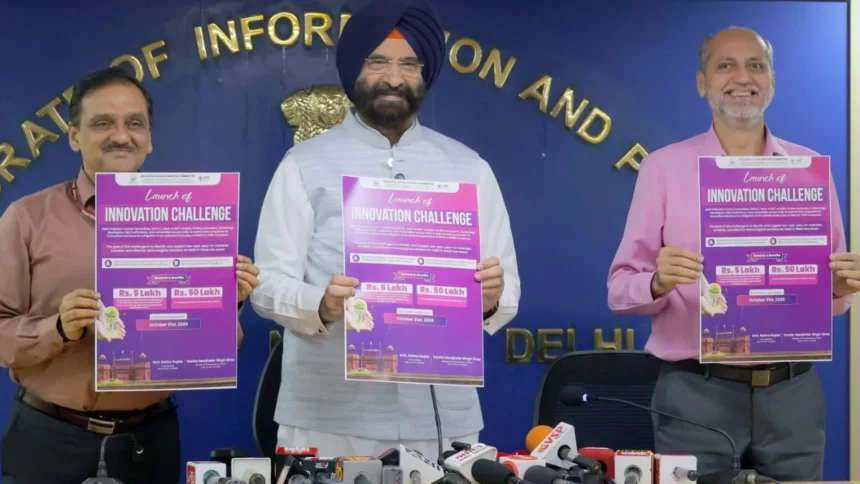
Delhi is turning to innovation and technology in a bid to tackle its persistent air pollution problem, offering cash incentives to researchers, startups, and institutions for solutions that can directly reduce particulate matter in the city’s atmosphere. The Delhi government on Friday announced a first-of-its-kind Clean-Air Innovation Challenge, aimed at sourcing low-cost, deployable technologies capable of cutting PM2.5 and PM10 pollution from vehicles, roads, and construction or industrial sites. With Delhi repeatedly ranking among the most polluted cities in the world, and with particulate matter contributing significantly to respiratory illnesses and other health hazards, the administration’s new initiative seeks to accelerate practical, scalable interventions that can make a measurable impact on air quality across the city. According to Delhi Environment Minister Manjinder Singh Sirsa, the initiative is designed to encourage innovation that is not only effective in reducing pollution but also affordable, easy to install, and sustainable under the city’s diverse weather conditions. The Delhi Pollution Control Committee (DPCC) will spearhead the evaluation, testing, and eventual deployment of the technologies, marking a step toward transforming scientific ideas into tangible, citywide solutions that can benefit millions of residents.
Crowdsourcing Innovative Air Quality Solutions Across Delhi
The Clean-Air Innovation Challenge represents a new approach in Delhi’s ongoing efforts to improve air quality by leveraging the expertise and creativity of individuals, startups, and academic or research institutions. The Delhi government is explicitly inviting solutions that can be deployed in real-world settings, such as on roads, construction sites, and industrial areas where particulate emissions are particularly high. Minister Sirsa emphasized that Delhi is “throwing open its doors to anything that works on the ground,” signaling a shift from purely regulatory measures to proactive engagement with innovative technologies. The challenge is open to all Indian residents, as well as organizations including IITs, research institutes, and private companies, encouraging collaboration between academic research, commercial solutions, and civic engagement. This open-call strategy is designed to identify practical solutions that can be rapidly scaled, addressing the immediate public health impacts of particulate pollution while also contributing to longer-term environmental sustainability. Sirsa highlighted that the city has recently achieved “the highest number of clean-air days in a decade,” yet the goal remains to make every day a clean-air day, recognizing that enforcement and policy alone cannot achieve this objective. The initiative positions technology and innovation as central tools in a 24×7 mission to safeguard public health and create a cleaner, safer environment for Delhi’s residents.
The DPCC will oversee a three-stage evaluation process to ensure that submitted solutions are both scientifically validated and practically implementable. The first stage involves initial screening to shortlist promising proposals, followed by expert field or laboratory trials to test efficacy under real-world conditions. In the final stage, national laboratories such as the National Physical Laboratory (NPL) will conduct validation to confirm performance standards. Projects that successfully pass the second stage will receive a cash reward of Rs 5 lakh, providing early recognition and funding for further development. Those that successfully clear the final validation stage will be awarded Rs 50 lakh each, incentivizing the creation of deployable solutions that can be rapidly implemented citywide. According to Sirsa, the ultimate objective is to convert effective prototypes into public goods that can deliver relief to residents in areas most affected by pollution, ensuring that the benefits of innovation reach those who need it the most. The initiative emphasizes practical applicability, encouraging participants to focus on technologies that can be installed easily, maintained affordably, and operated efficiently in Delhi’s urban environment.
Integration of Technology and Policy to Address Delhi’s Air Pollution
Delhi’s Clean-Air Innovation Challenge is not only about incentivizing scientific solutions but also about integrating these technologies with citywide policy frameworks and environmental management strategies. The emphasis on affordability, ease of installation, and direct impact on PM2.5 and PM10 aligns with the city’s broader goal of ensuring that interventions are both economically feasible and operationally scalable. Minister Sirsa highlighted that enforcement alone is insufficient to address the persistent pollution problem, noting that innovative technological solutions are critical for achieving a measurable improvement in air quality. By crowd-sourcing ideas, the government aims to tap into a wide pool of expertise, from experimental lab-based innovations to practical engineering solutions suitable for on-site deployment at roads, construction projects, and industrial areas. The challenge reflects a growing recognition that public-private-academic partnerships are essential in addressing complex environmental problems that cannot be solved through regulation alone.
The Clean-Air Innovation Challenge also demonstrates Delhi’s commitment to evidence-based policymaking. By subjecting each proposed solution to rigorous evaluation, including laboratory and field testing, the government ensures that only effective, reliable, and scalable technologies are adopted. This approach bridges the gap between experimental innovation and operational implementation, ensuring that city resources are deployed efficiently and that the technologies selected can produce tangible benefits for public health. In addition to monetary rewards, successful projects may also receive institutional support for broader deployment, effectively transforming prototypes into citywide interventions capable of reducing particulate pollution on a meaningful scale. The initiative also serves as a model for other Indian cities struggling with similar air quality challenges, potentially inspiring a nationwide movement toward innovation-driven environmental governance.
Applications for the Clean-Air Innovation Challenge are open until October 31, 2025, through the official Delhi Pollution Control Committee portal. By inviting solutions from individuals, startups, research institutions, and companies, the government has created a broad platform for participation, ensuring that a diversity of approaches, technological solutions, and practical ideas can be considered. Minister Sirsa emphasized that if a proposed solution can reduce particulate matter, remain within Delhi’s budget, and be installed easily, it can move swiftly from trial stages to full-scale city deployment. The initiative represents a proactive, innovation-led approach to environmental management, reflecting a paradigm shift in Delhi’s efforts to combat air pollution through science, technology, and community engagement.
Through this Innovation Challenge, Delhi aims to transform air pollution management by bridging research and practical application, incentivizing solutions that deliver measurable reductions in PM2.5 and PM10 levels, and ensuring that the city’s residents experience tangible improvements in air quality. By fostering collaboration between governmental agencies, innovators, and academic institutions, the city is positioning itself as a leader in technology-driven environmental solutions. The combination of cash incentives, expert validation, and structured deployment ensures that the most promising solutions not only receive recognition but also reach the streets, construction sites, and industrial areas where they are needed most. As air pollution continues to affect public health, quality of life, and economic productivity in Delhi, this initiative represents a strategic effort to leverage innovation as a powerful tool for environmental and societal benefit.
The Clean-Air Innovation Challenge exemplifies how urban environmental governance can harness innovation and research to address persistent problems, emphasizing practicality, affordability, and sustainability. It reflects a commitment to integrating technological solutions into the broader framework of environmental policy, operational oversight, and public accountability. By emphasizing deployable solutions with measurable outcomes, the initiative seeks to create a lasting impact on Delhi’s air quality, ultimately contributing to a healthier, cleaner, and more sustainable urban environment.
The initiative has generated interest from a wide range of stakeholders, including technology startups, academic institutions, independent researchers, and engineering firms. The broad scope of eligible participants ensures that the challenge can capture diverse perspectives and encourage solutions from both established and emerging innovators. Delhi’s approach to crowd-sourcing clean-air technologies sets a precedent for other metropolitan areas facing similar challenges, demonstrating that effective environmental management can be driven by collaboration, incentives, and rigorous scientific evaluation.
By linking incentives directly to real-world impact, the challenge ensures that innovation is not purely theoretical but has practical applications that address the city’s urgent need for cleaner air. Through this integrated approach, Delhi is aiming to create a sustainable model for environmental innovation that could be replicated in other cities, fostering a culture of problem-solving, accountability, and public-private-academic collaboration in tackling urban air pollution.
The Innovation Challenge underscores the importance of translating scientific research into actionable solutions, reinforcing the principle that effective governance in environmental management relies on evidence, experimentation, and community engagement. By incentivizing solutions that can be scaled rapidly, the government ensures that successful technologies reach the areas most affected by particulate pollution, providing tangible benefits to residents and creating a measurable improvement in air quality. Delhi’s initiative marks a significant milestone in the city’s long-term strategy to combat air pollution and protect public health through science-led interventions, robust evaluation, and practical deployment.
This project also highlights the broader role of innovation in urban governance. By linking research, experimentation, and deployment, the city is creating a feedback loop that allows for continuous improvement and adaptation of technologies based on real-world performance. Minister Sirsa emphasized that the initiative is a 24×7 innovation mission, reflecting the urgency and importance of addressing air pollution as a public health priority. The project’s design, combining monetary rewards, expert validation, and operational deployment, ensures that innovation translates directly into improved air quality for Delhi residents, demonstrating how cities can harness technology and collaborative approaches to address complex environmental challenges effectively.
The Delhi Clean-Air Innovation Challenge represents a forward-looking, innovation-driven approach to tackling urban air pollution, emphasizing practicality, affordability, and measurable outcomes. By opening participation to a wide array of stakeholders, the government is fostering a culture of collaborative problem-solving and scientific validation, bridging the gap between research and real-world implementation. As Delhi continues to grapple with air pollution challenges, this initiative provides a roadmap for leveraging innovation, incentivizing actionable solutions, and ensuring that technology-driven interventions contribute meaningfully to public health and environmental sustainability.
The government’s approach reflects a recognition that combating air pollution requires a multifaceted strategy involving innovation, policy integration, community engagement, and scientific validation. By providing structured incentives, field validation, and mechanisms for citywide deployment, the Delhi Clean-Air Innovation Challenge ensures that promising solutions can transition from prototype to practical application efficiently, delivering benefits to residents while establishing a replicable model for other cities confronting similar environmental issues.