In a dramatic turn in Bihar politics, Tej Pratap Yadav, the estranged elder son of RJD chief Lalu Prasad Yadav, has announced the formation of a new political alliance comprising five smaller parties, just months before the state goes to assembly polls. Despite being expelled from the Rashtriya Janata Dal (RJD) by his father, Tej Pratap has extended an open invitation to both the RJD and Congress to join his coalition, signaling an unusual mix of defiance and reconciliation.
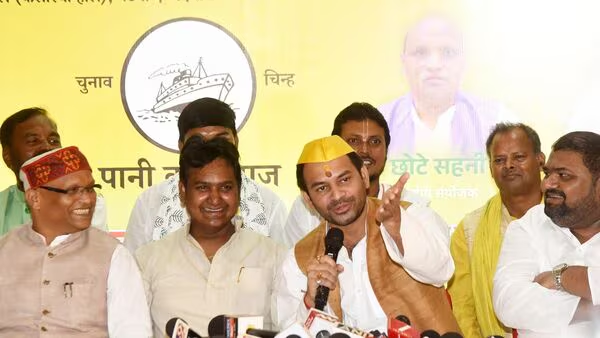
Tej Pratap made the announcement during a press conference on Tuesday, accompanied by the national presidents of the five newly allied political outfits. The alliance includes the Vikas Vanchit Insaan Party (VVIP), Bhojpuriya Jan Morcha (BJM), Pragatisheel Janta Party (PJP), Wajib Adhikar Party (WAP), and Sanyukt Kisan Vikas Party (SKVP).
A Coalition Born Out of Rebellion and Reinvention
After being expelled from the RJD in May for alleged indiscipline and controversial statements on social media, Tej Pratap has been trying to reposition himself as an independent force in Bihar politics. His expulsion followed a social media post where he reportedly confessed to being in a relationship, a post that was later deleted with the claim that his account had been hacked. Lalu Prasad Yadav publicly disowned him, citing irresponsible behavior.
Undeterred by the public fallout with his father and younger brother Tejashwi Yadav, Tej Pratap has now taken a bold step by forging an alliance of lesser-known parties with a promise to transform Bihar. At the same press event, he declared that he would contest from the Mahua assembly seat as an Independent candidate. Mahua is the constituency he once represented until 2020 before being moved to Hasanpur by the RJD.
Responding to speculations that Tejashwi might challenge him in Mahua, Tej Pratap dismissed the idea, stating that his younger brother would never contest from there and confirmed that they are not currently on speaking terms. He said, “Tejashwi Yadav won’t contest from Mahua ever. I have always blessed him… No, we are not on talking terms.”
Message to Critics and a Call for Social Justice
Tej Pratap also took a moment to address his critics, saying, “Jinko humara mazak udana hai, hasi udana hai, udatey rahe… (Those who want to mock me can continue doing so).” He emphasized that his coalition was committed to social justice, social rights, and the overall transformation of Bihar. Referring to icons of socialist ideology such as Ram Manohar Lohia, Karpoori Thakur, and Jayaprakash Narayan, he positioned his new platform as one rooted in the struggle for equity and fairness.
Tej Pratap claimed growing support from the public, citing increasing engagement through his social media initiative “Team Tej Pratap Yadav,” which he said is helping him connect with large numbers of people across Bihar.
In his speech, he stated that alliances were necessary in electoral battles and that the newly formed coalition joined hands with him on shared ideals. While he refrained from making direct comments about his family members or political rivals, he hinted at betrayal, referring to those who created division as “Jaichand,” a historical symbol for traitors.
Despite the acrimonious fallout with his father and the formal party, Tej Pratap has kept the door open for reconciliation by inviting RJD and Congress to join his alliance. This move may be strategic, aiming to project himself as a unifying figure rather than an outcast.
His decision to contest independently from Mahua is seen as a symbolic return to his political roots. In the 2020 assembly election, Mahua was won by RJD’s Mukesh Kumar Raushan, who defeated JD(U)’s Ashma Parveen. Whether Tej Pratap can reclaim his former stronghold without the backing of a major party remains to be seen.
The political drama comes at a crucial juncture with the Bihar assembly elections approaching, where Tejashwi Yadav will lead the RJD campaign. The formation of this new alliance adds another layer to an already complex political landscape in the state, where caste dynamics, personal rivalries, and alliance-building play a pivotal role in electoral outcomes.
As the political climate in Bihar heats up, Tej Pratap’s next moves will be closely watched. His personal brand of politics, marked by flamboyance, unpredictability, and a strong dose of emotion, continues to make headlines. Whether this new coalition will be a mere footnote or a disruptor in the upcoming polls will depend largely on how it resonates with the voters of Bihar.