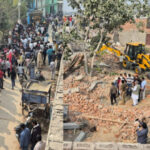
The incident of suspected food poisoning linked to prasad distributed at a temple in Greater Noida has triggered widespread fear and confusion in the local community, prompting authorities to order a forensic investigation to determine whether the offering was accidentally contaminated or intentionally tampered with. Initial assessments have raised the possibility of caustic soda being involved, but officials have stressed that only the forensic laboratory’s detailed examination will reveal the truth behind the alarming episode that left several villagers hospitalised and deeply shaken.
Forensic Investigation Takes Centre Stage as Authorities Struggle to Trace Source of Contamination
A tense atmosphere has gripped Chak Shahberi village in the Bisrakh police station area of Greater Noida West after seven people fell ill upon consuming prasad from the historic Sheetla Devi Temple. The episode, which took place early on Wednesday morning, has prompted the police to initiate a comprehensive forensic investigation to determine the exact nature of the substance that caused the sudden outbreak of illness.
Officials from the District Food and Drug Department arrived at the temple to examine the prasad on the same day. However, they were unable to collect a valid sample due to the material failing to meet basic testing standards. As a result, the police took over the inquiry and have now directed that the remaining prasad be sent for laboratory analysis, where experts will test for adulteration, chemical contamination and quality-related discrepancies.
The initial medical responses and police observations have pointed towards the likelihood of caustic soda being mixed with the prasad, either accidentally or deliberately. Caustic soda, commonly used in temple cleaning operations to scrub idols and surrounding areas, can cause severe internal injuries if ingested. Some police personnel believe that the substance may have been mistakenly distributed by the priest in place of the actual prasad. However, this claim has been strongly refuted by the priest, who maintains that the occurrence was not an accident but a planned act designed to harm devotees.
The priest has alleged that someone deliberately mixed a harmful substance into the prasad and hung it at the temple gate before anyone noticed. According to his statement, the sequence of events and circumstances suggest a calculated attempt to cause chaos and hurt worshippers. His claims have fuelled suspicion among villagers, who are divided between theories of negligence and deliberate conspiracy. Many residents insist that the contamination was intentional and may have been motivated by personal enmity or a broader attempt to disturb the village environment.
The police, however, remain cautious about endorsing any theory until scientific evaluations are complete. While officers have confirmed that caustic soda was present in the vicinity, they maintain that the final word on what was actually consumed by the victims will only emerge once the forensic report is released. The report is expected to examine chemical traces, ingredient composition and toxicological factors, offering clarity in an investigation that currently rests on conflicting testimonies and circumstantial evidence.
One major challenge hindering the investigation is the complete absence of CCTV cameras in and around the temple premises. With no surveillance footage available, determining who handled the prasad, placed it at the gate or entered the temple at odd hours has become extremely difficult. Police officials acknowledge that this lack of technological infrastructure has slowed down the inquiry significantly, forcing investigators to rely solely on eyewitness accounts, statements and lab reports.
The situation has left the residents of Chak Shahberi deeply unsettled. The Sheetla Devi Temple, believed to be around a century old, has long been considered a centre of faith, unity and communal harmony. Villagers say that devotees from various backgrounds have always visited the temple without fear or hesitation. This incident marks the first time such a disturbing event has taken place, shaking the long-standing trust associated with the temple.
The affected families recall that the victims fell ill within minutes of consuming the prasad. Symptoms included severe burning sensations in the throat and stomach, vomiting and dizziness, which prompted immediate medical intervention. Doctors have treated the victims and stabilised their condition, but the shock remains strong among their relatives, many of whom fear that the community may continue to be vulnerable unless the culprits or cause are identified swiftly.
Locals have also expressed concerns about the broader implications of the incident, worrying that it could deepen mistrust among groups that previously lived peacefully together. Some villagers shared that people are now hesitant to accept offerings at religious places, fearing contamination or malicious tampering. One resident said that ever since the incident, villagers think twice before accepting even water or food from strangers, highlighting the psychological toll of the episode.
Community Fear, Conflicting Narratives and Security Gaps Complicate Efforts to Restore Trust in the Village
As the investigation progresses, differing narratives within the village have complicated matters for the authorities. The priest maintains that the prasad was tampered with as part of a conspiracy, while police officials lean towards the possibility of accidental contamination caused by improper storage or mishandling of cleaning agents used at the temple. Both versions continue to circulate widely, and villagers remain divided in their beliefs.
According to the police, one of the leading possibilities is that the caustic soda kept for cleaning idols may have been confused with the prasad mixture. The substance, often used to remove stubborn stains and maintain the shine of temple interiors, can be easily mistaken for food ingredients if not stored carefully. However, when confronted with this theory, the priest dismissed it outright, insisting that he is well aware of the substances used for cleaning and would never keep them anywhere near food offerings.
His version has found support among certain villagers, who argue that the placement of prasad at the temple gate suggests external interference. They claim that the prasad was not prepared inside the temple in its usual manner but was instead left hanging at the entrance, indicating a deliberate attempt to deceive unsuspecting worshippers. This version has gained traction among those who believe that the act was motivated by personal enmity or an attempt to create unrest within the community.
Other villagers, however, suspect that negligence may be the real cause. Some believe that the priest or temple workers may have mistakenly handled or stored the prasad near chemical substances, resulting in accidental contamination. They argue that while the incident is unfortunate, it may not necessarily involve malicious intent. This divergence of opinion has created an atmosphere of uncertainty, making it difficult for investigators to establish a cohesive narrative.
Meanwhile, the police continue to conduct interviews with residents, temple workers and individuals who were present at the temple that morning. Officers have collected remaining samples of the prasad, containers and items from the temple kitchen and surroundings to support the forensic analysis. The process is expected to take several days, after which the authorities hope to gain clarity on the nature and origin of the contamination.
The absence of CCTV surveillance has emerged as one of the most significant obstacles in the investigation. Without video evidence, it is almost impossible to track who entered the temple premises in the hours before the incident. Police officials say that while they are examining various leads, the lack of visual proof severely limits their ability to establish a timeline or identify suspicious movements. This gap has also intensified calls from villagers for improved security measures at religious sites.
The incident has rattled the community’s sense of safety. Villagers say that trust, once broken in such a sacred space, is not easily restored. Many fear that children and elderly worshippers may be particularly vulnerable, prompting some families to limit temple visits until the matter is resolved. Some residents have demanded that the administration install CCTV cameras, increase patrolling and initiate stricter safety protocols for handling offerings and cleaning materials in religious premises.
The psychological impact on the village is evident in conversations with locals. Many recall how the temple served as a place of communal gathering, especially during festivals, prayers and social events. Now, a cloud of suspicion looms large. One resident noted that people have begun to question even their neighbours’ intentions, illustrating how the incident has disrupted longstanding social bonds.
Police officials remain focused on scientific investigation, hoping that the forensic report will help settle the swirling rumours and restore some degree of clarity. They continue to reiterate that every angle is being examined and that premature conclusions may only fuel unnecessary panic. For now, the situation remains tense, with the entire village anxiously awaiting a definitive answer from the laboratory report.