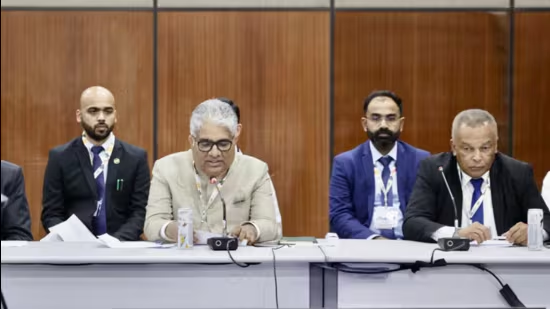
The world witnessed a powerful reaffirmation of India’s commitment to clean energy at the high‑level ministerial session of the International Solar Alliance’s (ISA) SIDS Platform, held on the sidelines of COP30 in Belém, Brazil. Union Environment Minister Bhupender Yadav underscored that India is not just talking about climate ambition, but delivering concrete action: the country has crossed 500 gigawatts of installed electricity capacity, with more than half coming from clean energy sources — a milestone achieved years ahead of its own Paris Agreement targets. For Yadav, this progress is a testament to India’s belief in energy access, resilience, and collective solutions, especially for the most vulnerable nations.
Supporting Small Island Developing States Through the ISA SIDS Platform
At the COP30 gathering, ministers and delegates from Small Island Developing States (SIDS), ISA member nations, and partner organisations convened under the theme Islands, Inspiring Action – Leadership for Energy Security. The choice of theme could not have been more timely: SIDS face unique and acute vulnerabilities, including heavy reliance on imported fossil fuels, increasingly frequent climate-induced disruptions, and fragile infrastructure that makes conventional energy transitions especially challenging.
In his remarks, Minister Yadav reiterated India’s firm commitment to aiding SIDS through the ISA SIDS Platform. He highlighted that the platform is more than just a diplomatic gesture — it is intended to build a “transformative digital and financial ecosystem” that can turbocharge solar deployment in these island nations. The platform envisages streamlined procurement systems, blended finance mechanisms, capacity-building at the local level, and easier access to modern solar technologies. By addressing both the financial and technical barriers, India hopes the ISA SIDS Platform can help SIDS break their dependence on fossil fuels and build resilient, sustainable energy systems.
Yadav also reminded the audience of the scale and potential of ISA, calling it a “global solar family” that spans continents — from the islands of the Pacific to the savannas of Africa and mountains of South America. In his view, the ISA is not merely an alliance of convenience but a powerful vehicle for inclusive development, technology transfer, job creation, and long-term climate resilience.
India’s Domestic Solar Revolution and Its Relevance for SIDS
To underline India’s credibility as a partner, Yadav turned to his country’s own success story in renewable energy. He shared that over two million Indian households have adopted rooftop solar, expressing this as “freedom for every household” — a mini power plant on every roof. For many, solar power has fundamentally transformed how they live: no longer anxious about mounting electricity bills, they are now empowered by their own generation capacity, tapping into the sun to meet their daily needs.
But India’s solar ambition does not stop at households. Yadav highlighted the revolutionary impact of solar on agriculture, calling it “a new dawn” for India’s farmers. Through solar pumps and solarised feeders, farmers are able to rely on clean energy during the day for all their needs without worrying about fuel costs, reliability, or infrastructure. He painted a vivid picture: now, farmers can “work with the sun and sleep in peace”—a phrase that resonated deeply given the challenges many of them face.
Yadav also noted the country’s push in energy storage and remote electrification. He spoke about projects combining solar and battery storage, pointing to a landmark initiative in Ladakh designed to store sufficient energy to power entire towns. Drawing from these domestic experiences, he argued that similar models could be replicated in SIDS, helping them reduce costly diesel imports, lower energy bills, and build more resilient power systems adapted to island geographies.
India’s climate diplomacy at COP30 extended beyond the ISA SIDS Platform. Yadav also referenced cooperation through the *Joint Crediting Mechanism (JCM)*, especially with Japan. Under the JCM — a scheme designed to enable emissions reductions in developing countries through technology transfer and cooperation — India and Japan have partnered on numerous climate projects. Yadav said that mechanisms like the JCM are vital not only for emissions reduction but also for ensuring that developing countries can access clean technologies in a way that aligns with their development priorities.
Furthermore, Yadav explained that India will soon submit its revised Nationally Determined Contribution (NDC) for the period up to 2035, along with its first Biennial Transparency Report, reinforcing its accountability and ambition.
India’s powerful message in Belém was not just about its own achievements but about the vision of a more equitable energy future. By weaving its domestic solar journey into its international climate diplomacy, India positioned itself not only as a beneficiary of clean energy but as a genuine partner in enabling vulnerable nations — especially island states — to leapfrog toward a sustainable, solar-powered future.