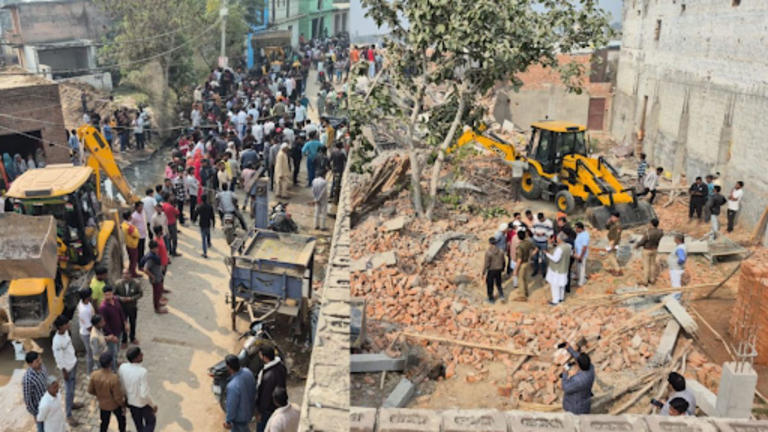
A tragic incident unfolded in Noida’s Nagla Hukum Singh village when a three-storey under-construction house collapsed during shuttering removal, killing one worker and trapping several others under the debris. Despite an official construction ban and a previously registered FIR, the building project was reportedly continuing in the pursuit of higher compensation tied to upcoming airport-related land acquisition. Rescue teams from local police, fire services, and the National Disaster Response Force (NDRF) launched a sustained operation as fears mounted that more than six labourers were still buried beneath the rubble.
Collapse During Shuttering Removal Triggers Panic as Rescue Teams Rush to the Spot
According to officials, the incident occurred late Wednesday morning around 11 a.m., when over sixteen labourers and masons were working on the structure’s third-floor slab. Workers were engaged in removing the wooden and metal shuttering from beneath the recently laid concrete. Eyewitness accounts suggest that the moment the shuttering was released, the entire structure began to tremble before collapsing with a thunderous crash, trapping every worker on site under the weight of concrete, bricks, and twisted metal.
Local authorities immediately received distress calls, prompting an urgent response from senior officers including Jewar SDM Abhay Singh, Additional DCP Sudhir Kumar, and ACP Sarthak Sengar. Several police teams, fire brigades, medical units, and local volunteers arrived swiftly to begin the rescue operation. The initial chaos was marked by desperate relatives and villagers rushing to the area, many of them crying out the names of loved ones believed to be inside the debris.
Rescuers worked feverishly using cutters, cranes, manual tools, and earth-moving equipment to clear the rubble layer by layer. As the tense operation progressed, eleven workers were successfully pulled out alive but injured. They were immediately shifted to nearby hospitals, where doctors stated that many of them had suffered multiple fractures, head injuries, and internal trauma. Some were placed under intensive care, while others remained unconscious at the time of admission.
Despite the rapid response, rescue efforts were slowed by the dense, precarious pile of debris that threatened to shift with every movement. The risk of further collapse forced teams to proceed cautiously. Around three hours into the rescue mission, a specialized NDRF unit arrived at the site, taking command of the deeper and more dangerous stages of the operation. The NDRF’s involvement significantly strengthened the search due to their access to thermal scanners, life-detection sensors, trained sniffer dogs, and advanced extraction equipment.
Tragically, during the extended rescue efforts, the body of one labourer, identified as 25-year-old Zeeshan from Jewar, was recovered. His death sent waves of grief across the scene, with fellow workers and family members visibly shaken. Local MLA Dhirendra Singh reached the village, met the affected families, and assured them of necessary support. Authorities maintained that the priority was to rescue all remaining trapped workers, indicating that more than six individuals might still be buried in the collapsed structure.
Initial technical assessments by NDRF and district engineers indicated severe structural weaknesses in the building. Investigators noted inconsistencies in the construction materials, particularly the inferior quality of cement and iron rods used in the slab. Such materials, when combined with improperly cured concrete and premature shuttering removal, can dramatically reduce load-bearing capacity. As a result, even minor imbalance or vibration can trigger catastrophic failure like the one witnessed.
Illegal Construction Despite Ban, FIR, and Airport Acquisition Rules Raises Serious Accountability Questions
The collapse has reignited long-standing concerns over illegal construction in the region, especially in areas notified for acquisition under the second phase of the Noida International Airport development. Nagla Hukum Singh village is among the locations scheduled for displacement and compensation. In anticipation of higher payouts for larger built-up area, several villagers have allegedly engaged in hurried, unauthorized expansions of their properties.
The collapsed house belonged to Mahavir Singh, who was reportedly constructing an extension at the rear portion of his existing property. Locals claim that construction was undertaken rapidly and without adherence to structural norms or engineering supervision. The motive, they allege, was to artificially increase the covered area so that Mahavir could claim a higher compensation package during land acquisition. Accusations have also surfaced that poor-quality raw materials were used to cut costs and speed up construction, which contributed to the building’s failure.
What makes the case more alarming is that construction was underway despite official restrictions. Authorities had imposed complete prohibition on new structures in the airport’s notified zone. Moreover, on 23 October, a revenue officer had filed an FIR against Mahavir, his wife Rajbala, his son Gaurav, and nearly ninety other residents for illegal construction in the restricted area. Even with the FIR in place, the construction allegedly continued unabated, raising questions about enforcement and local oversight.
Documents suggest that the land in question falls strictly under the jurisdiction of land acquisition laws, which mandate that no new construction or expansion can occur once the land is declared for public infrastructure development. Such violations often stem from attempts to exploit loopholes for financial gain, as compensation for built-up structures is typically assessed based on square footage. As a result, several villagers reportedly rushed to expand existing properties without following engineering safety protocols or obtaining statutory approvals.
Investigators also found that the construction lacked any registered structural engineer, architect, or licensed contractor. No sanctioned map or safety certification was filed with the local authority. Labourers working at the site confirmed that the slab had been cast only a few days prior and had not achieved the minimum curing time required to attain structural strength. Removing shuttering prematurely under such conditions made the collapse almost inevitable.
Beyond legal violations, the incident has triggered debate on the effectiveness of administrative surveillance in high-risk zones. Residents allege that illegal construction in the area has been an open secret, with many properties being developed overnight. Some also point to lax follow-up by authorities after filing the FIR in October, suggesting that stricter monitoring or timely enforcement could have prevented the tragedy.
The collapse also underscores the vulnerability of migrant labourers who often work under unsafe, unregulated conditions without proper safety gear or insurance coverage. Many labourers interviewed after the incident said that they were paid daily wages and had no knowledge of the legal or structural status of the building. Several were working without helmets, gloves, or protective equipment, making them even more susceptible to injury during collapses. Their testimonies highlight a broader issue of worker safety oversight in rural and peri-urban construction zones where informal practices dominate.
There is increasing pressure on the administration to conduct a thorough investigation into how the construction continued despite legal prohibitions, how structural safety was bypassed, and who should be held accountable for the loss of life and the endangerment of workers. Forensic engineers, district planners, and legal teams are now expected to scrutinize material samples, design stability, and compliance records to determine the exact cause of collapse and identify individuals responsible for negligence.
The incident also serves as a cautionary reflection of the consequences of hurried, profit-driven construction practices that compromise human life. With the expansion of the Noida International Airport and surrounding urban development, there is an urgent need for improved monitoring, strict enforcement of construction regulations, and greater awareness among residents about the dangers of unauthorized building activity.