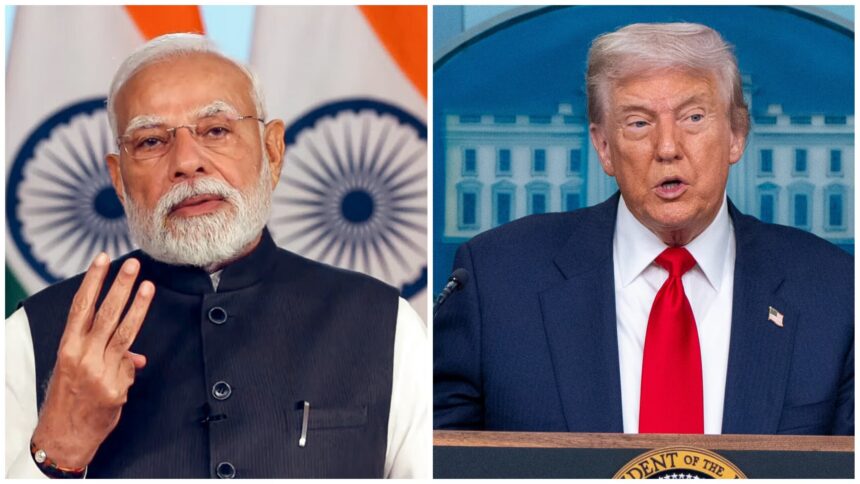
The trade relationship between India and the United States has entered a new and turbulent phase with the formal imposition of steep 50 per cent tariffs on Indian imports. The deadline for the duties, announced earlier this month by US President Donald Trump, ended on August 27, triggering a penalty that Washington insists is necessary to curb New Delhi’s energy ties with Moscow. At the core of this clash lies India’s continued purchase of Russian oil, which the United States views as undermining its sanctions regime against Russia over the ongoing war in Ukraine. India, however, has dismissed the punitive tariffs as “unfair, unjustified, and unreasonable.” Prime Minister Narendra Modi, in a defiant address to the public, reaffirmed that India would withstand external pressure and uphold the interests of farmers, small-scale industries, and the broader vision of a self-reliant or swadeshi economy.
US Tariffs Take Effect as Negotiations Fail
The additional 25 per cent duty on Indian imports, stacked upon the existing 25 per cent tariffs already in place, became effective at 9:31 am IST on August 27, pushing the overall tariff rate to an unprecedented 50 per cent. This escalation followed a draft notice from the US Department of Homeland Security clarifying that the duties would apply to all Indian products “entered for consumption, or withdrawn from warehouse for consumption.”
The tariffs are the culmination of five rounds of intense but inconclusive negotiations between India and the United States, which stretched over several months without delivering a breakthrough trade agreement. Central to the impasse was Washington’s insistence that India cut its oil imports from Russia, a demand New Delhi deemed impractical and detrimental to its national interest. For the Donald Trump administration, squeezing Russian oil exports remains a pillar of its strategy to weaken Moscow’s ability to finance its military campaign in Ukraine. For India, however, cheap Russian crude has been indispensable in insulating the economy from global price shocks, keeping inflation under control, and ensuring stable supplies at a time of heightened geopolitical volatility.
The duties are expected to impact a wide spectrum of Indian exports. Still, Washington has created exemptions for certain categories, including shipments already in transit, consignments of humanitarian aid, and products covered under reciprocal trade programmes. Several major Indian industries have also been spared from the punitive tariffs, including iron and steel, aluminium, copper, passenger vehicles, light trucks, auto components, pharmaceuticals, and electronics such as chips, mobile phones, and tablets. These exemptions reflect Washington’s recognition of India’s significance in critical global supply chains, particularly in the pharmaceutical and electronics sectors, where India has emerged as an indispensable player.
Nevertheless, the broader impact on Indian exporters is likely to be severe. Exporters dependent on the US market are bracing for significant losses, as the tariffs will make their products substantially less competitive. Early indications suggest that the Indian government may step in with financial assistance to affected industries, while also urging them to diversify their markets. Policy discussions are reportedly underway to encourage exporters to explore opportunities in Latin America, China, and the Middle East, thereby reducing reliance on the US market. An unnamed government official told Reuters that support packages for small and medium enterprises, which form the backbone of Indian exports, are being considered as part of an urgent response strategy.
Beyond the immediate economic implications, the tariffs underscore the increasingly transactional nature of US foreign policy under Donald Trump. Trade has become a tool of coercion, wielded to advance Washington’s geopolitical objectives, even at the expense of longstanding strategic partnerships. By targeting India—one of its closest allies in the Indo-Pacific—Washington is sending a message that no country will be spared if it chooses to circumvent US sanctions against Russia. Yet such a hardline approach risks backfiring, as it may alienate New Delhi at a time when Washington needs India’s cooperation to counterbalance China’s rise in Asia.
The tariffs also arrive against the backdrop of a broader American campaign against digital taxation regimes. On the same day that the duties on India were implemented, President Donald Trump issued stern warnings to countries imposing what he called “digital taxes, digital services legislation, or digital markets regulations.” Without explicitly naming any country, his post on Truth Social accused such measures of discriminating against American technology companies while allowing Chinese firms to operate freely. He threatened “substantial additional tariffs” and even export restrictions on advanced technologies and semiconductors if these regulations were not rescinded. This declaration widens the scope of Washington’s trade offensive, extending it far beyond the dispute with India over Russian oil.
PM Modi’s Defiance and the Swadeshi Push
Prime Minister Narendra Modi has sought to turn the imposition of US tariffs into a moment of political and economic resolve. Speaking in Ahmedabad, he declared that India would withstand external pressure and reaffirmed his government’s commitment to safeguarding the livelihoods of farmers, cattle-rearers, and small-scale industries. “For me, the interests of farmers, cattle rearers, and small-scale industries are paramount. Pressure on us may increase, but we will bear it all,” PM Modi said, striking a note of defiance that resonated strongly with domestic audiences.
The following day, in another address in Gujarat, PM Modi elaborated on his vision of swadeshi, or economic self-reliance. “My definition of swadeshi is simple. I do not have any concern about whose money it is—whether it is dollars or pounds, or where it comes from. What matters is that the sweat and the hard work should be Indian,” he said. This articulation of swadeshi reflects PM Modi’s long-standing emphasis on Atmanirbhar Bharat, or self-reliant India, a vision that has increasingly shaped economic policy since the COVID-19 pandemic disrupted global supply chains.
The swadeshi narrative has deep historical roots in India. It was a cornerstone of the freedom struggle against British colonial rule, embodying the idea of rejecting foreign domination in favour of domestic production and indigenous enterprise. PM Modi’s invocation of swadeshi in the current context is both a political maneuver and a policy signal. By framing the tariffs as an external challenge to Indian self-reliance, he seeks to rally national sentiment around his government’s economic policies while also encouraging industries to look inward for strength.
The immediate implications of the tariffs on rural India and small-scale industries cannot be overlooked. Though many of these sectors are not directly targeted by the new duties, the knock-on effects of reduced export demand, fluctuating commodity prices, and potential disruptions in global trade flows could still affect farmers and micro enterprises. PM Modi’s decision to foreground these groups in his response highlights both their political importance as core constituencies and their economic vulnerability in the face of external shocks.
At the same time, PM Modi’s push for swadeshi aligns with broader structural reforms aimed at transforming India into a global manufacturing hub. Over the last several years, his government has rolled out production-linked incentive schemes in sectors ranging from semiconductors to renewable energy. These policies are designed to boost domestic production capacity, reduce dependence on imports, and integrate India more deeply into global value chains as an alternative to China. While US tariffs present a short-term challenge, they may inadvertently accelerate India’s pursuit of self-sufficiency by reinforcing the urgency of domestic capacity-building.
The larger challenge, however, lies in managing the strategic relationship with Washington. For two decades, India and the US have steadily built a partnership rooted in shared democratic values, counter-terrorism cooperation, and a common interest in maintaining a free and open Indo-Pacific. Defence and technology ties have deepened significantly, culminating in the signing of major defence agreements and collaborative frameworks. Just two days before the tariff deadline, senior officials from both sides met virtually to discuss trade, investment, energy security, counter-terrorism, and a new 10-year framework for defence cooperation.
Yet the tariffs threaten to inject mistrust into this relationship, underscoring the fragility of the economic dimension of the partnership. Unlike security and defence, trade has often been a source of friction between the two democracies. Disputes over visas, data protection rules, and digital taxes have repeatedly flared up, complicating the broader relationship. The 50 per cent tariffs represent perhaps the most serious escalation in trade tensions in recent years, raising concerns that the economic irritants could overshadow the strategic convergence.
For Donald Trump, the tariffs serve multiple political and diplomatic purposes. Domestically, they showcase his trademark hardline approach to trade, appealing to his political base. Internationally, they demonstrate resolve in confronting Russia and warn other nations against defying US sanctions. For PM Modi, however, the challenge is more complex. He must manage the economic fallout, reassure domestic stakeholders, and navigate the delicate task of maintaining strong ties with Washington while resisting what New Delhi perceives as unilateral and coercive measures.
As Indian exporters calculate losses and industries await government support, the broader uncertainty created by the tariffs is likely to weigh heavily on business sentiment. Even with exemptions in key sectors like pharmaceuticals and electronics, the unpredictability of Washington’s trade policy under Donald Trump will make long-term planning difficult for Indian businesses. At the geopolitical level, the tariffs may push India closer toward diversifying its partnerships, seeking new markets and reinforcing its economic sovereignty.