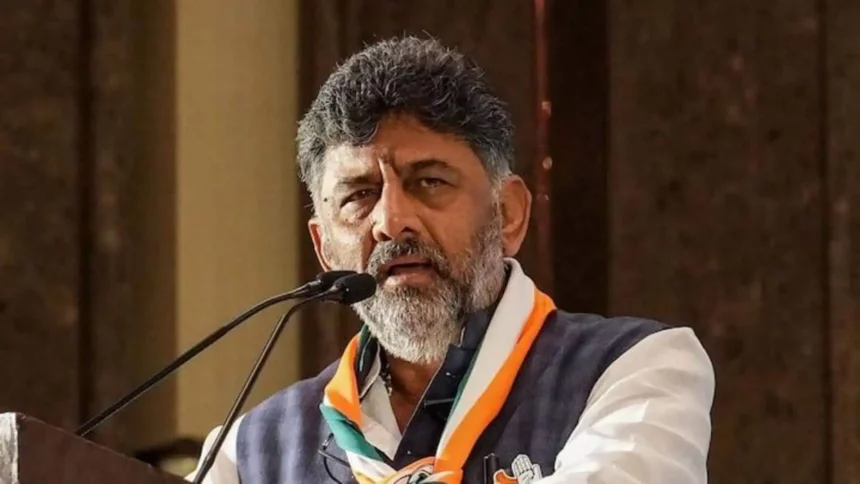
The political landscape in Karnataka has been set ablaze following remarks by Deputy Chief Minister DK Shivakumar asserting that the Chamundi Hills and the Chamundeshwari temple “belong to all communities, not just Hindus.” His comments came amid the controversy surrounding author Banu Mushtaq inaugurating this year’s Mysuru Dasara festival, a move that had already drawn opposition from the Bharatiya Janata Party (BJP). By stating that the temple and the deity are not exclusively the property of Hindus, DK Shivakumar triggered a storm of criticism, accusations of hurting religious sentiments, and heated debates on social media. The remarks have intensified the ongoing discourse about secular access to places of worship and the intertwining of religion and politics in India, particularly during high-profile cultural events like Mysuru Dasara. DK Shivakumar defended his statements by emphasizing inclusivity and arguing that the temple has historically been visited by people from multiple faiths, drawing parallels to other revered sites such as churches, mosques, Jain temples, and gurdwaras.
DK Shivakumar’s Statement and Defense of Inclusivity
During a public address in Karnataka, DK Shivakumar sought to clarify his position amid the controversy, stating that Chamundi Hills and the Chamundeshwari temple do not belong solely to Hindus. He highlighted that people from diverse communities have historically visited the temple, offered prayers, and practiced their beliefs freely. “Chamundi Hills and the Goddess Chamundeshwari belong to all communities. It is not the property of Hindus alone. People from every community go there, offer prayers, and follow their beliefs,” DK Shivakumar remarked, emphasizing the pluralistic nature of religious practice in the region.
DK Shivakumar drew attention to his personal experiences as a citizen of a diverse society, noting, “I myself visit churches, mosques, Jain temples, and gurdwaras. Has anyone ever stopped me? Likewise, have we ever stopped others from visiting Hindu temples?” By framing the debate in terms of individual freedom of worship and mutual respect among different faiths, he positioned the controversy as primarily political, rather than religious. DK Shivakumar further questioned the basis of restricting access to religious sites, asking rhetorically, “Has anyone ever said that only Hindus can visit the Ayodhya Ram temple? Where is such a rule written?”
His remarks were also aimed at defending the invitation extended to Banu Mushtaq for the inauguration of Mysuru Dasara. The Deputy Chief Minister argued that the presence of people from different communities in religious and cultural events should be seen as a symbol of India’s secular and inclusive heritage rather than a cause for political backlash. By asserting that the temple does not exclusively belong to Hindus, DK Shivakumar sought to underline the shared cultural ownership and historical pluralism of religious sites in Karnataka and across India.
DK Shivakumar’s position taps into a broader discussion about the accessibility of religious sites in India, reflecting the reality that many temples, mosques, churches, and other religious centers have been visited by devotees from multiple faiths over centuries. His defense aligns with the constitutional principle of secularism and the right to freely practice one’s religion, while simultaneously challenging political narratives that claim exclusive ownership over religious spaces for electoral gains.
Political Backlash and Criticism
The BJP’s Karnataka unit responded swiftly to DK Shivakumar’s remarks, accusing him and the Congress party of disrespecting Hindu traditions and sacred spaces. Through a statement on social media platform X, the party highlighted its disapproval, saying, “After Dharmasthala, Congress has set its sights on the abode of the state deity Chamundi Devi! To please the Congress high command, DCM @DKShivakumar has declared that Chamundi Hill does not belong to Hindus.” The party further warned that the Congress’s position on religious spaces could have political repercussions, suggesting that the party was likely to face setbacks in the state due to its perceived insensitivity toward Hindu sentiments.
The BJP’s statement also used emotive language to criticize DK Shivakumar personally. Party leaders claimed, “You, who used to bark like a dog, have already turned into a frog. If you go to mess with Chamundi Mother, beware, you will turn to ashes politically.” Such rhetoric underscored the intense politicization of religious spaces in Karnataka, particularly during major cultural festivals like Mysuru Dasara, where religious symbolism and public sentiment intersect with electoral politics. The BJP accused the Congress of aiding what they described as “the insult to Hindu religion” and of tarnishing the Hindu tradition associated with Vijayadashami celebrations.
Prominent figures outside of party politics also expressed disapproval. Mysuru MP and member of the Wadiyar royal family, Yaduveer Krishnadatta Chamaraja Wadiyar, described DK Shivakumar’s remarks as “unfortunate.” He highlighted the historical significance of the Chamundeshwari temple, noting that it has been a place of devotion for over a thousand years and is recognized as one of the Shakti Peethas developed by devotees across centuries. According to him, remarks suggesting communal or inclusive ownership, when made in a politically charged context, risk undermining the reverence and sanctity associated with such historic religious sites.
The controversy has sparked widespread debate on social media, with users split between those supporting DK Shivakumar’s view of inclusivity and those criticizing the perceived disregard for Hindu traditions. The discussion also raises questions about how political figures navigate the delicate balance between upholding secular principles and respecting long-standing religious sentiments, especially during culturally significant festivals.
DK Shivakumar’s remarks arrived at a sensitive moment, coinciding with the inauguration of Mysuru Dasara, an event that draws national attention and embodies Karnataka’s rich cultural and religious heritage. The BJP’s opposition to Banu Mushtaq’s participation had already fueled controversy, with DK Shivakumar’s statements intensifying the debate. By framing the temple and deity as accessible to all communities, he positioned his argument within a secular and inclusive framework, contrasting sharply with the BJP’s position, which emphasized exclusive Hindu association with the temple.
Furthermore, the political ramifications extend beyond immediate religious sentiment. Karnataka is a key battleground state, and public opinion on cultural and religious matters can heavily influence electoral outcomes. The debate over the Chamundeshwari temple’s accessibility reflects broader tensions between political parties in India over religion, cultural symbolism, and identity politics. DK Shivakumar’s statements can be seen as an attempt to assert Congress’s stance on inclusivity, while the BJP’s strong reaction underscores the party’s focus on consolidating support among Hindu voters.
The controversy also highlights historical and cultural dynamics in Karnataka, where religious sites like Chamundi Hills have long served as shared spaces for devotion, irrespective of community or faith. DK Shivakumar’s defense of Mushtaq’s participation and the temple’s accessibility resonates with a segment of the population that values secularism and pluralism, while critics frame it as an affront to Hindu heritage and local traditions. The tension between these perspectives reflects the ongoing struggle in Indian politics to reconcile secular constitutional principles with deep-rooted religious and cultural identities.
DK Shivakumar’s remarks and the ensuing backlash further demonstrate how political narratives are crafted around religious symbols. The Chamundeshwari temple, being a prominent Shakti Peetha, carries not only spiritual significance but also historical and cultural weight. The debate over who “owns” or has exclusive rights over such spaces is emblematic of broader contests over cultural authority, historical interpretation, and political legitimacy.
In addition, the discussion touches on comparative examples in other parts of India, such as access to the Ayodhya Ram temple, where debates over religious exclusivity and inclusive visitation rights have emerged in public discourse. DK Shivakumar’s rhetorical question—“Has anyone ever said that only Hindus can visit the Ayodhya Ram temple? Where is such a rule written?”—invites reflection on the legal and historical dimensions of access to religious sites, raising important questions about inclusivity, secularism, and community rights in a pluralistic society.
As the political debate continues, Karnataka’s citizens, devotees, and cultural commentators remain divided on the issue. Some view DK Shivakumar’s remarks as a courageous defense of secularism and inclusivity, consistent with India’s constitutional principles. Others interpret them as politically motivated statements that risk offending a community deeply attached to its religious traditions. The broader discourse underscores the ongoing challenges of navigating religion, politics, and cultural heritage in a democratic society with diverse faiths and communities.