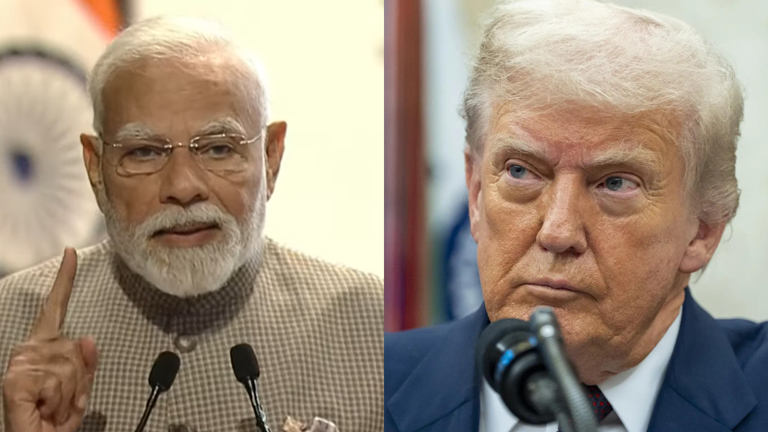
The United States has officially imposed steep 50% tariffs on Indian imports, marking a dramatic escalation in the ongoing trade tensions between New Delhi and Washington. The move, announced by President Donald Trump earlier this month, comes as a direct penalty for India’s continued purchase of oil from Russia despite repeated warnings from Washington. While the White House has defended the tariffs as a tool to choke off Moscow’s oil revenues and force Russian President Vladimir Putin to reconsider his war against Ukraine, New Delhi has denounced the decision as “unfair, unjustified, and unreasonable.” Prime Minister Narendra Modi, addressing the public in Ahmedabad, said India would withstand external pressures and reaffirmed his commitment to the interests of farmers, small-scale industries, and the pursuit of self-reliance or “swadeshi.”
US Tariffs Come into Force as Negotiations Collapse
The implementation of the additional 25% duties on top of the existing 25% tariffs officially took effect on August 27 at 9:31 am IST, pushing the total tariff burden on Indian imports to an unprecedented 50%. The US Department of Homeland Security had earlier published a draft notice confirming that higher duties would apply to Indian products “entered for consumption, or withdrawn from warehouse for consumption.”
This development comes after five exhaustive rounds of trade negotiations spanning several months, during which both India and the United States failed to reach a mutually acceptable trade deal. Washington’s insistence on curbing India’s energy imports from Russia remained the focal point of contention. For the Donald Trump administration, restricting India’s oil purchases was central to its wider sanctions framework designed to isolate Moscow internationally. For New Delhi, however, affordable Russian oil was seen as crucial for keeping inflation under control and ensuring energy security at a time when global markets remain volatile.
The tariffs are expected to hit a broad range of Indian exports to the United States, with exceptions carved out for shipments already in transit, humanitarian aid consignments, and items covered under reciprocal trade programmes. Interestingly, some of India’s most critical export sectors such as iron and steel, aluminium, copper, passenger vehicles, light trucks, auto components, pharmaceuticals, and electronics—including chips, mobile phones, and tablets—have been exempted from the punitive duties.
Despite these exemptions, exporters across several other sectors are bracing for an inevitable decline in orders from the US, India’s largest trading partner after the European Union. According to reports, the Indian government may consider offering financial assistance to affected exporters while also encouraging them to diversify into new markets such as China, Latin America, and the Middle East. An unnamed official told Reuters that policy interventions are being prepared to cushion the impact of this trade shock on India’s small and medium enterprises, which form the backbone of the export sector.
The tariffs reflect not just a trade dispute but also the shifting contours of geopolitics. For the Donald Trump administration, weaponising trade policy is part of a broader strategy to pressure countries into aligning with Washington’s foreign policy objectives. By targeting India, a strategic partner and a key player in the Indo-Pacific, the United States is signalling that no exception will be made for nations that defy its sanctions on Russia. However, the aggressive tariff regime risks souring bilateral ties at a time when both sides had recently celebrated two decades of the India–US Major Defence Partnership and were working on a new 10-year framework for defence and technology cooperation.
Adding further fuel to the fire, President Donald Trump on Monday also issued stern warnings to countries that impose “digital taxes” or implement “digital services regulations,” without naming any specific nation. In a sharply worded post on Truth Social, he declared that such taxes unfairly target American technology companies while giving Chinese firms a free pass. He threatened “substantial additional tariffs” and potential export restrictions on advanced technologies and semiconductors if countries did not roll back their digital regulations. This broader trade posture underscores Donald Trump’s willingness to use tariffs as leverage across multiple domains, not just in the context of energy sanctions against Russia.
PM Modi’s Defiance and the Swadeshi Narrative
Prime Minister Narendra Modi, while acknowledging the challenges ahead, has sought to project confidence and resilience in the face of escalating American tariffs. Speaking at a rally in Ahmedabad, he asserted that India would withstand external pressures and reiterated his commitment to protecting the interests of farmers, cattle-rearers, and small-scale industries. “For me, the interests of farmers, cattle rearers, and small-scale industries are paramount. Pressure on us may increase, but we will bear it all,” he declared, striking a tone of defiance that resonated with his audience.
During another address in Gujarat the following day, PM Modi expanded on his vision of “swadeshi,” or self-reliance, in economic terms. “My definition of swadeshi is simple. I do not have any concern about whose money it is—whether it is dollars or pounds, or where it comes from. What matters is that the sweat and the hard work should be Indian,” he said. This emphasis on indigenous labour and effort reflects the PM Modi government’s long-standing narrative of economic nationalism and self-reliance, which gained momentum during the “Atmanirbhar Bharat” initiative launched in the wake of the COVID-19 pandemic.
The timing of PM Modi’s statements is significant. By invoking swadeshi and asserting that India will not bow to external pressure, he is attempting to turn a trade setback into a rallying point for economic nationalism. Historically, the idea of swadeshi has deep political resonance in India, dating back to the independence movement when it was invoked to resist British colonial economic dominance. PM Modi’s adaptation of this concept in a 21st-century trade dispute with the United States is both a political strategy and an attempt to reassure domestic stakeholders that the government remains committed to protecting their interests.
For small-scale industries, farmers, and cattle rearers—groups that PM Modi explicitly mentioned—American tariffs could have indirect effects even if their sectors are not directly targeted. For example, higher tariffs on certain agricultural products or textiles could affect rural livelihoods dependent on exports. By foregrounding their concerns, PM Modi is signaling that his government is preparing for compensatory policies to mitigate the fallout.
At the same time, the push for swadeshi dovetails with India’s larger ambition of becoming a global manufacturing hub and reducing its dependency on imports. Over the last few years, the government has rolled out production-linked incentive (PLI) schemes in key sectors such as electronics, semiconductors, and renewable energy. These programmes aim to enhance domestic production capacity and position India as an alternative to China in global supply chains. The US tariffs, though painful in the short term, may ironically accelerate this inward push for economic self-sufficiency.
Yet, the broader implications for India–US relations cannot be ignored. For decades, Washington and New Delhi have painstakingly built a strategic partnership, underpinned by shared interests in counter-terrorism, maritime security, and balancing China’s rise in the Indo-Pacific. While differences on trade have persisted, both sides generally managed to compartmentalize disagreements and move forward on areas of convergence. The latest tariff episode, however, risks deepening mistrust at a time when bilateral ties were already under strain from disputes over visas, data protection rules, and digital services taxes.
Just two days before the tariff deadline, senior officials from both countries held a virtual meeting to discuss cooperation in trade, investment, energy security, and counter-terrorism. They also reviewed progress on finalizing a new 10-year framework for the Major Defence Partnership. The meeting, though cordial, underscored the paradox of the relationship: even as the two democracies emphasize their shared strategic vision, they remain locked in acrimonious disputes over trade and economic policies.
For Donald Trump, the tariffs on India serve multiple domestic and international objectives. They signal toughness to his political base at home, demonstrate commitment to confronting Russia abroad, and send a warning to other countries contemplating digital taxes or regulatory frameworks that Washington deems discriminatory. For PM Modi, however, the challenge is more delicate. He must shield vulnerable sectors of the Indian economy from the immediate impact of tariffs, maintain public confidence in his leadership, and at the same time preserve the long-term trajectory of India–US relations, which remain central to his foreign policy vision.
The path forward will not be easy. Indian exporters are already calculating losses, trade negotiators are bracing for a protracted standoff, and businesses across both countries are seeking clarity on how exemptions will be implemented. While the exemptions for key sectors such as pharmaceuticals and electronics provide some relief, the broader atmosphere of uncertainty will likely dampen investment sentiment. With both sides standing firm on their positions—Washington insisting on sanctions compliance and New Delhi refusing to compromise on energy security—the standoff may continue to shape not only trade flows but also the geopolitical balance in the Indo-Pacific.