The mgnrega bachao sangram reflects a deeper political struggle over rural livelihoods, federalism, and the future of rights-based welfare.
As india enters a new phase of political and economic debate around rural employment, the decision of the Indian National Congress to launch a nationwide movement titled mgnrega bachao sangram marks a significant escalation in opposition to recent policy changes. Scheduled to run from january 10 to february 25, the campaign is aimed at challenging the replacement of the long-standing rural employment guarantee framework with a newly enacted law that, according to the congress, fundamentally alters the nature of employment security in rural india. At the heart of the protest lies a broader argument about the role of the state in guaranteeing livelihoods, the balance of power between the centre and states, and the preservation of local self-governance institutions.
From rights-based employment to contested reform
The roots of the mgnrega bachao sangram lie in the legacy of the Mahatma Gandhi National Rural Employment Guarantee Act, a landmark legislation enacted in 2005 that transformed the rural welfare landscape. Mgnrega established a legal right to employment for rural households, mandating the provision of up to one hundred days of wage employment on demand. Over the years, it became more than just a social protection programme; it emerged as a critical safety net during economic slowdowns, agrarian distress, and crises such as droughts and pandemics. For millions of households, particularly among dalits, adivasis, and women, the scheme offered not only income support but also a measure of dignity and bargaining power.
The congress argues that the new rural employment law introduced by the central government represents a departure from this rights-based framework. According to party leaders, the new legislation shifts the emphasis from a legally enforceable guarantee to a more administratively driven model, where employment provision is subject to budgetary ceilings and centralised decision-making. This, they contend, weakens the core principle that made mgnrega unique: the obligation of the state to provide work on demand or compensate workers if employment is not provided.
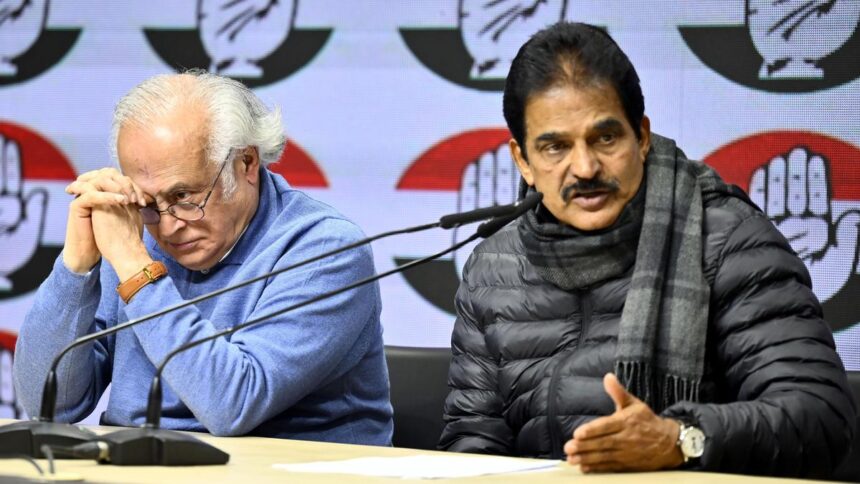
At press briefings announcing the nationwide campaign, senior congress leaders described the new law as a dilution rather than a reform. They argued that while the government has presented the changes as part of a broader vision for rural development, the practical outcome would be reduced autonomy for panchayats and greater uncertainty for workers. The congress has repeatedly emphasised that mgnrega was designed as a demand-driven programme, empowering local governments to identify works based on community needs. Any move towards centralisation, they claim, risks undermining this decentralised architecture.
The political context of the protest is equally significant. Rural distress, unemployment, and migration remain pressing issues in many parts of the country. For the congress, positioning itself as the defender of mgnrega is both a policy stance and a political strategy, aimed at reconnecting with rural voters and reasserting its role in shaping welfare discourse. By framing the campaign as a “sangram,” or struggle, the party seeks to evoke a sense of urgency and collective resistance, drawing parallels with earlier mass movements centred on social and economic rights.
Beyond immediate employment concerns, the congress has also raised constitutional questions. Party leaders argue that the new law alters funding arrangements between the centre and states in ways that could strain cooperative federalism. They have suggested that fixed cost-sharing formulas imposed without adequate consultation undermine the spirit of decentralisation enshrined in the constitution. In this narrative, the mgnrega bachao sangram is not merely about one scheme but about preserving institutional balances and democratic accountability in policy-making.
Nationwide mobilisation and the battle for rural political space
The structure of the mgnrega bachao sangram reflects an attempt to combine grassroots mobilisation with sustained political messaging. The campaign is planned as a multi-phase movement spanning more than six weeks, with activities designed to engage different levels of society, from village panchayats to state capitals. According to the congress, the emphasis will remain firmly on rural and semi-urban areas, where the impact of changes to employment schemes is most directly felt.
The initial phase of the movement focuses on awareness-building. District-level interactions, press conferences, and public meetings are intended to explain the implications of the new law and articulate the party’s objections. By foregrounding testimonies from workers and local representatives, the congress hopes to translate what might otherwise appear as a technical policy debate into a lived narrative of insecurity and loss. This approach reflects an understanding that rural employment policy resonates most strongly when framed in terms of everyday experiences rather than abstract legislation.
As the campaign progresses, the focus is expected to shift towards deeper community engagement. Panchayat-level meetings and local gatherings are designed to reinforce the idea that mgnrega was closely tied to grassroots democracy. By involving elected local representatives and community leaders, the congress aims to underline its argument that decentralised planning and implementation are essential for effective rural development. These interactions are also intended to build organisational momentum, ensuring that the movement is not confined to party offices but embedded within villages themselves.
The later stages of the sangram are planned to bring the protest into more visible public spaces, including state capitals. Demonstrations and symbolic actions at this level are meant to amplify the message nationally and apply pressure on both state and central governments. While the congress has emphasised that the movement will remain peaceful, its scale and duration signal an attempt to sustain political attention over an extended period rather than through isolated protests.
Strategically, the mgnrega bachao sangram also reflects the congress’s broader effort to consolidate opposition voices around issues of livelihoods and social welfare. The party has indicated that it is in dialogue with other opposition groups and state governments that share concerns about the new rural employment framework. By positioning mgnrega as a unifying issue, the congress hopes to build a wider coalition that cuts across regional and ideological lines, anchored in shared anxieties about employment and economic security.
The movement also highlights the evolving nature of political contestation in india. Welfare schemes are no longer debated solely on grounds of efficiency or fiscal cost; they are increasingly framed in terms of rights, dignity, and democratic participation. In this context, the congress’s critique of the new law emphasises not just what has changed, but how those changes alter the relationship between the state and citizens. The insistence on a rights-based approach reflects a belief that welfare programmes gain legitimacy and effectiveness when beneficiaries are treated as rights-holders rather than passive recipients.
At the same time, the government’s defence of the new law points to a different vision of governance, one that emphasises integration, standardisation, and administrative efficiency. This contrast sets the stage for a larger ideological debate about the future of social policy in india. The mgnrega bachao sangram thus becomes a focal point for competing narratives: one centred on decentralisation and legal guarantees, the other on reform and restructuring within a unified national framework.
As the campaign unfolds between january and february, its impact will be measured not only by the size of rallies or the intensity of protests, but by its ability to shape public discourse. For rural workers facing uncertain employment prospects, the debate touches on immediate survival. For policymakers and political observers, it raises questions about how india balances growth, welfare, and federalism in the years ahead. In that sense, the mgnrega bachao sangram is as much about the future direction of governance as it is about the fate of a single employment scheme.