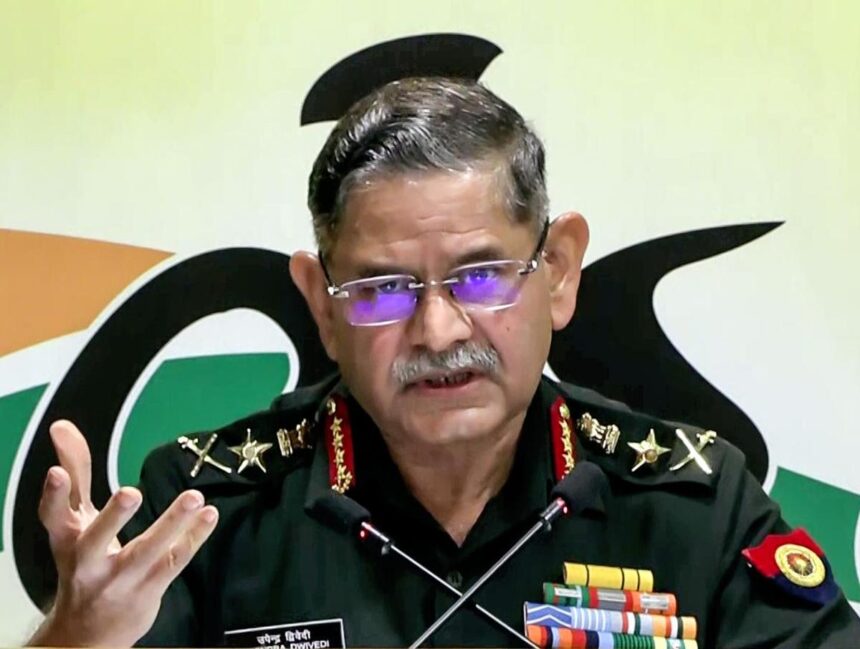
The ongoing Russia-Ukraine war has emerged as a real-time classroom for militaries across the world, and India is no exception. Army Chief General Upendra Dwivedi, speaking at the Delhi Defence Dialogue organized by the Manohar Parrikar Institute for Defence Studies and Analyses, called the conflict a “living laboratory” offering valuable lessons for future wars. Drawing parallels between the Ukrainian battlefield and India’s border realities, he stressed that modern conflicts are rapidly evolving with drones, electronic warfare, and information campaigns playing decisive roles even before conventional battles begin.
The Ukraine War as a Modern Warfare Classroom
General Dwivedi noted that the Indian Army is observing the developments in Ukraine closely, as the war provides insights into future battle scenarios. “The Ukrainian battlefield is a living lab in terms of the conditions we are having along our borders,” he said. Elaborating on the technological and tactical innovations seen in the conflict, he added, “Drones are stalking the armoured columns, electronic warfare systems are jamming radios, precision fires are reaching much beyond the 100-kilometre range, and information campaigns are winning wars even before a single shell lands.”
His remarks highlight the shift in modern military strategy — from conventional warfare to technology-driven operations. The conflict, according to the Army Chief, has underlined the importance of speed, precision, and digital dominance in determining the outcome of battles. He remarked that wars today are not just fought on land, air, and sea but across the information and cyber domains as well.
General Dwivedi further explained that the nature of global conflict is undergoing a major transformation. “As far as the future battlefield is concerned, it is the era of jostling and competition. The long peace is declining, and comprehensive conflicts are on the rise,” he said, referring to more than 50 ongoing global conflicts involving over 100 nations. The Army Chief’s comments reflect India’s growing emphasis on preparing for hybrid and multi-domain warfare, which blends conventional combat with cyber, space, and psychological operations.
He also made a pointed reference to the recent confrontation with Pakistan, stating that the Indian Army’s response under Operation Sindoor in May offered valuable lessons. The operation, launched after the April 22 Pahalgam terror attack that killed 26 people, saw India’s direct military action against terror and military installations across the border, including in Pakistan-occupied Kashmir (PoK). “We were empowered as far as Sindoor 1.0 is concerned. We have learned our lessons,” Dwivedi said, suggesting that those learnings are being integrated into planning for future missions like Sindoor 2.0.
Operation Sindoor: A Showcase of India’s Evolving Defence Capabilities
Operation Sindoor marked a turning point in India’s modern military doctrine, demonstrating its readiness to engage in swift and precise operations. The Indian Air Force and Army executed coordinated strikes on terror launch pads and command centres in PoK and Pakistan, with the operation concluding after a four-day confrontation from May 7 to May 10. Fighter jets, missiles, armed drones, and artillery units played crucial roles in the tightly controlled engagement, making it a landmark operation in India’s recent military history.
Chief of Defence Staff General Anil Chauhan, speaking at the same forum a day earlier, called Operation Sindoor a “compelling example of modern warfare.” He noted that the operation showcased India’s growing precision strike capabilities, integration of digital intelligence, and ability to conduct multi-domain tactics within compressed timelines. “Operation Sindoor is a compelling example of modern warfare, where precision strike capabilities, network-centric operations, digitised intelligence, and multi-domain tactics were effectively deployed within a compressed time-frame,” General Chauhan said during his special address on the impact of technology on modern warfare.
The operation was launched in response to Pakistan’s involvement in cross-border terrorism and marked India’s proactive stance against terror networks. According to military observers, the strikes reflected a new level of operational confidence and technological sophistication within the Indian armed forces. By combining advanced reconnaissance, AI-enabled targeting, and coordinated command structures, the operation underscored India’s ability to respond effectively to security challenges without escalating into prolonged conflict.
General Dwivedi added that open-source and predictive analysis played a significant role in the success of Operation Sindoor. “A lot of volunteers came forward inside the country, and the diaspora came forward and helped us,” he said. This cooperation, he noted, empowered the armed forces to act decisively. He emphasized that these experiences have become the foundation for shaping India’s approach to future conflicts. “Whether it is Sindoor 2.0 or any other battle thereafter, we are looking at it in a big way,” he added, signaling ongoing modernization and preparedness efforts.
The Army Chief’s remarks also underline the Indian military’s increasing reliance on technological tools such as artificial intelligence, satellite imagery, predictive analytics, and electronic surveillance to anticipate threats and execute operations with precision. His comments reflect a strategic shift from reactive defence to proactive deterrence, where technological superiority plays a pivotal role in ensuring national security.
India’s Strategic Outlook and the Changing Nature of Warfare
The Delhi Defence Dialogue served as a platform for policymakers, defence researchers, and industry experts to discuss the challenges and opportunities posed by emerging technologies in warfare. General Dwivedi’s address highlighted India’s intent to integrate lessons from global conflicts into its own defence planning, ensuring that the country stays ahead in the evolving landscape of military strategy.
He emphasized that the boundaries between peace and war are increasingly blurred. “The long peace is declining,” he said, hinting at a world where geopolitical rivalries are intensifying and flashpoints are multiplying. India’s defence strategy, he noted, must therefore adapt to the dynamics of competition and confrontation that define 21st-century warfare.
The Army Chief’s focus on drones, electronic warfare, and precision-guided weapons echoes the global consensus that future wars will be driven more by data and algorithms than by traditional troop movements. The Ukraine war, for instance, has shown how small drones equipped with surveillance and strike capabilities can alter battlefield outcomes. Similarly, cyberattacks and information campaigns have emerged as powerful tools to shape perceptions and undermine adversaries.
General Dwivedi’s remarks also reflect the Indian Army’s commitment to harnessing indigenous technologies under the ‘Atmanirbhar Bharat’ initiative. The push for self-reliance in defence production, combined with collaborations between the military, academia, and private sector, is aimed at creating a robust ecosystem for innovation. The Delhi Defence Dialogue brought together policymakers, researchers, industry leaders, and academicians to deliberate on how new-age technologies can be leveraged to enhance India’s defence preparedness.
The discussions also revolved around the need for strategic foresight and flexible doctrines that can accommodate rapid technological disruptions. Participants agreed that wars of the future will require militaries to be agile, data-driven, and capable of operating in multiple domains simultaneously.
General Dwivedi’s speech served as a reminder that the nature of conflict is undergoing a fundamental change. From hybrid warfare to information dominance, and from AI-assisted decision-making to space-based reconnaissance, the tools of war are evolving faster than ever before. The Army Chief underscored the need for constant adaptation, innovation, and collaboration to maintain a decisive edge.
As India looks to strengthen its strategic capabilities, the lessons from both the Russia-Ukraine war and Operation Sindoor will continue to guide its approach. The combination of real-world experience, technological advancement, and global awareness is shaping a new chapter in India’s military modernization — one that aims to ensure readiness for the unpredictable wars of the future.
The Delhi Defence Dialogue, through its discussions and insights, reaffirmed India’s resolve to transform its armed forces into a technology-driven, future-ready institution capable of defending the nation’s interests in an increasingly volatile global order.