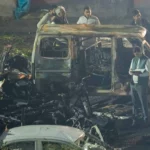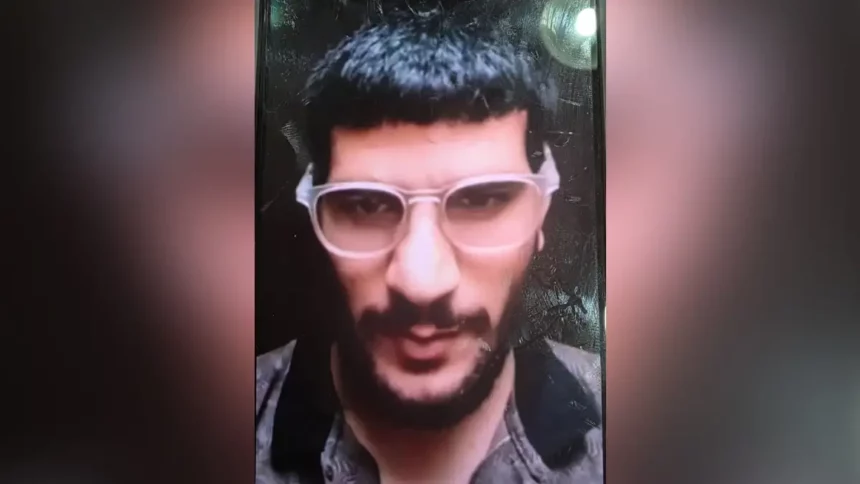
The Delhi Police on Thursday confirmed through DNA analysis that the man behind the wheel of the white Hyundai i20 that exploded near Delhi’s Red Fort on Monday evening was Dr Umar Un Nabi, a 35-year-old assistant professor from Pulwama, Jammu and Kashmir. This crucial finding has not only identified the main perpetrator but also established his direct involvement in one of the most alarming terror incidents to strike the national capital in recent years. The DNA confirmation came after investigators discovered a severed leg trapped between the steering wheel and accelerator of the car, believed to belong to the driver at the time of the explosion.
According to officials familiar with the probe, the forensic team at the Forensic Science Laboratory (FSL) matched the DNA from the recovered leg with that of Nabi’s mother, whose samples were collected in Pulwama and flown to Delhi for testing. This match served as conclusive proof that Umar Un Nabi was indeed the man who carried out the Red Fort blast. The development marks a major turning point in the investigation being jointly handled by the Delhi Police, the National Investigation Agency (NIA), and other intelligence units.
Investigators said Nabi’s leg was found trapped between the car’s steering and accelerator, a detail that corroborates their theory that he was driving the vehicle when it detonated. Officials described this discovery as critical forensic evidence, as it connects Nabi directly to the explosion and removes any ambiguity about his presence inside the blast site. The forensic laboratory has verbally confirmed the DNA match to the police, even as the complete written report is awaited.
DNA confirmation links Umar directly to Red Fort blast
Police officers involved in the investigation said multiple charred body parts were recovered from the car, the nearby post office, and even within the premises of adjacent shops and religious structures following the explosion. However, the most vital piece of evidence came from the leg that was found wedged in the driver’s compartment of the car. “The DNA test conclusively matched with Nabi’s mother’s sample,” a senior police official said, adding that the forensic match has removed all remaining doubt about the identity of the person who carried out the attack.
Officials said that this DNA match represents one of the most significant breakthroughs in the ongoing investigation, helping establish the blast as a well-planned terror incident. According to police, the blast was likely triggered by explosives that Nabi had been transporting in the vehicle. Investigators believe that the explosion occurred prematurely, possibly due to a technical failure or accidental detonation, leading to Nabi’s immediate death inside the car.
Sources revealed that Nabi was working as an assistant professor at Al Falah University in Haryana’s Faridabad. His professional background and movement patterns have shocked authorities, as he appeared to lead an ordinary life while secretly planning an act of terror. Police reports show that Nabi had close ties with two other individuals from Jammu and Kashmir—Dr Muzammil Shakeel Ganaie and Dr Adeel Rather—who were arrested earlier for their involvement in storing nearly 2,900 kilograms of ammonium nitrate, detonators, timers, and assault rifles in Faridabad.
Delhi Police officials said that Nabi purchased the white Hyundai i20 just 11 days before the explosion. He bought it from a local dealer in Faridabad, and CCTV footage captured him along with the dealer and his associate, Amir Rashid, during the transaction. However, after the arrest of Ganaie on October 30, Nabi reportedly went into hiding. When authorities seized the large stockpile of explosives from a Faridabad residence, Nabi panicked and fled towards Delhi, carrying with him a detonator and other materials that investigators believe he intended to use in further attacks.
Terror links deepen as second car found and network expands
Investigations have further revealed that Nabi’s movements were carefully tracked through CCTV footage collected from multiple areas across Delhi. The footage showed him driving through the Badarpur border, Connaught Place, Turkman Gate, Sunehri Masjid area, and finally approaching the Red Fort shortly before the explosion. Police sources said that although they initially could not confirm whether Nabi had died in the blast due to the condition of the remains, the DNA confirmation has now settled the question.
The forensic link has also allowed investigators to reconstruct the sequence of events leading to the blast. It appears that Nabi was alone in the vehicle when the explosives detonated. Police officers have since detained his mother and two brothers for questioning, mainly to understand his connections, sources of funding, and possible support network both in Haryana and Jammu and Kashmir. Their DNA samples were also collected to assist in the confirmation process.
On Wednesday, just a day before the DNA confirmation was received, investigators recovered another vehicle associated with Nabi—a red Ford EcoSport parked near Khandawali village in Faridabad. Preliminary inspection by a National Security Guard (NSG) bomb disposal team revealed suspected traces of ammonium nitrate inside the car. The NSG sealed off the area within a 50-metre radius while Haryana Police created an extended security cordon of 200 metres around the site. The car has since been handed over to the NIA for forensic analysis.
Officials said this second vehicle was used by Nabi to transport explosive materials, likely as part of a larger logistical chain linking Faridabad, Delhi, and several regions in Jammu and Kashmir. The discovery of the red EcoSport has been termed a “critical breakthrough” as it helps trace the network’s operational logistics and movement of explosive materials. The car was found parked outside the home of Farrukh Khan, an autorickshaw and JCB driver, who has been detained for questioning but is not currently considered a suspect.
Residents of Khandawali expressed disbelief at the developments, describing Farrukh as a simple and hardworking man with no apparent connection to terrorism. Police sources said that the car was registered under a fake Delhi address in Seelampur, reinforcing suspicions that Nabi and his associates used forged documents to mask their activities.
As the probe progresses, investigators are piecing together evidence that suggests Nabi had been working with a broader network involving individuals across multiple states. Intelligence inputs from Jammu and Kashmir indicated that this group was part of a recently busted terror module, responsible for storing and transporting large quantities of explosives and arms. The blast outside Red Fort, therefore, may not have been an isolated act but rather one part of a planned series of attacks.
Senior Delhi Police officials have described the identification of Dr Umar Un Nabi and the recovery of his vehicles as major strides toward uncovering the full scale of the conspiracy. The investigation now focuses on tracing the financial backers, logistical support, and ideological handlers behind the operation. Meanwhile, forensic experts continue to examine the chemical composition of the explosive residues to confirm whether the same ammonium nitrate batch seized earlier was used in the Red Fort blast.
With the DNA results confirming Nabi’s identity and the discovery of two vehicles linked to the terror module, investigators are closing in on the deeper network that coordinated the acquisition, transport, and storage of the explosives. The Red Fort explosion has triggered a multi-agency crackdown across Delhi, Haryana, and Jammu and Kashmir, aimed at dismantling any remaining sleeper cells connected to the case. The findings so far reveal a chilling picture of a well-educated individual who used his professional life as a cover while orchestrating one of the most alarming terror plots in the heart of India’s capital.