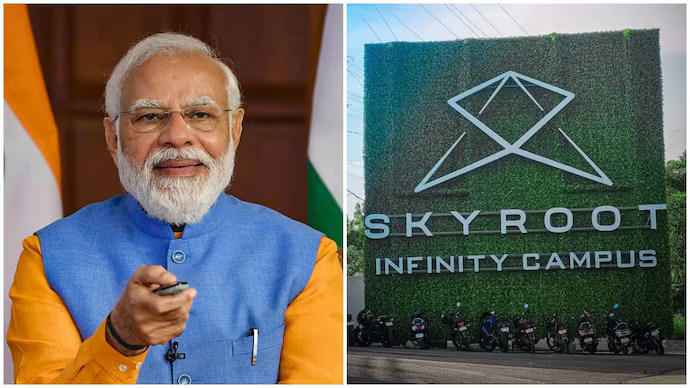
India’s space journey is entering a defining new chapter. Prime Minister Narendra Modi is set to unveil Vikram-I, the nation’s first privately developed orbital launch rocket, built by Hyderabad-based startup Skyroot Aerospace on Thursday, November 27, 2025, at 11 AM through video conferencing. The landmark event will also witness the inauguration of Skyroot’s new Infinity Campus, a 2,00,000-square-foot state-of-the-art facility built to design, integrate, test, and mass-produce multiple launch vehicles, including one orbital rocket every month. This milestone signals the growing strength of India’s private space sector and underlines the country’s ambition to emerge as a global space power through government-industry collaboration, commercial innovation, and rapid satellite deployment capabilities.
Vikram-I and Infinity Campus redefine India’s private rocket production, satellite deployment, and commercial space launch ecosystem
Skyroot Aerospace has steadily positioned itself as one of the most promising success stories to emerge from India’s growing private space sector. While the Indian Space Research Organisation (ISRO) laid the foundation of India’s space ambitions over several decades, Skyroot Aerospace has brought a fresh entrepreneurial spirit to the industry, showing that private players can also innovate, manufacture, test, and launch space-grade vehicles in record time. The unveiling of Vikram-I represents more than a product launch — it is a statement of intent that India’s private space companies are no longer supporting cast but key drivers shaping the future.
Founded by Pawan Chandana and Bharath Daka — both IIT alumni and former ISRO scientists — Skyroot Aerospace was born out of a simple but powerful idea: if India wanted to become a space superpower, it had to democratize access to space by creating a fast, affordable, scalable, and commercially sustainable space launch model. The founders believed that while ISRO’s rockets were powerful and reliable, India still needed a parallel private ecosystem that could build rockets far more rapidly, launch satellites more efficiently, and meet global commercial demand for small-to-medium satellite deployment.
The company’s Vikram programme is based on a modular rocket architecture approach, enabling flexibility depending on customer satellite needs — whether small payloads for Earth observation, research satellites for universities, or defense-grade orbital communication technology. Named after Dr. Vikram Sarabhai, the father of India’s space program, the Vikram rocket series honors India’s legacy while also representing a new future.
Vikram-I is a multi-stage orbital rocket designed to place satellites into Low Earth Orbit (LEO) — one of the most commercially demanded orbital pathways in the satellite launch market. Unlike sub-orbital flights, which reach space briefly before falling back to Earth, orbital rockets must reach precise velocity, altitude, and trajectory to insert satellites into continuous rotation around Earth. With Vikram-I, Skyroot Aerospace becomes the first Indian private company to develop an indigenous rocket system capable of orbital satellite deployment.
The rocket has been engineered using advanced 3D printing technology — especially for critical components like engines, nozzles, fuel injectors, and propulsion sub-systems. Skyroot Aerospace considers 3D printing a cornerstone of its manufacturing strategy, enabling reduction of parts, faster production timelines, lower structural weight, and improved combustion precision. Compared to traditional rocket fabrication, which can take 18 to 36 months, Skyroot aims to do it in weeks rather than years.
The Infinity Campus, also being inaugurated by PM Modi on November 27, has been built to further accelerate this ‘build-fast, launch-fast’ vision. The facility spans 2,00,000 square feet (around 1.85 hectares) and includes specialized centers for rocket design, development, manufacturing, payload integration, structural assembly, avionics testing, propulsion analysis, ground simulation, and comprehensive mission-level launch validation trials. More importantly, it has been built for capacity — not prototypes. The campus can reportedly build one orbital rocket every month, giving Skyroot Aerospace a production throughput unmatched in the Indian ecosystem.
This capability gives India a strategic advantage — especially in the satellite launch market, where turnaround time is becoming the most important differentiator. With global communication networks investing in LEO satellite constellations — companies like Starlink, Amazon Kuiper, European space startups, and Asian telecommunication incubators planning thousands of satellites — launch service providers need to be scalable, flexible, affordable, and fast. Vikram-I has been engineered to cater to that demand.
Each stage of the rocket has been developed to offer optimized thrust-to-weight ratios, precise guidance algorithms, and automated flight stability corrections. The payload bay has been built to accommodate multiple satellite sizes, including nano-satellites, micro-satellites, research-grade payload modules, defense-aligned orbital sensors, and remote-sensing earth observation satellites. Skyroot Aerospace has stated that the rocket is designed for LEO injection, with the possibility of future upgrades for sun-synchronous orbit, geostationary transfer orbit (GTO), and other mission-specific orbital pathways based on client demand.
The company earlier made history in November 2022 when it launched Vikram-S, India’s first privately developed sub-orbital rocket to reach space. The development from Vikram-S to Vikram-I in just 3 years reflects a uniquely fast innovation timeline — one rarely achieved even by global space startups outside India. Vikram-S was designed as an early validation test vehicle that helped the company demonstrate propulsion reliability, avionics stability, launch structure capability, telemetry synchronization, real-time launch intelligence, and mission-level safety validations. While Vikram-S briefly touched space before descending back to Earth, Vikram-I will deploy satellites into continuous orbital flight.
The unveiling event will also inaugurate the Infinity Campus, which functions as a launchpad for innovation and industrial-level scalability. Unlike typical IT R&D hubs that focus only on software simulations, Infinity Campus combines physical space engineering with real-world launch-grade hardware manufacturing. Each mechanical tolerance, engine combustion trajectory, stage separation sequence, inertial navigation algorithm, avionics synchronization, and payload detachment system undergoes full ground-based testing before flight validation.
Skyroot Aerospace’s launch infrastructure strategy also includes rapid launch assembly, reusable fabrication components (where applicable), reduced rocket structural mass, and affordable per-satellite launch cost models. The founders believe that the next decade will be driven not by space exploration alone but by space commercialization — a shift happening globally. India, however, has entered this race late compared to China and the USA. This is where private rocket startups like Skyroot Aerospace fill the gap.
Policy reforms, private sector participation, orbital innovation, and government-industry space collaboration drive India toward global space competitiveness
India has come a long way since its first satellite Aryabhata was launched in 1975 on a Soviet rocket. The journey, once limited to government-run laboratories, space scientists, and public funding cycles, has now expanded into private entrepreneurship. The credit for this shift goes largely to structural reforms introduced by the Government of India since 2020, which opened the space sector to private competition.
One of the most important changes came through the establishment of IN-SPACe (Indian National Space Promotion and Authorisation Centre), an independent nodal agency created to regulate, support, authorize, and enable private companies to conduct satellite launches, use ISRO’s launch infrastructure, build space vehicles, commercialize orbital deployments, test rocket propulsion independently, and sign global satellite launch contracts. This development changed India’s space sector landscape forever.
Skyroot Aerospace was one of the first companies to benefit from these reforms. Before IN-SPACe existed, private companies struggled to access government-grade launch facilities, rocket fabrication infrastructure, propulsion testing centers, range authorization protocols, real-time launch intelligence networks, telemetry precision data, and satellite integration docking chambers. The entire ecosystem was limited to government-run projects.
The reforms, however, made space innovation competitive. Private startups could now raise funding independently, hire global propulsion experts, partner with defense agencies, design modular orbital rockets, test multi-stage engine separation hardware, get clearance for commercial launch trials, and contribute strategically to India’s space economy.
Skyroot Aerospace has raised funding from major investors including sovereign funds, venture capital firms, engineering accelerators, global defense-aligned space tech incubators, private equity space enthusiasts, Indian industrial tech conglomerates, satellite-data companies, university research networks, and global LEO communication providers. This allowed the company to transition from concept to commercial rocket engineering faster than expected.
India’s satellite launch market is also expanding rapidly. The country is a preferred hub for cost-effective space launches owing to its engineering talent, lower launch production costs, favourable geography near the equator, strong industrial hardware supply chains, rapidly growing startup ecosystem, deep engineering manpower talent, high-precision launch intelligence networks, defense-aligned orbital hardware partnerships, and growing government backing for commercial space innovation.
Space is no longer only about exploration — it is about data. Today, satellites power digital payment systems, weather forecasting, cyclone tracking, defense-aligned orbital intelligence, secure communication networks, aviation-grade navigation signals, border monitoring infrastructure, maritime tracking systems, global space imaging, missile trajectory monitoring intelligence, climate satellite mapping, educational satellites, disaster mapping solutions, mineral imaging, 5G orbital communication docking, mid-orbit data hubs, global communication uplinks, and future internet-communication constellations.
India now launches more than 100 satellites for private companies every year using ISRO rockets but does not have enough rockets to match global launch demand. For instance, China has 19+ private orbital launch companies, USA has 40+, Europe has 15+, Russia has 7+, Australia has 6+, and Japan has 10+ private rocket programmes. India had none until 2022, when Vikram-S launched as the first privately developed Indian rocket to touch space.
With Vikram-I India will now enter orbital-grade private rocket satellite deployment for the first time. This gives India strategic autonomy in satellite deployment, commercial LEO space race participation, space economy partnership acceleration, independent rocket propulsion manufacturing scalability, defense-aligned orbital intelligence manufacturing growth, and future reusable launch solutions.
What makes Vikram-I particularly strategic is its payload segment focus. ISRO already has powerful rockets like PSLV, GSLV, LVM3 etc., that can launch satellites easily into orbit, but these rockets are large and expensive for the small-satellite market. India’s private sector mostly needs *small-to-medium satellite launchers*, and this is exactly what Vikram-I offers.
Each stage of this rocket has been powered by solid-liquid hybrid propulsion technology. Solid propulsion gives faster initial thrust for rocket detachment from Earth while liquid propulsion helps LEO orbital insertion with greater trajectory control and navigation precision.
Skyroot Aerospace rocket production is being built for commercial continuity — not government cycles. Global space rocket firms launch satellites rarely and take long production timelines but Skyroot aims to mass-produce 12 orbital rockets every year — nearly 1 orbital rocket every month — a production pace unmatched even by some state-funded international launch agencies.
The Infinity Campus will supply mass-manufacturing support for real-world launch algorithms, propulsion testing, hardware integration validation, avionics synchronization testing, satellite payload docking, mission flight configuration engineering, orbital detachment simulation testing, internal rocket guidance intelligence, external telemetry integration, defense-aligned orbital payload detachment, and commercial LEO satellite injection analysis.
Global companies increasingly demand LEO satellite constellation deployment — not single satellites and LEO networks require hundreds or even thousands of satellites launched in short intervals. This opportunity is now open for Skyroot Aerospace to serve.
India’s space economy is also growing fast. The Indian space economy was valued at around USD 8.4 billion in 2022, USD 13 billion in 2024, estimated USD 24 billion in 2027, and expected to cross USD 44 billion by 2030. Most of this growth will be driven by satellite data, orbital internet communications, commercial space launch programs, defense-aligned rocket manufacturing orbital contracts, global LEO communication networks, climate satellite mapping contracts, university research satellite deployments, defense-aligned orbital intelligence, reusable propulsion rocket manufacturing, orbital remote sensing satellite modules, 4G/5G orbital communication modules, missile telemetry orbital tracking sensors, defense-aligned orbital hardware modules, climate satellite commercial partnership data injection, non-military commercial satellite orbital contracts, astronomy research orbital deployments, private rocket orbital flights, future space tourism test flights, reusable orbital hardware modules, rapid propulsion engine segment, Indian rocket export engineering modules.
While ISRO will continue to power large national missions, private companies like Skyroot will power commercialization, scalability, affordability, and turnaround.
Prime Minister Narendra Modi’s unveiling of Vikram-I underscores the national importance of private rockets to India’s future. This is not merely engineering — it is geopolitics, economics, innovation, data, defense technology, digital orbit autonomy, telecommunications orbit scalability, national space accessibility democratization, commercial LEO satellite deployment investment, orbital innovation acceleration capability.
As India stands on the threshold of becoming a global hub for commercial satellite deployment, Skyroot Aerospace is set to be one of the companies shaping that national vision through fast, affordable, indigenous, scalable rocket manufacturing and satellite orbital launch deployments.