In the race to dominate the future of artificial intelligence, tech leaders are growing increasingly detached from the real-world implications of the technology they champion. As billionaires promise sweeping revolutions, their casual dismissal of job displacement paints a troubling picture: a trillion-dollar industry more obsessed with innovation than the livelihoods it threatens to upend.
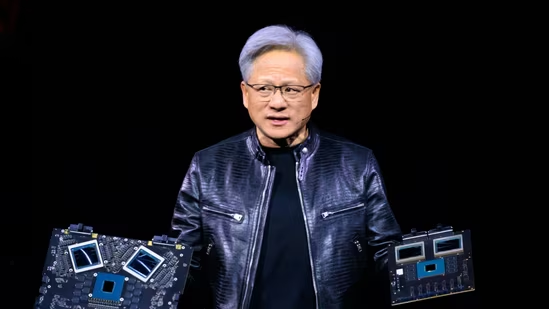
At the recent Milken Institute Global Conference, Nvidia CEO Jensen Huang delivered a statement that, while meant to be insightful, exposed the widening gap between tech elites and everyday workers. “Every job will be affected,” he said. “Some jobs will be lost, some jobs will be created. But every job will be affected. And immediately, it is unquestionable, you’re not going to lose your job to an AI, but you’re going to lose your job to somebody who uses AI.”
The message, framed as a warning, instead sounded like a shrug. It highlighted a common refrain among Silicon Valley executives: disruption is inevitable, so adapt or fall behind. But for millions whose jobs are at risk—not a decade from now, but within the next few years—this kind of statement offers little comfort, guidance, or responsibility.
The God Complex in Tech Culture
There is a persistent pattern among Silicon Valley leaders—a belief that technological advancement is not only inevitable but inherently virtuous. When AI enters the conversation, this belief often transforms into what critics have called a “God complex.” From Meta’s Mark Zuckerberg to Tesla’s Elon Musk and OpenAI’s Sam Altman, many of the most powerful voices in tech frame their innovations as not just beneficial, but essential for human progress.
This mindset allows them to speak with a kind of detached omnipotence. Job loss? A necessary sacrifice. Social upheaval? A transition phase. Questions about ethics, regulation, and the human impact are often waved off as barriers to progress. The underlying message: trust us, we know what we’re doing. Yet history tells a different story.
Previous industrial revolutions—from the steam engine to the internet—did result in new kinds of employment. But the transition periods were brutal, and the benefits unevenly distributed. This time, the disruption is happening faster, and the safety nets are thinner. Unlike the past, AI doesn’t just automate repetitive tasks—it can write code, design graphics, make strategic decisions, and even produce entire films or legal documents. The threat is no longer confined to blue-collar jobs; it’s coming for creatives, knowledge workers, and even engineers.
Big Tech’s Tone-Deaf Optimism
When tech leaders are asked to elaborate on which new jobs will be created in the AI era, the answers are vague at best. They often speak in aspirational terms about prompt engineers, AI ethicists, or new creative roles, but these jobs are few and require high-level expertise. They do little to address the looming crisis for millions of people whose current roles are not easily transferable.
The reality is, retraining programs are either underfunded or non-existent, and the onus is increasingly placed on individuals to stay relevant in a rapidly evolving job market. Meanwhile, companies continue to slash workforces while reporting record profits, attributing layoffs to “restructuring for AI adoption.”
This dissonance between financial success and human fallout reveals the extent to which tech executives have insulated themselves from the societal impact of their decisions. They see themselves as futurists, not as employers with moral obligations.
In recent years, some of the largest tech firms—Google, Meta, Amazon—have laid off tens of thousands of employees, often citing the need to pivot to AI or streamline operations. In press releases, these companies tout their vision for an AI-powered future, but rarely do they acknowledge the human cost of reaching it. It’s a narrative where disruption is celebrated and casualties are footnotes.
The issue is not that tech shouldn’t evolve—it must. But evolution without accountability leads to exploitation. AI has the potential to enhance productivity, cure diseases, and solve complex problems. However, it also threatens to widen the gap between the elite and the working class unless checks are put in place.
The problem isn’t just what the technology can do—it’s how it’s being deployed, who controls it, and who gets left behind. And right now, the people making those decisions are surrounded by wealth, power, and a profound lack of empathy for those on the outside looking in.
This disconnect between AI evangelists and the global workforce is growing more pronounced with every keynote speech and corporate announcement. Instead of preparing the world for the future, many tech leaders seem content to build that future for themselves—while telling everyone else to catch up.
As AI continues to reshape industries, it is imperative that the conversation around job loss and workforce transformation is not dominated solely by those who stand to profit from it. We need broader coalitions—governments, labor unions, educators, and communities—at the table. We need transparency in AI development, and we need corporate responsibility that goes beyond PR campaigns and blog posts.
Until then, the warnings from the top sound less like wisdom and more like indifference dressed up as inevitability. And that should concern us all.