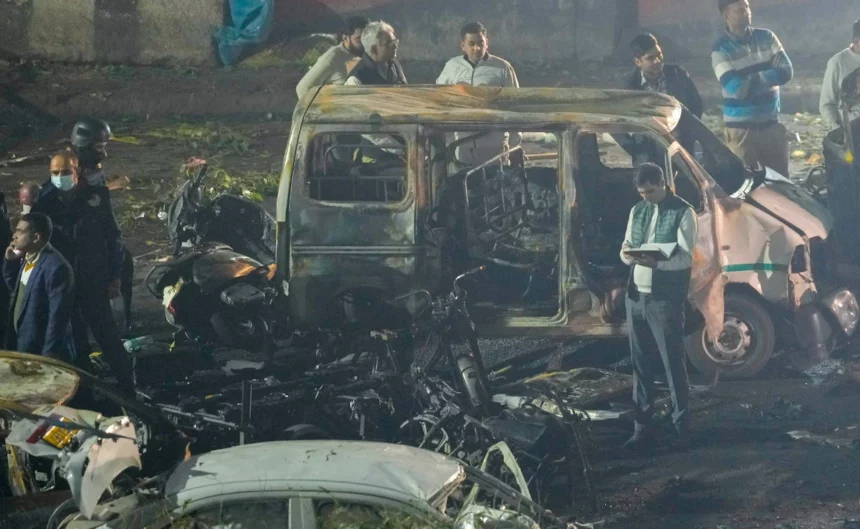
In a significant breakthrough in the investigation into Monday’s Red Fort blast in Delhi, suspected traces of ammonium nitrate were found in a red Ford EcoSport recovered near Faridabad’s Khandawali village. The car, owned by Dr. Umar Un-Nabi, the prime suspect in the case, has become a key piece of evidence in the expanding probe that now spans multiple states. Officials from the National Security Guard (NSG), the National Investigation Agency (NIA), and the Haryana Police jointly examined the site as the case deepens into a major counterterrorism investigation.
Suspected Traces of Explosives Found in Faridabad Vehicle
According to preliminary reports, the red Ford EcoSport, bearing the Delhi registration number DL10 CK 0458, was discovered parked outside a house near Khandawali village. The car was traced on Wednesday after intelligence inputs from the Jammu and Kashmir Police indicated that it was among several vehicles used by a terror module allegedly responsible for the Red Fort blast. Upon receiving the alert, an NSG bomb disposal team was rushed to the scene, where they immediately sealed an area within a 50-metre radius of the vehicle. The Haryana Police extended the security perimeter to 200 metres, ensuring that residents were evacuated and the area was fully cordoned off.
Officials present at the scene confirmed that the NSG team carried out a detailed inspection of the vehicle to verify whether it contained any hidden explosive materials. “The preliminary inspection suggests that the car might contain traces of ammonium nitrate,” said a senior police officer familiar with the operation. “Samples have been collected and sent for laboratory testing to confirm the chemical composition. The indications so far point toward the same compound being used for transporting explosive materials across multiple vehicles and locations before the blast.”
The discovery of ammonium nitrate traces in the vehicle follows the recovery of nearly 2,900 kilograms of the same compound, along with detonators, timers, and assault rifles, from various locations after the Red Fort blast. Investigators believe that the explosive material was distributed across a network of vehicles to avoid detection. This method, they say, reflects the sophisticated planning and coordination involved in the terror plot.
Faridabad Police spokesperson Yashpal Singh said that the vehicle was found parked near the premises of one Farrukh Khan, who works as an autorickshaw and JCB driver. “The car has been seized and handed over to the National Investigation Agency (NIA) for a detailed forensic examination,” Singh stated. The vehicle’s seizure marks a critical moment in the ongoing investigation, as it could help trace the logistical movement of the explosives used in the Delhi blast.
Leads Point to Wider Terror Network Across States
Following the recovery, Farrukh Khan was detained for questioning by the local police. However, early reports suggest that he might not be directly involved in the incident. “He is a poor man and appears to have no connection with Dr. Umar or any known terror activity,” said another senior officer. Local residents of Khandawali village also expressed disbelief over the developments, emphasizing Farrukh’s simple lifestyle and lack of means to be involved in any such operation.
“Farrukh is a hardworking man who barely earns enough to support his family. It is difficult to believe he could have any link to terrorists,” said Mohammad Mubin, one of his neighbors. Another villager, Shakir Hussain, added, “He doesn’t even own a car. We were shocked when we heard that a suspicious vehicle was found outside his home.”
The investigators have since confirmed that the red Ford EcoSport was registered under a fake address in Delhi’s Seelampur area, known for its dense population and frequent use of false documents in illegal vehicle registrations. According to intelligence sources, Umar Un-Nabi, the primary suspect, is believed to have used the car for reconnaissance missions and to transport explosive materials ahead of the Red Fort blast. Officials said that the car’s recovery would play a crucial role in reconstructing the events leading up to the explosion and identifying the individuals who assisted Nabi in executing the plan.
The NSG team conducted multiple scans of the vehicle using advanced detection devices to rule out the presence of secondary explosive materials. Forensic experts are also examining residue samples found inside the car, including traces from the seats, boot space, and undercarriage. These samples are being analyzed to determine whether the ammonium nitrate present in the vehicle matches the compound recovered from other sites connected to the blast. If confirmed, the link would establish that the same terror group coordinated the movement of explosives across Delhi, Haryana, and Jammu and Kashmir.
A senior NIA official described the recovery as “a critical breakthrough” in tracking the movement of the accused. “This discovery helps us piece together the logistics network used by the suspects. It shows that the operation involved multiple vehicles and locations to divert attention from the main target,” the official said. The NIA is now focusing on identifying individuals who may have provided logistical support, safe houses, or false documentation to the accused.
The Red Fort blast, which shook Delhi on Monday evening, has since triggered a series of coordinated operations across North India. Multiple agencies, including the Intelligence Bureau (IB) and Research and Analysis Wing (RAW), are believed to be assisting in analyzing the communication trails of suspects linked to the case. According to intelligence sources, Dr. Umar Un-Nabi, who has been missing since the blast, was previously under the scanner for suspected links to radical groups based in Kashmir. His recent activities, including frequent travel between Delhi and Srinagar, have come under renewed scrutiny.
Investigators suspect that Umar was part of a larger network that coordinated the movement of explosive materials using fake identities and stolen or fraudulently registered vehicles. The use of ammonium nitrate—a fertilizer compound that can be used as an explosive when mixed with certain chemicals—points to a deliberate attempt to evade detection while assembling a powerful device capable of causing widespread destruction.
Forensic experts from the NIA and NSG are now analyzing CCTV footage, call data records, and financial transactions associated with Umar and his associates. They are also examining possible links between the Delhi blast and earlier seizures of ammonium nitrate in Haryana and Uttar Pradesh. A series of raids have been conducted in Delhi’s Seelampur, Lajpat Nagar, and Jamia Nagar areas to trace individuals who might have assisted in vehicle procurement and transportation.
Meanwhile, local police in Faridabad and neighboring regions have been instructed to remain on high alert. Additional security checkpoints have been established across key routes connecting Delhi and Haryana, particularly along National Highway 19. “We are taking no chances. Every vehicle that matches the description or registration pattern of those linked to the case is being thoroughly inspected,” said an officer involved in the operation.
Officials are also examining whether the ammonium nitrate transported in these vehicles was stored at multiple safe houses before being assembled into the explosive device used in the blast. Intelligence inputs suggest that some of the material may have been brought from industrial suppliers under the guise of agricultural or construction use. The NIA is investigating whether fake trade licenses or invoices were used to purchase and move such materials without raising suspicion.
The case has also highlighted the increasing use of cross-border logistical routes by terror networks to transport explosive materials through legitimate supply chains. Investigators are exploring potential links with smuggling routes in Punjab and Jammu, which have historically been used to move weapons and narcotics.
The NSG and NIA teams have maintained a constant presence at the Faridabad site since the recovery. High-resolution imaging, chemical analysis, and fingerprint extraction are being carried out under strict supervision. According to officials, even minor evidence from the car could prove vital in tracing the network of individuals involved in one of the most audacious terror plots in recent years.
In Delhi, security has been tightened around heritage sites, government buildings, and crowded public areas, as authorities fear the possibility of additional planned attacks. The Ministry of Home Affairs has ordered a comprehensive review of urban security infrastructure, emphasizing the need for better coordination among state police forces and central intelligence agencies.
As the investigation unfolds, the discovery of suspected ammonium nitrate in Faridabad marks a major turning point in the Red Fort blast case. It not only sheds light on the planning and coordination behind the attack but also underscores the complexity of modern terror operations that exploit urban infrastructure, fake documentation, and legitimate trade systems to conceal their tracks.
Officials remain confident that with the new forensic leads, the NIA will be able to map the entire chain of events leading up to the explosion and identify the individuals responsible for one of Delhi’s most serious security breaches in recent memory.