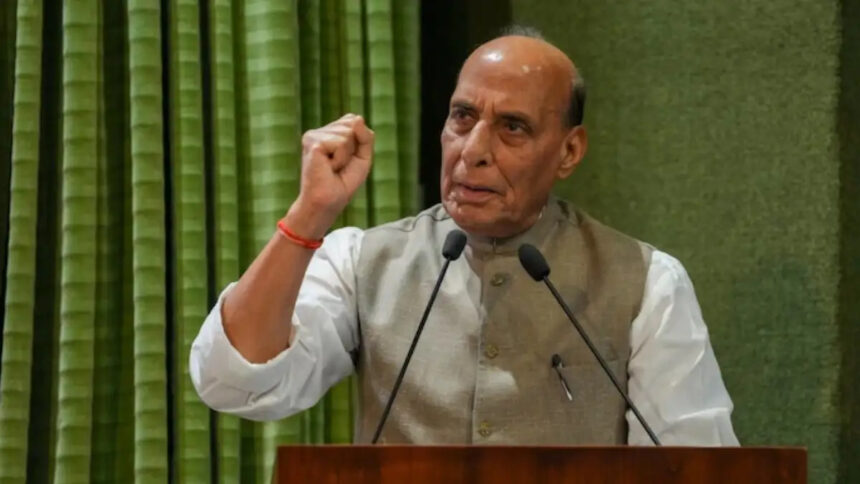
India and Pakistan have once again found themselves entangled in a fresh diplomatic confrontation after Defence Minister Rajnath Singh’s recent comments hinting that Sindh “may return to India” sparked sharp criticism from Islamabad. Pakistan’s Ministry of Foreign Affairs issued a strongly worded statement calling the remarks “delusional,” “dangerously expansionist,” and a violation of established international principles. The incident has reignited debates around territorial claims, historical narratives, political messaging, and the fragile state of India-Pakistan relations at a time when tensions between the two nuclear-armed neighbours remain high.
*Pakistan’s Strong Objection to Rajnath Singh’s Remarks and the Political Significance Behind Them*
The controversy began when Defence Minister Rajnath Singh, while addressing a public gathering, referenced Sindh within a historical and cultural context, suggesting that the region “may return to India” in the future. Though political leaders in India often make such statements in a symbolic or ideological framework, the comments immediately triggered outrage in Pakistan, with officials interpreting the remark as a direct challenge to Pakistan’s sovereignty.
In its official response, the Pakistan Ministry of Foreign Affairs condemned the remarks outright, describing them as rooted in an “expansionist Hindutva mindset.” Pakistan argued that Singh’s statement represented an attempt to rewrite history, undermine the sanctity of recognized borders, and promote a revisionist political ideology. The ministry accused India of harboring territorial ambitions extending beyond Jammu and Kashmir and framed Singh’s remarks as part of a broader ideological shift in New Delhi’s foreign and security policy.
Pakistan maintained that such comments not only inflame bilateral tensions but also contribute to destabilizing regional dynamics. By calling the remarks “delusional,” Islamabad suggested that India was attempting to project power and influence in regions historically beyond its political control. Officials stated that the reference to Sindh, one of Pakistan’s largest and most culturally significant provinces, signified an unacceptable breach of diplomatic norms.
Islamabad further linked the comments to what it describes as India’s alleged efforts to unilaterally alter the status of territories under dispute. Pakistani authorities stated that India should instead focus on addressing the long-standing issue of Jammu and Kashmir “in accordance with UN Security Council resolutions and the aspirations of the Kashmiri people.” By invoking the Kashmir question, Pakistan sought to redirect global attention to what it sees as the central dispute between the two nations.
Diplomatic observers noted that Pakistan’s sharp reaction reflects deep sensitivities around territorial identity and national integrity. Sindh holds immense historical, political and economic value for Pakistan. Any external suggestion regarding its potential “return” to another state is treated with exceptional seriousness. As a result, even symbolic or rhetorical statements from Indian leaders tend to provoke strong official responses.
The Pakistani statement also underscored concerns about what it described as India’s aggressive narratives aimed at reshaping South Asian geopolitics. From Islamabad’s perspective, such statements echo wider ideological themes associated with cultural or civilizational unity across regions that were once part of pre-Partition India. Pakistani analysts argue that this ideological framing threatens modern political realities carved out in 1947 and upheld by international treaties.
The reaction within Pakistan was not limited to diplomatic circles. Political commentators, analysts, and media outlets reacted strongly, interpreting Singh’s remarks as another indicator of India’s assertive regional posture. Public debates emphasized Pakistan’s responsibility to defend its territorial sovereignty and respond firmly to what many perceived as provocative messaging. The rhetoric surrounding Sindh carries additional emotional significance due to the province’s cultural diversity, political history, and symbolic association with the roots of the Indus civilization.
Within India, the comments were seen by some as part of the broader narrative the ruling establishment often uses to evoke historical themes and connect contemporary political messages with civilizational contexts. Supporters argued that the statement was symbolic rather than literal, intended to highlight cultural continuity rather than political ambition. However, analysts acknowledged that Pakistan’s response was predictable given the sensitivity around territorial sovereignty.
Diplomatically, such statements contribute to a cycle of rhetorical escalation between the two nations, especially as bilateral dialogue has remained nearly frozen for years. The lack of structured diplomatic engagement increases the likelihood that even symbolic remarks are interpreted through a lens of mistrust. The incident demonstrates how quickly public comments by political leaders can trigger full-scale diplomatic reactions when the overall relationship remains fragile.
Pakistan’s insistence that the remarks violate international law reflects its attempt to frame the issue not only bilaterally but also within the broader context of global norms. By invoking sovereignty and the inviolability of borders, Islamabad sought to appeal to international audiences that prioritize stability and adherence to established boundaries. The argument also mirrors Pakistan’s traditional diplomatic strategy of highlighting international principles when addressing disputes with India.
For regional security dynamics, the episode contributes to an atmosphere of heightened rhetoric at a time when several geopolitical fault lines—including Afghanistan developments, border disputes, and global strategic alignments—are already influencing India-Pakistan relations. In such an environment, statements that touch upon territorial identity tend to carry amplified political significance, often shaping public narratives on both sides of the border.
Kashmir, Diplomatic Messaging, and the Escalation of Narratives Between the Two Nations
Pakistan’s response did not stop with condemning the remarks regarding Sindh. In its official statement, the Ministry of Foreign Affairs called on India to “take credible steps” toward resolving the Jammu and Kashmir dispute in accordance with international mechanisms. By linking the Sindh episode to Kashmir, Pakistan sought to frame India’s political rhetoric as part of a consistent pattern involving territorial claims.
Islamabad emphasized that India’s constitutional changes in Jammu and Kashmir in August 2019—when the region’s special status was revoked—remain unacceptable. Pakistan continues to assert that these actions violate UN resolutions and bilateral agreements. In this context, Singh’s remarks were portrayed as further evidence of what Pakistan sees as India’s unilateral approach to territorial issues.
The reference to Kashmir also reflects Pakistan’s long-standing diplomatic strategy of ensuring that any major confrontation or political incident involving India is contextualized within the larger dispute. Islamabad has consistently argued that peace in the region is impossible without resolving the Kashmir issue. By drawing a connection between the Sindh remark and Kashmir, Pakistan aimed to reinforce this narrative and maintain international attention on the dispute.
For India, the response was expected. New Delhi maintains that Jammu and Kashmir is an internal matter and rejects Pakistan’s attempts to internationalize the issue. Indian officials argue that Pakistan’s invocation of Kashmir in unrelated situations is an attempt to divert attention from issues within Pakistan and its own internal challenges, particularly in regions dealing with political instability and economic stress.
Furthermore, Pakistan’s accusation that India is promoting an “expansionist Hindutva mindset” reflects the ideological component of Pakistan’s diplomatic messaging. Islamabad often frames India’s political decisions through the lens of ideological motivations attributed to the ruling establishment. The statement suggests Pakistan’s view that India’s domestic political ideology is influencing its foreign policy rhetoric.
The escalation of narratives between the two nations has been particularly visible in recent years. Since the breakdown of comprehensive bilateral dialogue, communication has largely taken the form of public statements, diplomatic notes, and political speeches rather than structured conversations behind closed doors. This shift amplifies the impact of public remarks, especially those touching on sensitive topics like territory and national identity.
In India’s political landscape, references to historical regions like Sindh resonate with certain ideological and cultural frameworks emphasizing shared civilizational heritage. These narratives are often used in political speeches to evoke a deeper sense of national pride or cultural continuity. However, they also carry diplomatic risks, especially when interpreted as territorial assertions rather than cultural or historical reflections.
Pakistan’s reaction also demonstrates ongoing anxieties surrounding nationalist narratives within India. While Indian leaders often argue that such references are symbolic, Pakistan perceives them as potential indicators of policy direction. The broader geopolitical competition in South Asia further fuels suspicion, resulting in strong and immediate diplomatic pushback.
The diplomatic tension arising from the Sindh remarks comes at a time when both nations face internal challenges and shifting regional dynamics. Pakistan is navigating economic constraints, political realignments, and security concerns. India is dealing with strategic recalibrations involving global powers, ongoing border tensions with China, and domestic political considerations. Against such a backdrop, even isolated remarks can become catalysts for extended diplomatic disputes.
The insistence from Pakistan that India must address Kashmir “in accordance with the aspirations of the Kashmiri people” reinforces Islamabad’s enduring diplomatic stance. India, on the other hand, maintains that Pakistan’s involvement in the region contributes to instability. These deeply divergent perspectives make meaningful dialogue challenging, increasing the likelihood that political rhetoric will continue shaping the relationship.
This latest episode highlights how fragile India-Pakistan relations remain, and how deeply embedded historical grievances continue to influence political discourse. Even in the absence of direct conflict, the rhetoric on both sides reflects mistrust, competing narratives, and entrenched positions that complicate prospects for future engagement.