In a strong show of confidence in India’s security apparatus, US Secretary of State Marco Rubio has praised New Delhi’s “professional and measured” handling of the investigation into the Delhi blast near the Red Fort Metro Station. Marco Rubio, who was attending the G7 Foreign Ministers’ Meeting in Canada, said the United States had offered assistance in the probe but added that India had demonstrated full control and capability in managing the investigation independently. His remarks highlighted Washington’s trust in India’s counter-terrorism abilities and the maturity of its response amid heightened regional tensions.
Speaking to reporters on the sidelines of the G7 meeting, Marco Rubio said that while the US stood ready to cooperate, India’s security forces had proven their expertise and professionalism in dealing with the crisis. “We’ve offered to help, but I think they’re very capable in these investigations. They don’t need our help, and they’re doing a good job,” he said, according to Reuters. The statement was seen as a significant endorsement of India’s investigative institutions, which have been working around the clock to piece together evidence following the explosion that rocked Delhi on November 10.
The blast, which occurred near the Red Fort Metro Station, claimed at least ten lives and left several others injured. The nature of the explosives and the circumstances of the detonation pointed to a deliberate and coordinated act of terror. Marco Rubio described the incident as “clearly a terrorist attack,” noting that “a car loaded with highly explosive materials detonated and killed a lot of people.” His comments reflected growing international concern over the re-emergence of terror networks in South Asia and their cross-border implications.
Marco Rubio’s remarks came at a time when the investigation, led by the National Investigation Agency (NIA) and supported by forensic and counter-terror teams, had entered a crucial phase. Authorities have been tracing the origin of the vehicle used in the blast, as well as possible international links to the attack. Forensic evidence collected from the site indicated the use of advanced explosive materials, pointing to a well-planned operation.
India’s measured response and diplomatic engagement
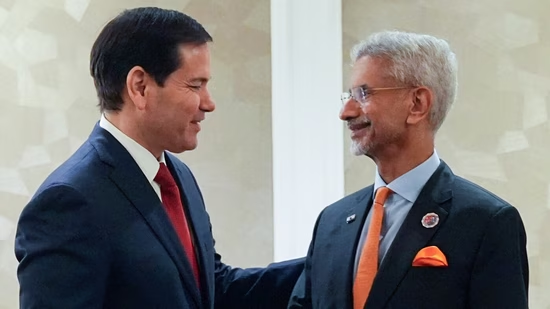
Marco Rubio’s acknowledgment of India’s professionalism underscored New Delhi’s growing global reputation for managing crises with restraint and maturity. Addressing the media in Canada, Marco Rubio said that External Affairs Minister S. Jaishankar had personally briefed him about the ongoing investigation during their bilateral meeting. “They’ve been very measured and cautious and very professional in how they’re carrying out this investigation,” he said, adding that India’s approach demonstrated the strength of its institutions and the discipline of its investigative agencies.
S. Jaishankar and Marco Rubio’s meeting, held on the sidelines of the G7 summit, covered not only the Delhi blast but also broader issues of bilateral and global significance. Both leaders discussed trade, supply chain resilience, and security challenges in the Indo-Pacific. In a post on X (formerly Twitter), S. Jaishankar wrote, “Appreciate his condolences on the loss of lives in the blast in Delhi. Discussed our bilateral ties, focusing on trade and supply chains. Exchanged views on the Ukraine conflict, the Middle East/West Asia situation, and the Indo-Pacific.”
The meeting reflected India’s proactive diplomatic outreach at the multilateral forum, where S. Jaishankar also engaged with his counterparts from several major nations, including Saudi Arabia, Ukraine, Canada, Mexico, France, Brazil, South Africa, the UK, and Germany. These engagements demonstrated India’s increasing centrality in global discussions on security and stability, particularly at a time when international attention remains focused on regional conflicts and counter-terrorism cooperation.
Marco Rubio’s endorsement of India’s investigative response carried symbolic significance, particularly as it came from one of the world’s most powerful nations with a deep stake in global security. By stating that India “did not need American help,” Marco Rubio effectively underlined New Delhi’s self-reliance in managing terror-related crises. Analysts interpreted the remarks as a reflection of Washington’s respect for India’s growing strategic and operational competence in the fight against terrorism.
Regional tensions and Pakistan’s allegations
Marco Rubio’s comments also came against the backdrop of rising tensions in the subcontinent following a deadly suicide bombing in Islamabad that killed at least twelve people earlier in the week. Pakistan’s Prime Minister Shehbaz Sharif had quickly blamed “terrorist proxies backed by India” for the attack — an allegation that New Delhi dismissed as “baseless and unfounded.” India described the statement as coming from an “obviously delirious Pakistani leadership” attempting to divert attention from its own internal security failures.
Marco Rubio, when asked whether the Delhi explosion could further strain relations between India and Pakistan, acknowledged the sensitivity of the situation but lauded India’s restraint. “We are aware of the potential that holds,” he said, “but India’s approach has been measured and commendable.” His response indicated Washington’s awareness of how delicate the balance in South Asia remains and its appreciation for India’s responsible handling of provocative situations.
The US has often walked a tightrope in its dealings with India and Pakistan, balancing its counter-terrorism priorities with strategic partnerships in the region. However, Marco Rubio’s latest remarks appeared to tilt clearly toward India’s side, reaffirming American trust in New Delhi’s security framework and intelligence-gathering mechanisms. Washington’s position also aligns with its broader Indo-Pacific strategy, which views India as a crucial partner in maintaining stability and countering extremist threats.
The US Embassy in New Delhi had earlier issued a message of support following the blast. Ambassador Sergio Gor expressed condolences and solidarity with the victims’ families, saying in a post on November 11: “Our thoughts and prayers are with the families of those who were lost in the terrible explosion in New Delhi last night. We wish a swift recovery to those who were injured.” The statement reflected Washington’s continued commitment to cooperation with India on counter-terrorism and intelligence-sharing, even as New Delhi maintained operational independence in handling the crisis.
The Delhi blast has once again brought to the forefront the persistent threat of urban terrorism and the challenges faced by Indian security forces in safeguarding densely populated areas. Investigations so far suggest a sophisticated level of planning behind the attack, with experts pointing to similarities with previous terror strikes carried out by transnational groups. The authorities have maintained that every lead is being thoroughly examined, including the possibility of sleeper cells or foreign involvement.
Diplomatic observers believe Marco Rubio’s public endorsement could have wider diplomatic implications, reinforcing India’s credibility in international security circles. The praise from Washington also comes at a time when India has been actively deepening intelligence-sharing partnerships with allies across the G7, Quad, and BRICS forums to counter emerging security threats.
At the same time, Pakistan’s renewed accusations against India reflect a familiar pattern of deflection seen after major domestic attacks within its territory. The Islamabad bombing, claimed by a faction of the Pakistani Taliban, highlighted Pakistan’s own struggles with militancy. By attempting to link India to the incident, Islamabad appeared to be shifting blame away from its internal instability. India’s response, however, remained firm yet restrained, consistent with the “measured” approach that Marco Rubio and other world leaders have praised.
Marco Rubio’s remarks, coming from a senior member of the G7 and one of India’s key diplomatic partners, thus hold considerable weight in shaping the global narrative around the Delhi blast investigation. They not only reflect international trust in India’s capabilities but also signify growing convergence between New Delhi and Washington on counter-terrorism strategies and regional stability efforts.
As investigations continue, Indian authorities have vowed to ensure that every individual involved in the attack is brought to justice. Meanwhile, international attention remains fixed on how India’s disciplined response could serve as a model for other nations grappling with similar security challenges. The episode, while tragic, has reaffirmed India’s status as a resilient democracy capable of handling terror threats with both firmness and professionalism — a message that, as Marco Rubio’s remarks demonstrate, has resonated strongly across the global stage.