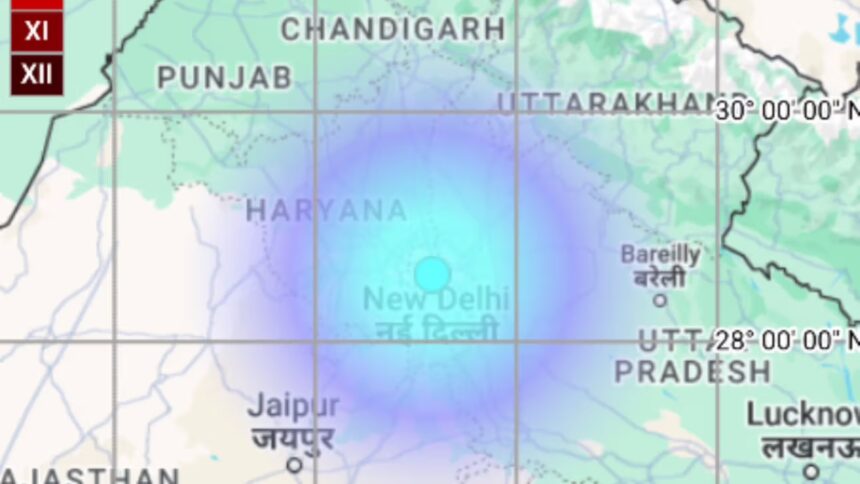
Strong tremors jolted Delhi and its neighbouring cities on Thursday morning, sending people rushing out of buildings and onto the streets as fear and confusion spread across the region. The earthquake, measured at a magnitude of 4.4, struck near Jhajjar in Haryana at 9:04 am, and while there were no immediate reports of casualties or damage to property, the quake served as a stark reminder of the seismic vulnerability of Delhi-NCR, which sits precariously in a high-risk seismic zone.
According to the National Center for Seismology (NCS), the earthquake originated at a depth of 10 km, causing noticeable tremors across Delhi, Noida, Ghaziabad, Gurugram, and Faridabad, as well as in parts of Rajasthan and Uttar Pradesh. The sudden tremors led to widespread panic, with social media flooded with residents sharing their experiences of cupboards rattling and vehicles shaking. “We felt the tremors clearly, and it was really scary. My vehicle shook, and the impact was strong,” an eyewitness in Delhi told ANI, while another resident from Ghaziabad described how it felt as though the entire shop he was in was being shaken.
Seismic Pattern in Delhi-NCR
This is not the first time residents have experienced such tremors. On February 17, the region felt similar jolts after a 4.0 magnitude earthquake with its epicentre in Delhi’s Dhaula Kuan was recorded. Data from NCS indicates that the area within a 50 sq km radius of Dhaula Kuan has witnessed 446 earthquakes between 1993 and 2025, with magnitudes ranging from 1.1 to 4.6. These figures reflect the high seismic activity of the region and underline the need for consistent monitoring and preparedness in the capital and surrounding areas.
The Bureau of Indian Standards (BIS) classifies India into four seismic zones, from Zone II (low intensity) to Zone V (very severe). Delhi and the NCR fall under Zone IV, marking it as a severe seismic zone where earthquakes are not uncommon. The capital’s vulnerability is compounded by the presence of three active fault lines — the Sohna, Mathura, and Delhi-Moradabad fault lines — running through it, while the neighbouring Haryana region has seven fault lines that increase the seismic sensitivity of the area.
Delhi’s Proximity to the Himalayas Increases Risks
Delhi’s geographical proximity to the Himalayan region, which is itself a high seismic zone, further heightens the capital’s risk of experiencing strong tremors and aftershocks. Experts explain that the ongoing tectonic movements in the Himalayan belt contribute to the seismic activity felt across the northern plains, including Delhi-NCR. As the Indian plate continues to push against the Eurasian plate, the accumulated stress often results in seismic releases, which are felt across the capital and its neighbouring regions.
Residents across Delhi-NCR have expressed concerns about safety, particularly in older structures and unplanned urban settlements where compliance with seismic building codes is inconsistent. The jolts on Thursday morning once again brought attention to the fragile infrastructure and the urgent need for retrofitting buildings to withstand moderate to strong earthquakes.
People took to social media to share their moments of panic, narrating how ceiling fans swayed and windows rattled during the tremors. While many offices and schools saw people rushing outside to open grounds, authorities urged the public to remain calm and follow safety protocols in case of future quakes.
The episode serves as a reminder for Delhi-NCR residents to remain prepared for seismic events, ensuring emergency kits are accessible, and family members are aware of basic earthquake safety measures. While no major damage was reported this time, experts continue to emphasise the importance of urban resilience planning in a region that remains prone to sudden seismic disruptions.