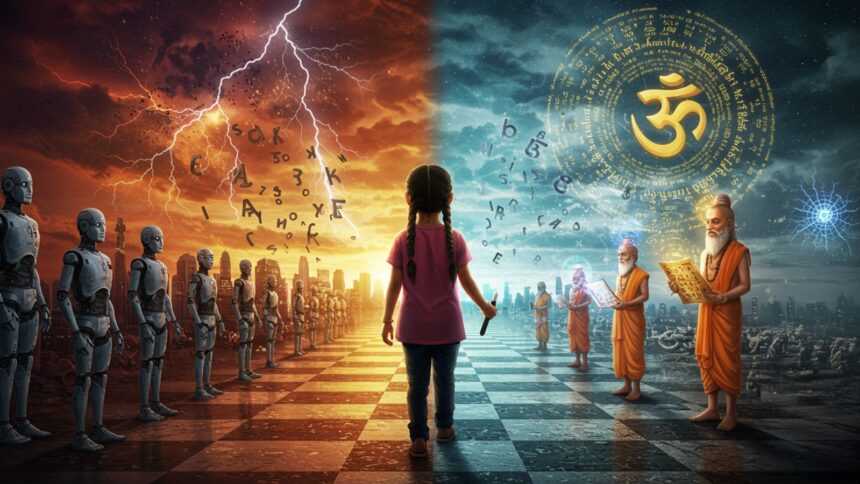
In an age where our thoughts are increasingly shaped by what we scroll, click, and binge-watch, the very foundation of how we think—our language—has become both a battleground and a beacon. Today’s digital world is a loud place. But ironically, even in all that noise, we are hearing less that is truly new. Algorithms are serving us the same kind of content over and over again. Social media, AI, and even our preferred language of discourse—English—are all feeding into a global echo chamber. But what if there’s a better way forward? What if India, through its ancient linguistic wisdom and youth-driven digital innovation, could lead the way out of this maze?
The Invisible Cage: Ill Effects of Social Media
At first glance, social media seems liberating—free expression, global connection, instant news. But look closer, and you’ll find a darker underside. From London to Lucknow, studies repeatedly show that excessive social media use correlates with anxiety, depression, loneliness, and low self-worth—especially among teens.
Take Instagram, for example. A study by the UK’s Royal Society for Public Health found it to be the worst platform for young people’s mental well-being. The curated perfection of filtered lives triggers an endless comparison loop. Likes become dopamine hits, and the mind becomes addicted. Productivity tanks, attention spans shrink—down to just 8 seconds, according to a Microsoft study (yes, less than a goldfish). Meanwhile, misinformation spreads six times faster than truth, as the MIT Media Lab found, and hate speech thrives because algorithms reward outrage.
We are all being nudged—silently, constantly—by systems that weren’t built with our long-term well-being in mind.
Western Biases: Exporting One Narrative to All
Why is it that even in Delhi, Lagos, or São Paulo, the idea of success often looks like a Manhattan apartment and speaking perfect American English? It’s not coincidence. It’s algorithmic colonialism.
Western civilization, particularly through the American tech industry, has quietly exported its value systems through platforms, streaming services, and even productivity tools. English-language platforms dominate 60% of the web, even though only 5% of the world speaks it natively. Western beauty standards, neoliberal values, individualism, and hyper-capitalism are embedded into the very scroll of your screen.
Educational frameworks, like standardized testing or AI training datasets, are rooted in Western logic systems. The so-called “global village” has started to look suspiciously like a Western suburb.
AI and Echo Chambers: A Dangerous Amplifier
Artificial Intelligence was supposed to be the great equalizer. Instead, it has become a mirror—reflecting and reinforcing our biases at scale.
AI algorithms, especially in content recommendation (like TikTok or YouTube), optimize for engagement. The result? More of what you already agree with. Filter bubbles become harder to break. And when this system is applied to children and teens—whose brains are still developing—it becomes dangerous.
UNICEF warns that AI in children’s content can reinforce gender, racial, and social stereotypes. Worse, AI systems often learn from biased datasets dominated by Western, English-language, liberal worldviews. This homogenizes thinking, leaving little room for pluralism, reflection, or contradiction—the very essence of a healthy democracy.
English: The Double-Edged Sword
English has given India access to global markets, academic journals, and international diplomacy. But it has also flattened the rich topography of Indian thought and identity. As per W3Techs data (2024), over 60% of all online content is in English, often positioning it as the “default lens” to interpret the world.
But language is not just communication. It’s cognition. The Sapir-Whorf Hypothesis suggests that language actually shapes the way we think. So, when a generation of Indians thinks, dreams, and argues in a borrowed language, they may unknowingly adopt borrowed thought patterns—ones not always suited to our context.
And because tech models like ChatGPT or Bard are trained primarily on English sources, they often fail to capture the nuance of Indic philosophy, regional idioms, or native logics.
Sanskrit: A Forgotten Key for Future Tech
As a Sanskrit literate person, I must stress: Sanskrit is not just an ancient language. It is a computational framework in linguistic form. Panini’s Ashtadhyayi, a 4th century BCE grammar, is one of the earliest known examples of a formal system—complete with rules, exceptions, and meta-rules. This structure resembles the syntax trees used in modern programming languages.
In 1985, NASA researcher Rick Briggs wrote a seminal paper suggesting that Sanskrit could be the most suitable natural language for AI, due to its precise structure and lack of ambiguity. In Sanskrit, a sentence has a single, logically valid interpretation. That’s a dream for AI parsing.
Moreover, Sanskrit embodies layered thinking—where a single word (like Dharma) carries philosophical, legal, social, and emotional meanings. This richness is the antidote to AI’s current lack of depth and context.
Of course, challenges remain—modern corpora, terminology, and widespread fluency are lacking. But the potential is immense.
India’s Moment: Language as Resistance, Language as Leadership
India’s greatest asset is not just its demographic dividend—it’s its cognitive diversity, enabled by linguistic diversity. Over 22 official languages and hundreds of dialects mean we inherently think in pluralities.
The Indian government’s Bhashini initiative is a step toward empowering this diversity in the digital space. Local AI models like IndicBERT and Google’s Project Vaani show that India can lead in creating AI systems rooted in Indian languages and values.
But beyond tools, we need a movement—a collective resolve to promote linguistic self-respect, cultural nuance, and youth-led innovation. Imagine school children learning coding through Sanskrit logic, or village entrepreneurs building apps in Maithili or Kannada. That’s not just inclusion. That’s revolution.
Conclusion: From Echo to Voice
The world stands at a crossroads. One path leads deeper into homogenized thought, algorithmic addiction, and cultural erasure. The other leads to a diverse, conscious, and plural future—powered by the wisdom of old languages and the clarity of new tech.
India can, and must, choose the latter path.
By rethinking our relationship with language, AI, and culture, we can reclaim the narrative—not just for ourselves, but for the world. Let’s not just scroll through the future. Let’s write it—in our own voice.