Prime Minister Narendra Modi’s recent visit to Tamil Nadu highlighted the intersection of politics, agriculture, and public engagement, as he addressed the South India Natural Farming Summit 2025 in Coimbatore. Arriving amid local political controversies over metro projects and special intensive revision (SIR) exercises, PM Modi praised the region’s farmers for embracing natural farming practices while subtly connecting their support and enthusiasm to the National Democratic Alliance’s (NDA) decisive victory in Bihar. Speaking to a crowd of farmers and party officials, PM Modi’s remarks combined an acknowledgment of grassroots agricultural innovation with reflections on political resonance, emphasizing the broader significance of sustainable farming for India’s rural economy, environmental health, and youth engagement. The visit underscored how regional politics, central policies, and local agricultural initiatives often converge in shaping narratives that influence both voter sentiment and policy priorities across states. Modi also used the occasion to release the 21st instalment of PM-Kisan Samman Nidhi, transferring more than ₹18,000 crore directly into the accounts of nine crore farmers, further linking governance initiatives with economic empowerment.
Farmers, Natural Farming, and Political Symbolism
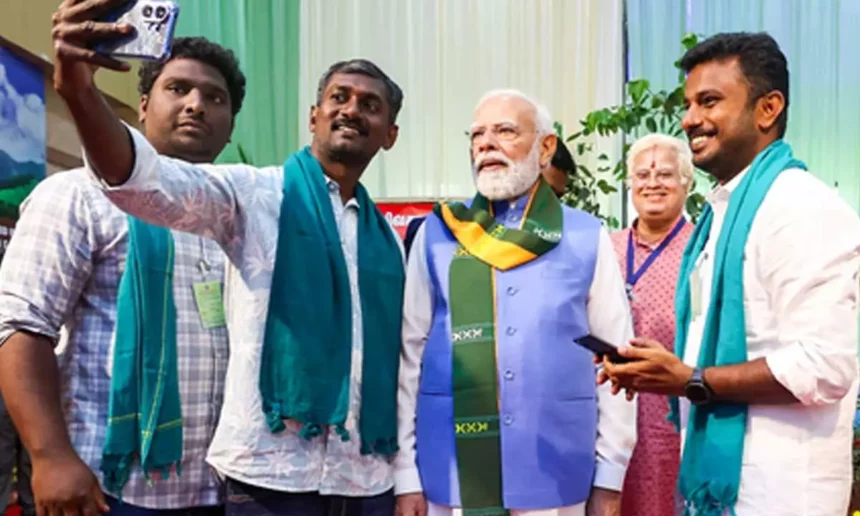
During his address at the summit, PM Modi drew attention to the sight of farmers in Coimbatore waving their towels and gamchas over their heads, an image he described as reminiscent of the “winds of Bihar” arriving in Tamil Nadu even before his own arrival. This metaphor reflected his observation that enthusiasm and grassroots mobilization often transcend regional boundaries, highlighting the symbolic resonance of Bihar’s electoral success and its perceived influence on political morale elsewhere. While PM Modi’s remarks touched upon the electoral outcome in Bihar, the larger focus was on recognizing farmers’ efforts to reduce chemical dependency and adopt traditional, environmentally friendly farming practices. He emphasized that natural farming represents a forward-looking solution to pressing issues such as climate change, soil degradation, and the health risks posed by excessive use of chemical fertilizers and pesticides. By linking Bihar’s political momentum to Tamil Nadu’s agricultural innovation, PM Modi underscored the potential for governance, economic empowerment, and environmental sustainability to intersect in meaningful ways.
PM Modi’s observations also served to spotlight the evolving nature of Indian agriculture, particularly in southern states. He commended local farmers for blending tradition with modern techniques, noting that the reduced reliance on chemicals not only preserves soil health but also lowers input costs, making farming more economically sustainable. Highlighting individual stories of transformative farming experiences, PM Modi pointed to graduates and professionals, including a mechanical engineer and a former NASA employee, who had turned to agriculture, training youth and adopting innovative natural farming techniques. These anecdotes illustrated the capacity of agriculture to attract talent, inspire youth participation, and catalyze economic growth in rural areas, thereby positioning natural farming as both a livelihood strategy and a vehicle for broader socio-economic transformation.
The summit itself became a platform for showcasing the potential of natural farming to reshape India’s agricultural landscape. PM Modi predicted significant changes in India’s farming sector, driven by youth involvement, technological integration, and scalable practices that enhance productivity while protecting environmental resources. By emphasizing natural farming, PM Modi linked governance priorities to ecological sustainability and long-term rural development, framing the practice as essential for India’s global competitiveness and for ensuring health-conscious food systems. The public engagement with farmers further reinforced the message that political leadership and policy initiatives must align with grassroots innovation to foster inclusive growth.
Metro Project Controversies and Political Undercurrents
PM Modi’s visit, while primarily focused on agriculture and natural farming, occurred against a backdrop of political tensions in Tamil Nadu regarding metro rail projects in Coimbatore and Madurai. Opposition leaders, including AIADMK general secretary Edappadi Palaniswami, formally received PM Modi at Coimbatore airport and submitted a memorandum seeking the expedited approval and execution of these projects. The projects had become contentious after Chief Minister M.K. Stalin accused the Union government of blocking metro rail expansions in Tamil Nadu’s Tier II cities due to political bias, claiming the BJP favored metro projects in states governed by its allies while neglecting opposition-ruled states. This assertion intensified local political debate, highlighting the friction between state and central authorities, particularly in regions with upcoming assembly elections.
State BJP leaders countered these allegations, clarifying that the delays were procedural rather than politically motivated. Vanathi Srinivasan, BJP Mahila Morcha national president and Coimbatore South MLA, explained that the central government had returned the Detailed Project Reports (DPRs) based on population thresholds outlined in the 2017 Metro Policy, which relied on 2011 census data. Coimbatore’s population had fallen below the 20 lakh mark, necessitating revisions or special justification to meet approval criteria. Srinivasan cited precedents such as the Agra Metro project, as well as similar adjustments in Bhopal and Patna, to reinforce the argument that Tamil Nadu’s projects were neither ignored nor politically sidelined. Additionally, she highlighted the substantial rail funding Tamil Nadu had received under NDA governance, totaling ₹1.5 lakh crore, asserting that these investments contradicted claims of anti-Tamil Nadu bias.
This debate underscored the broader political dynamics in Tamil Nadu, where central policies, local governance, and electoral calculations often intersect. PM Modi’s presence in Coimbatore, coupled with his praise for farmers and natural farming initiatives, served both as a platform for policy advocacy and as a subtle reinforcement of NDA political narratives ahead of the state’s assembly elections. While the event’s central theme was agricultural innovation, the surrounding controversies highlighted the challenges of navigating federal governance structures, local expectations, and opposition scrutiny. By engaging with both farmers and political stakeholders, PM Modi’s visit exemplified how public outreach, policy promotion, and political signaling can operate simultaneously in Indian political contexts.
The interaction with farmers, combined with the political backdrop of metro project disputes, reinforced PM Modi’s message that governance must address practical needs while aligning with broader strategic objectives. His emphasis on natural farming, climate resilience, and youth engagement reflected a vision of long-term development, while his remarks linking Bihar’s political winds to Tamil Nadu symbolically highlighted the interconnected nature of regional and national political currents. The event demonstrated that agricultural policy, infrastructure development, and political strategy are increasingly intertwined, particularly in states approaching elections where governance initiatives and political narratives influence public perception and electoral outcomes.
PM Modi’s Coimbatore visit also illustrated the growing role of narratives in Indian politics, where symbolic gestures, agricultural innovation, and project approvals can be leveraged to communicate leadership priorities. By celebrating the adoption of natural farming, PM Modi highlighted both environmental sustainability and economic viability, reinforcing a governance model that integrates citizen welfare, climate consciousness, and rural development. Concurrently, by addressing metro project concerns and providing clarifications, the central government sought to preempt criticisms of regional bias, demonstrating the complex balance required in managing state-center relations. The dual focus on agriculture and infrastructure exemplified a governance approach that blends policy delivery, public engagement, and political strategy to reinforce national development objectives.
PM Modi’s remarks on youth involvement and professional transitions into agriculture underscored a broader narrative about skill application, innovation, and entrepreneurship in rural sectors. The acknowledgment of highly educated professionals entering farming served to challenge conventional perceptions about agriculture as low-income or traditional work, projecting it instead as a dynamic, modern, and scalable occupation. This narrative aligns with broader policy frameworks emphasizing rural revitalization, innovation-driven growth, and youth empowerment, positioning natural farming not only as an ecological necessity but also as a driver of socio-economic transformation.
The release of the PM-Kisan Samman Nidhi’s 21st instalment added a tangible policy dimension to PM Modi’s visit, linking financial support with developmental priorities and reinforcing governance credibility. By directly transferring funds to nine crore beneficiaries, the initiative highlighted both administrative efficiency and the government’s focus on rural livelihoods. This financial support complements the policy emphasis on natural farming, providing farmers with the resources needed to adopt sustainable practices while addressing economic security, input costs, and agricultural productivity. Together, these measures exemplify an integrated approach to rural governance, where financial assistance, agricultural policy, and public engagement collectively support sustainable development objectives.
PM Modi’s visit to Tamil Nadu thus served multiple purposes: it celebrated farmers’ adoption of natural farming, linked grassroots agricultural success to political narratives, addressed infrastructural concerns, and reinforced central governance priorities in a state preparing for upcoming assembly elections. By highlighting the convergence of policy, politics, and public engagement, the visit illustrated how effective governance relies on integrating economic empowerment, sustainable development, and political strategy. Modi’s interactions emphasized that development initiatives, when communicated effectively and tied to tangible benefits, can influence public perception, strengthen voter engagement, and create momentum for broader policy adoption.